

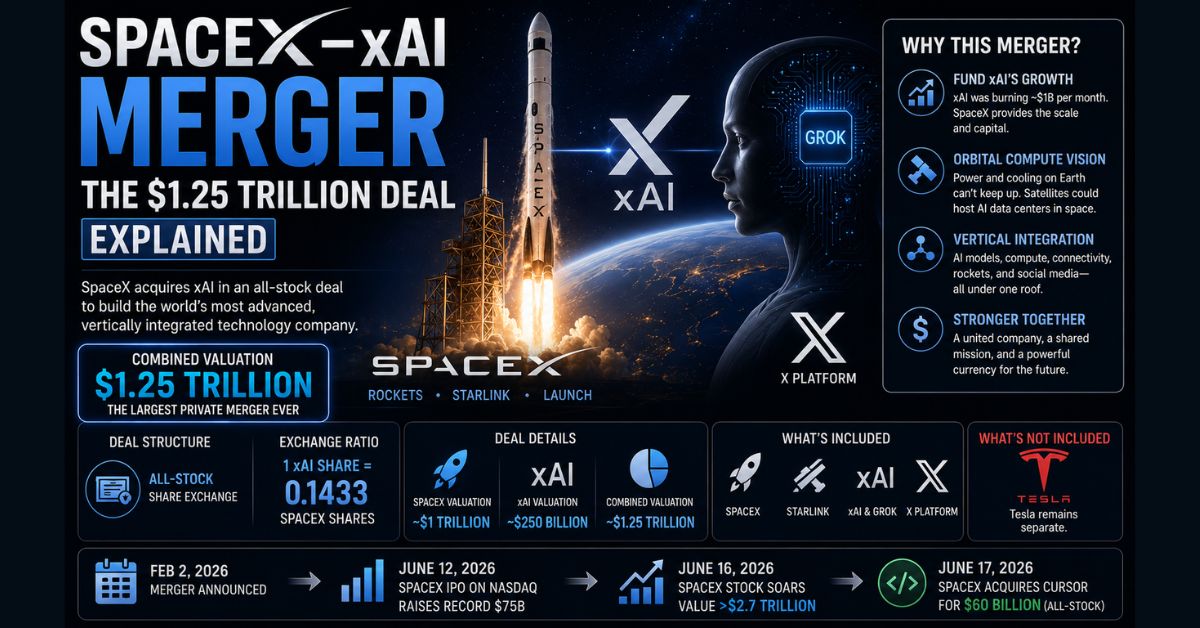
On February 2, 2026, SpaceX acquired Elon Musk’s AI company xAI in an all-stock merger valuing the combined entity at $1.25 trillion ($1T for SpaceX, $250B for xAI), described by CNBC as the largest private merger ever. Tesla was not included. The combined company then went public in June 2026.
- The deal: all-stock; each xAI share converted to 0.1433 SpaceX shares
- The why: fund xAI’s cash burn and build space-based data centers
- Tesla: left out; its $2B xAI stake became an indirect SpaceX stake
- What followed: a record June IPO, then a $60B acquisition of Cursor
What is the SpaceX–xAI merger?
On February 2, 2026, SpaceX acquired Elon Musk’s artificial intelligence company xAI in an all-stock deal that valued the combined business at $1.25 trillion. CNBC, which reviewed deal documents, described it as the largest private merger in history. The transaction valued SpaceX at $1 trillion and xAI at $250 billion.
This was not the three-way SpaceX, Tesla, and xAI combination that earlier reports had floated. Tesla stayed out. What closed was a two-company tie-up that folded xAI, its Grok chatbot, and the X social platform into SpaceX.
In a memo on the SpaceX website, Musk framed the merger as building a vertically integrated company spanning AI, rockets, satellite internet, and social media. The combined entity briefly became the most valuable private company in the world.
Why did SpaceX buy xAI?
Two motives drove the deal: capital and compute. xAI was burning roughly $1 billion per month as it raced to keep pace with OpenAI and Anthropic, the rivals tracked in our Claude vs ChatGPT vs Gemini comparison. Folding it into SpaceX gave the AI unit access to a far larger balance sheet.
The second reason is Musk’s fixation on orbital data centers. He has argued that Earth-based power and cooling cannot meet AI’s energy demand, and that satellites could host compute in space. SpaceX’s launch capability and Starlink network make that vision at least theoretically possible, a thesis we examine in our piece on orbital data centers.
As TechCrunch reported, Musk’s memo leaned heavily on this space-based compute argument as the strategic core of the merger.
Why was Tesla left out?
Early rumors suggested a “Musk Trinity” merger uniting all three companies. That did not happen, and structurally it was difficult.
Tesla is a public company with outside shareholders and fiduciary duties. Merging it into a private entity raises legal and governance complications that a private-to-private deal avoids. As Electrek noted, the cleaner outcome was SpaceX-xAI-X on one side and Tesla on the other.
Tesla is not entirely separate, though. It had invested about $2 billion in xAI, and that position converted into an indirect stake in the merged company. Tesla shareholders now hold a small slice of SpaceX through that earlier investment.
How was the deal structured?
The merger was an all-stock share exchange rather than a cash purchase. Here are the core terms.
| Deal Metric | Detail |
| Announcement date | February 2, 2026 |
| Structure | All-stock share exchange |
| Exchange ratio | 1 xAI share → 0.1433 SpaceX shares |
| SpaceX valuation | ~$1 trillion |
| xAI valuation | ~$250 billion |
| Combined valuation | ~$1.25 trillion |
| Assets combined | SpaceX, Starlink, xAI/Grok, X platform |
| Notably excluded | Tesla |
What happened after the merger?
The merger set up an even bigger sequence of events. SpaceX had been preparing a public offering, and the timing lined up with reporting that Musk wanted a mid-June debut, covered in our piece on the planned IPO date.
That offering arrived on June 12, 2026, when SpaceX debuted on the Nasdaq and raised a record sum, detailed in our SpaceX IPO coverage. Within days, the stock surged and the company’s value climbed past $2.7 trillion.
SpaceX then used that high-flying stock as currency for its first major acquisition: a $60 billion all-stock purchase of Cursor, the AI coding startup, explained in our SpaceX–Cursor breakdown. The merger, in other words, was the first move in a much larger consolidation.
Is the SpaceX–xAI merger a good deal? The bull and bear case
Analysts are split, and the disagreement is worth understanding before drawing conclusions.
The bull case
- Vertical integration aligns compute, connectivity, launch, and AI under one roof.
- SpaceX’s Starlink revenue helps fund xAI’s heavy losses.
- A shared stock gives the AI unit a strong currency for talent and acquisitions.
- The orbital data center vision, if it works, addresses a real energy bottleneck.
The bear case
- xAI was burning roughly $1 billion per month and lagging rivals before the deal.
- Critics compared the move to a bailout of a weaker company by a stronger one.
- Orbital compute faces hard engineering limits that analysts say are years away.
- Musk retains voting control with a minority economic stake, concentrating power.
The bottom line
The SpaceX-xAI merger turned a set of separate Musk ventures into a single trillion-dollar entity, then funded a record IPO and a $60 billion acquisition within months. Whether it proves visionary or overextended depends on execution, especially on the unproven idea of moving AI compute into orbit. What is no longer in doubt is the scale of Musk’s consolidation, which now ranks among the largest corporate restructurings in history.
FAQ
How much was the SpaceX–xAI merger worth?
The merger valued the combined company at about $1.25 trillion, with SpaceX valued at roughly $1 trillion and xAI at roughly $250 billion. CNBC described it as the largest private merger ever completed when it was announced on February 2, 2026.
Did Tesla merge with SpaceX and xAI?
No. Despite earlier speculation about a three-way combination, Tesla was not part of the deal. As a public company, merging Tesla into a private entity raised governance and fiduciary complications. Tesla’s earlier $2 billion investment in xAI did convert into an indirect stake in the merged company.
Why did SpaceX merge with xAI?
SpaceX merged with xAI mainly to fund the AI company’s heavy cash burn and to pursue Musk’s plan for space-based data centers. Combining the two gave xAI access to a larger balance sheet and tied it to SpaceX’s launch and satellite infrastructure.
Did the SpaceX–xAI merger lead to an IPO?
Yes. The merged company went public on the Nasdaq on June 12, 2026, in a record-setting IPO. Days later, SpaceX used its newly public stock to acquire the AI coding startup Cursor for $60 billion.
What is xAI’s Grok, and how does it fit in?
Grok is xAI’s AI chatbot, now part of SpaceX after the merger. The combined company has signaled it wants Grok to compete more directly with OpenAI, Anthropic, and Google, including in areas like AI coding where it has trailed.