

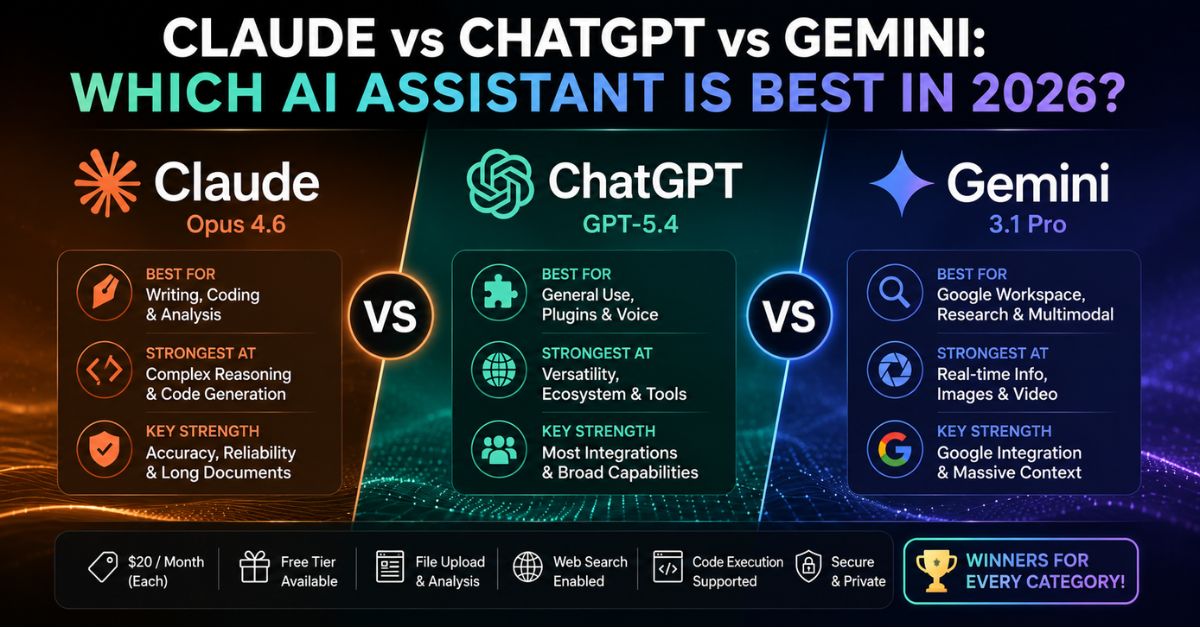
For 2026, Claude (Opus 5.5) is best for writing and coding, ChatGPT (GPT-6 Astra) is best for general use, apps, and voice, and Gemini (3.1 Pro) is best for Google Workspace and multimodal tasks. Each paid plan costs about $20/month, and all three offer free tiers with lower limits.
- Best writing & coding: Claude — most natural prose, narrowly leads published coding benchmarks
- Best all-rounder: ChatGPT — strongest ecosystem, apps, and voice
- Best for Google users: Gemini — deep Workspace integration, 1M-token context on Google AI Pro
- Price: All three are about $20/month, with free tiers that have lower limits
- Bottom line: The “best” assistant depends on your main task and existing tools
The three dominant AI assistants — Anthropic’s Claude, OpenAI’s ChatGPT, and Google’s Gemini — have all released major updates in 2026. As of September 2026, Claude’s flagship is Claude Opus 5.5 (released September 22, 2026), ChatGPT’s most capable model is GPT-6 Astra (released September 3, 2026, for Plus, Pro, Business, and Enterprise users), and free ChatGPT users get GPT-5.6 Luna. Google’s top model in the Gemini app remains Gemini 3.1 Pro, alongside Gemini 3.6 Flash for everyday tasks, and Gemini now reaches across its entire Workspace ecosystem.
Each platform has carved out genuine strengths, and each has real blind spots. This isn’t one of those comparisons that ends with “they’re all great” — we’ll give you actual winners for each category, based on our earlier side-by-side testing and the latest published benchmarks for the current models.
Quick Comparison Table
| Feature | Claude (Opus 5.5) | ChatGPT (GPT-6 Astra) | Gemini 3.1 Pro |
| Monthly Price | $20 (Pro) | $20 (Plus) | $19.99 (Google AI Pro) |
| Free Tier | Yes (Sonnet and Haiku models) | Yes (GPT-5.6 Luna, unlimited text chats) | Yes (3.6 Flash, limited 3.1 Pro) |
| Context Window | Up to 1M tokens (varies by model) | Up to 256K tokens on Plus (400K on Pro) | 1M tokens on Google AI Pro (32K free) |
| Web Search | Yes | Yes | Yes (native Google) |
| Image Generation | No | Yes (ChatGPT Images 2.5) | Yes (Nano Banana 2) |
| Code Execution | Yes (Artifacts) | Yes (Code Interpreter) | Yes |
| File Upload | Yes | Yes | Yes |
| Best For | Writing, coding, analysis | General use, apps, voice | Google Workspace, multimodal |
Writing Quality
Winner: Claude
Claude consistently produces the most natural, least “AI-sounding” prose of any major model. It follows style instructions precisely, adapts tone effectively, and avoids the formulaic structures that plague outputs from other models. Anthropic says Opus 5.5 communicates more naturally than its predecessors and puts the most important information up front.
ChatGPT tends toward predictable patterns — it loves numbered lists, bold headers, and phrases like “in the ever-evolving landscape.” Newer GPT models have improved on this compared to GPT-4o, but the tendency remains. Gemini writes competently but lacks Claude’s adaptability when matching specific voices or styles.
For long-form content like blog posts, reports, and documentation, Claude also benefits from superior instruction-following across extended outputs. Where ChatGPT can drift from initial constraints mid-way through a long document, Claude maintains consistency throughout.
Coding and Development
Winner: Claude
Claude has built a strong reputation among developers, and the launch of Claude Code — a command-line tool for agentic coding — widened its lead. Anthropic reports that Claude Opus 5.5 scores 66.4% on the Terminal-Bench 4.0 agentic coding benchmark, compared with 57.9% for GPT-6 Astra as reported by OpenAI; both figures are self-reported by the companies. The independent Artificial Analysis Intelligence Index also places Opus 5.5 (58) ahead of GPT-6 Astra (53) and Gemini 3.1 Pro Preview (30) as of September 2026. It handles full-file refactors and understands architectural patterns. For developers choosing tools for daily programming work, it is also worth comparing the best AI coding assistants to see which option fits their workflow, IDE, and codebase needs.
ChatGPT is a close second. OpenAI describes GPT-6 Astra as its best model for software engineering to date, and ChatGPT remains strong for quick scripts with broad IDE plugin support. Its Code Interpreter is particularly useful for data analysis tasks where you need to run Python and see results immediately.
Gemini 3.1 Pro improved dramatically in coding but still trails the newer Claude and GPT-6 models on complex codebases. Its advantage is speed — Artificial Analysis measures Gemini 3.1 Pro Preview at about 120 output tokens per second, roughly twice GPT-6 Astra’s rate, which matters during rapid iteration.
Research and Information Access
Winner: Gemini
This is Gemini’s strongest category. Its native integration with Google Search means it provides up-to-the-minute information without the retrieval-augmented generation that other models require. Google has been expanding this with AI Mode, which can now pull context from your Gmail and Photos for personalized responses.
ChatGPT has web browsing that works well, and Claude also has web search capability. But Gemini’s integration is more seamless and consistently returns more current results, especially for Google-indexed content.
For market analysis, competitive intelligence, news monitoring, or fact-checking — anything where recency matters — Gemini has a structural advantage that model quality alone can’t overcome.
Context Window and Document Processing
Winner: Claude and Gemini (tie on capacity)
Claude and Gemini now both offer up to 1 million tokens of context. Anthropic lists a context window of up to 1M tokens, varying by model, on every Claude plan, and Google gives Google AI Pro and Ultra subscribers 1 million tokens in the Gemini app, compared with 32,000 tokens without a plan. ChatGPT Plus offers up to 256,000 tokens with reasoning models and 54,000 with Instant, rising to 400,000 on Pro, according to OpenAI’s pricing page. However, raw capacity and reliable processing are different things.
With any model, quality can degrade at extreme lengths, so it is worth spot-checking answers that depend on details buried deep in a very long upload.
For most real-world use cases — analyzing a 50-page contract, reviewing a codebase, or processing a long research paper — any of the three paid plans is sufficient. If you genuinely need to process an entire book in a single prompt, Claude or Gemini is the better fit.
Multimodal Capabilities
Winner: Gemini
Gemini leads here decisively. Native image, video, and audio understanding — plus deep integration with Google Lens, Photos, and YouTube — make it the clear multimodal winner. Its Nano Banana 2 model generates remarkably photorealistic images, you can upload video clips for analysis, and Google AI plan subscribers can create and edit videos with Gemini Omni.
ChatGPT offers strong multimodal features through ChatGPT Images 2.5 for image generation and excellent voice conversation mode. If you’re interested in AI image creation specifically, check our guide to the best free AI image generators in 2026 where we tested all the major options head-to-head.
Claude can analyze images and documents but doesn’t generate images. For users focused on text analysis and coding, this isn’t a limitation — but if image or video work is part of your workflow, Claude isn’t the right tool for those specific tasks.
Ecosystem and Integrations
Winner: ChatGPT (general) / Gemini (Google users)
ChatGPT has the most mature plugin and integration ecosystem. With GPTs, custom AI agents, third-party integrations, and extensive API support, it’s the most versatile platform for building AI into existing workflows. This strength also reflects OpenAI’s $4B enterprise bet, as the company continues pushing ChatGPT deeper into professional, developer, and business use cases. OpenAI’s ambitions are also starting to stretch beyond software alone, with the race to connect brains and AI hinting at how future AI interfaces could move past keyboards, apps, and voice assistants entirely.
For productivity-focused users, the right choice may also depend on whether they need a general AI assistant or a tool embedded inside their workspace. For example, comparing Notion AI vs ChatGPT for productivity can help teams decide whether they need document-native AI features, broader reasoning capabilities, or both.
For Google Workspace users specifically, Gemini is the obvious choice. Its recent update brought significantly improved integration with Docs, Sheets, Slides, and Drive, making it especially useful for teams already working inside Google’s ecosystem. Gemini’s reach may also extend well beyond Workspace as AI becomes more deeply embedded into operating systems and personal assistants — as seen in Apple’s WWDC 2026 plans around Siri, Gemini, and iOS 27. For a practical walkthrough, see our step-by-step Gemini tutorial on using Gemini across Google Workspace.
Claude’s integration ecosystem is newer but growing rapidly. Claude Code for terminal-based development, along with API access and Model Context Protocol support, makes it powerful for technical users. This is where Claude Code for developers stands out most: it is built less like a chatbot and more like a project-level coding agent for teams comfortable working in the terminal.
Reliability and Error Handling
Winner: No clear winner
This is a practical consideration many comparison guides overlook. How often does each platform go down, throw errors, or produce broken responses?
All three services report incidents on public status pages, and none has a clean record. ChatGPT’s massive user base means its servers are under constant strain — the “something went wrong” error is one of the most commonly searched ChatGPT problems. OpenAI has invested heavily in infrastructure, and OpenAI’s move toward the public markets will likely increase pressure to make ChatGPT more reliable for both consumer and enterprise users, but peak-hour slowdowns remain common.
Gemini benefits from Google’s infrastructure reliability but occasionally produces responses that contradict themselves within the same answer.
Pricing Comparison
As of September 2026, ChatGPT Plus and Claude Pro cost $20/month (Claude Pro is $17/month with annual billing), and Google AI Pro costs $19.99/month, making cost a non-factor for most users. Google also offers a cheaper Google AI Plus plan at $4.99/month, and heavier users can move up to Claude Max (from $100/month) or Google AI Ultra (from $99.99/month). Differences show up at the API level: Gemini tends to be cheapest per token with its Flash-Lite tier, Claude offers strong value for complex tasks where fewer retries are needed, and ChatGPT’s API pricing sits in the middle.
The AI landscape is evolving rapidly — companies like Nvidia are investing billions in AI startups to build the next generation of models, and we’ve already seen OpenAI face backlash over retiring popular models that users were emotionally attached to. The competitive dynamics keep improving all three platforms.
Safety and Accuracy
Winner: No clear winner
All three assistants still produce hallucinations — instances where the AI confidently states incorrect information — and the safety and accuracy results each company publishes are self-reported. Anthropic says Opus 5.5 achieved the best scores of any model to date on its automated behavioral audit, while OpenAI calls GPT-6 Astra its most aligned model.
ChatGPT’s newer models improved on accuracy compared to earlier versions, but they can still produce confident-sounding errors on niche topics. Gemini’s accuracy benefits from its Google Search grounding for factual queries, but non-search responses can occasionally be less reliable. For a broader view of the top AI models and their respective strengths, see our separate guide.
The Verdict: Which Should You Choose?
- Choose Claude if writing, coding, long-document analysis, or accuracy are your primary needs. Claude is a strong choice for professional work built on long documents and code.
- Choose ChatGPT if you want the most versatile all-rounder with the broadest ecosystem. ChatGPT handles virtually any task competently, even if it doesn’t always lead in specific categories.
- Choose Gemini if you’re embedded in Google’s ecosystem, need multimodal capabilities (especially video and image), or require the most current real-time information. For Workspace power users, Gemini’s deep Workspace integration is genuinely transformative across Docs, Sheets, Slides, and Drive. And if your decision is really between Google’s AI ecosystem and Apple’s more device-native approach, our Gemini vs Apple Intelligence guide gives a more focused comparison, while our Apple Intelligence tutorial walks through setup and everyday features on iPhone.
- The power-user strategy: Many professionals in 2026 use two or even all three. The $20/month per platform adds up, but if AI is central to your workflow, having the right tool for each task delivers better results than forcing one platform to do everything.
FAQ
1. Which AI is best for students?
For most students, ChatGPT’s free tier offers the best balance of features, including unlimited everyday text chats with GPT-5.6 Luna. If you need coding help, Claude’s free tier is more capable for programming tasks. Gemini offers a generous free tier and integrates well with Google Docs, which most students already use for essays and assignments, and eligible US college students can get one year of Google AI Pro at no cost if they redeem the offer by December 31, 2026. Students who want to compare free alternatives to ChatGPT should look closely at Claude and Gemini, since both offer strong no-cost options for writing, research, and coding support.
2. Can I switch between these platforms easily?
Yes. None of them lock you into a proprietary ecosystem, with the partial exception of Gemini’s Google Workspace integration. Your conversations don’t transfer between platforms, but you can use them interchangeably for different tasks without losing data.
3. Which AI hallucinates the least?
No assistant is clearly the least likely to hallucinate: Claude, ChatGPT, and Gemini all still make confident factual errors, and the accuracy claims each company publishes are self-reported. If factual accuracy is critical — legal documents, medical information, financial analysis — verify every answer against the original source, whichever assistant you use.
4. Is it worth paying $20/month for any of these?
If you use AI daily for work, absolutely. The free tiers have message limits, slower speeds, and reduced capabilities that make them impractical for professional use. The paid tier of any of these three platforms is likely the highest-ROI $20/month subscription most knowledge workers can buy in 2026.
5. What about AI tools for specific tasks like video or images?
For AI video generation, check our guide to the best AI video generators in 2026. For image generation specifically, see our best free AI image generators roundup where we tested every major tool with identical prompts.