

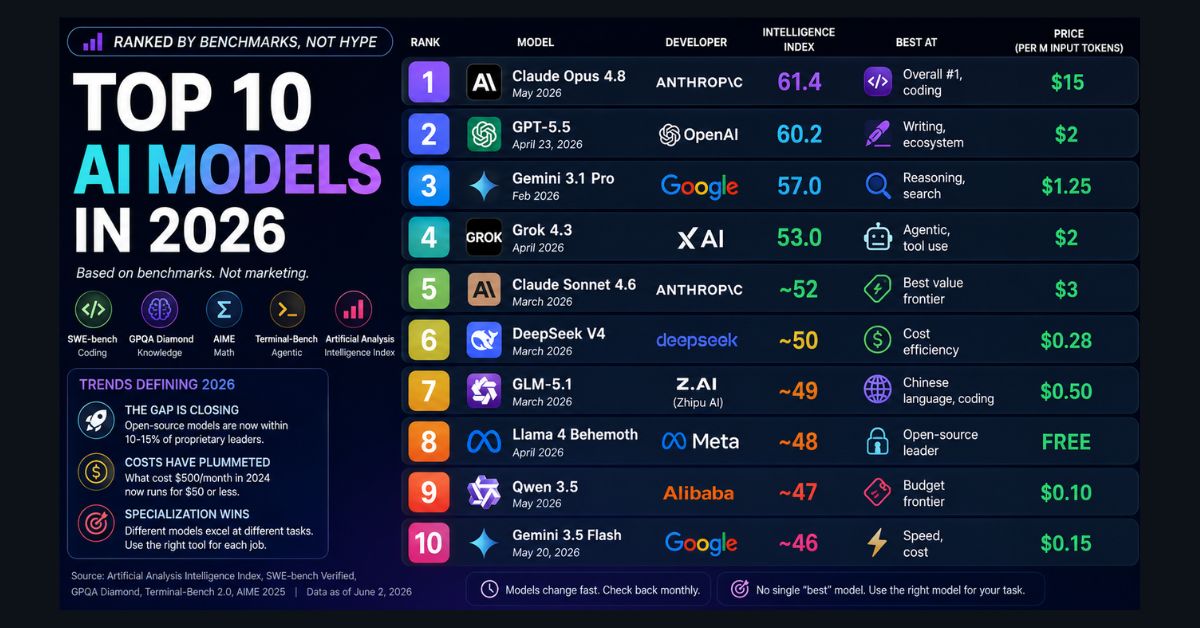
The AI model landscape changes so fast that rankings published three months ago are already obsolete. In Q1 2026 alone, LLM Stats logged 255 model releases from major organizations. Twelve significant models launched in a single week in March. The gap between open-source and proprietary AI has nearly closed. And the pricing has collapsed — what cost $500/month last year runs for $50 today.
This isn’t a list of “AI models you should know about” padded with descriptions of what machine learning is. It’s a benchmark-driven ranking of the 10 most capable AI models available right now in June 2026, based on actual performance data from SWE-bench, GPQA Diamond, Terminal-Bench, AIME, and the Artificial Analysis Intelligence Index.
Quick Rankings Table
| Rank | Model | Developer | Intelligence Index | Best At | Price (per M input tokens) |
| 1 | Claude Opus 4.8 | Anthropic | 61.4 | Overall #1, coding | $15 |
| 2 | GPT-5.5 | OpenAI | 60.2 | Writing, ecosystem | $2 |
| 3 | Gemini 3.1 Pro | 57.0 | Reasoning, search | $1.25 | |
| 4 | Grok 4.3 | xAI/SpaceX | 53.0 | Agentic, tool use | $2 |
| 5 | Claude Sonnet 4.6 | Anthropic | ~52 | Best value frontier | $3 |
| 6 | DeepSeek V4 | DeepSeek | ~50 | Cost efficiency | $0.28 |
| 7 | GLM-5.1 | Z.AI (Zhipu) | ~49 | Chinese language, coding | $0.50 |
| 8 | Llama 4 Behemoth | Meta | ~48 | Open-source leader | Free |
| 9 | Qwen 3.5 | Alibaba | ~47 | Budget frontier | $0.10 |
| 10 | Gemini 3.5 Flash | ~46 | Speed, cost | $0.15 |
Source: Artificial Analysis Intelligence Index, SWE-bench Verified, GPQA Diamond, June 2026.
1. Claude Opus 4.8 (Anthropic) — Best Overall
Released: May 2026 | Context: 200K tokens (1M in Opus 4.7) | Output limit: 128K tokens Intelligence Index: 61.4 (highest of any model)
Claude Opus 4.8 leads the Artificial Analysis Intelligence Index at 61.4, edging out GPT-5.5 (60.2) for the top overall position. It’s the strongest model for coding (leading SWE-bench Pro at 64.3% for complex GitHub issue resolution), produces the most natural-sounding writing of any frontier model, and has the largest output capacity (128K tokens — enough to generate a 90,000-word manuscript in one pass).
Opus 4.8’s writing quality remains its most distinctive strength. It follows complex style instructions precisely, maintains voice consistency across extremely long documents, and avoids the formulaic patterns that make other models’ output obviously AI-generated.
The model also powers Claude Code, Anthropic’s terminal-based coding agent that can read entire codebases and execute multi-file refactoring autonomously. Claude Opus 4.6 scored 80.8% on SWE-bench Verified — the version that many AI coding assistants still use.
Anthropic also built Mythos — the cybersecurity AI that found tens of thousands of software vulnerabilities — on the Opus architecture, though Mythos is not publicly available. Anthropic is preparing a ~$900 billion IPO for October 2026.
Best for: Writing, coding, long-document analysis, and any task where accuracy matters more than speed.
2. GPT-5.5 (OpenAI) — Best Ecosystem and All-Rounder
Released: April 23, 2026 | Context: 1M tokens | Output limit: Standard Intelligence Index: 60.2
GPT-5.5 is OpenAI’s current flagship and the model powering ChatGPT. It scored 82.7% on Terminal-Bench 2.0 for agentic coding workflows and 81.2 on AIME 2025 for mathematics. GPT-5.5 Instant is now the default model for all ChatGPT users, including the free tier.
GPT-5.5’s biggest advantage isn’t raw capability — it’s ecosystem. ChatGPT has 230+ million weekly users, the broadest plugin marketplace, the most mature enterprise integrations, image generation via GPT Image 2, voice conversation mode, and the Canvas collaborative editing interface. No other model has this breadth of consumer-facing features.
On writing, GPT-5.5 leads for creative tasks specifically — fiction, marketing copy, and imaginative content. For analytical and professional writing, Claude Opus produces more natural and precise output. For a detailed head-to-head comparison, see our Claude vs ChatGPT vs Gemini breakdown.
Best for: General-purpose use, creative writing, image generation, users who want one platform for everything.
3. Gemini 3.1 Pro (Google) — Best for Research and Reasoning
Released: February 2026 | Context: 2M tokens | Output limit: Standard Intelligence Index: 57.0
Gemini 3.1 Pro leads on reasoning and data analysis benchmarks, with native Google Search integration that no other model can match. When you ask about current events, recent research, or real-time data, Gemini draws directly from Google’s search index — providing more current and sourced answers than any competitor.
At Google I/O 2026, Google announced Gemini 3.5 Flash (faster, cheaper) and Gemini Omni (conversational video editing), expanding the Gemini ecosystem significantly. The 2M token context window is the largest of any closed-source model — useful for processing entire books, massive codebases, or years of financial data in a single prompt.
Best for: Research, real-time information, Google Workspace users, multimodal tasks (image/video/audio).
4. Grok 4.3 (xAI/SpaceX) — Best for Agentic Tool Use
Released: April 2026 | Context: 2M tokens (Grok 4 Fast) | Output limit: Standard Intelligence Index: 53.0
Grok 4.3 is xAI’s flagship, now part of the SpaceX ecosystem after the xAI-SpaceX merger. It scores highest on agentic tool-use benchmarks — tasks where the model needs to plan a sequence of actions, call external tools, interpret results, and adjust its approach based on feedback.
Grok is also the cheapest frontier model at $2/M input tokens (matching GPT-5.5 but available through the X platform’s Grok interface at no separate subscription cost). Its integration with X (formerly Twitter) gives it real-time access to social media data that other models don’t have.
Best for: Agentic workflows, real-time social data analysis, users in the X/SpaceX ecosystem.
5. Claude Sonnet 4.6 (Anthropic) — Best Value Frontier Model
Released: March 2026 | Context: 1M tokens | Output limit: 128K tokens Price: $3/M input tokens
Claude Sonnet 4.6 delivers approximately 85-90% of Opus 4.8’s quality at one-fifth the price. For many use cases — everyday writing, moderate coding tasks, document analysis, and general Q&A — the quality difference between Sonnet and Opus is imperceptible. It’s the model most free ChatGPT alternatives and student AI tools use.
Best for: Budget-conscious professionals, daily AI usage where Opus quality isn’t essential, API integrations where cost-per-token matters.
6. DeepSeek V4 (DeepSeek) — Best Cost Efficiency
Released: March 2026 | Context: 128K tokens | Parameters: 1 trillion Price: $0.28/M input tokens
DeepSeek V4 delivers approximately 90% of GPT-5.4’s quality at 1/50th the price. Built on Huawei Ascend chips (no Nvidia GPUs), it demonstrates that frontier-class AI doesn’t require access to Western semiconductor supply chains. The 1 trillion parameter model runs inference at $0.28/M input tokens — the lowest cost for near-frontier performance.
For developers and businesses running high-volume AI workflows where each percentage point of quality matters less than cost, DeepSeek V4 is the rational choice.
Best for: High-volume API usage, cost-sensitive businesses, proof that frontier AI doesn’t require Nvidia.
7. GLM-5.1 (Z.AI / Zhipu AI) — Rising Chinese Challenger
Released: March 2026 | Context: 128K tokens SWE-bench: 77.8%
GLM-5.1 scores 77.8% on SWE-bench Verified — just three points behind Claude Opus 4.6 on real GitHub issue resolution. For Chinese language tasks, it’s the strongest model available. Z.AI (formerly Zhipu AI) has been rapidly climbing benchmark rankings, and GLM-5.1 represents the closest any Chinese lab has come to matching Western frontier models.
Best for: Chinese-language AI tasks, businesses operating in China, developers seeking alternatives to Western models.
8. Llama 4 Behemoth (Meta) — Best Open-Source Model
Released: April 2026 | Context: 10M tokens (Scout variant) Price: Free (open-weights)
Llama 4 is Meta’s flagship open-source model family, and Behemoth is the largest variant. The most downloaded AI model of 2026, Llama 4 Scout ships with a 10M token context window — the largest of any model, open or closed. It’s free to download, modify, and deploy without licensing restrictions.
For organizations that need to run AI locally — for privacy, compliance, latency, or cost reasons — Llama 4 is the strongest option. Running it requires significant GPU hardware, but eliminates per-token API costs entirely.
Best for: Self-hosting, privacy-sensitive deployments, organizations that can’t send data to external APIs, researchers.
9. Qwen 3.5 (Alibaba) — Budget Frontier Killer
Released: May 2026 | Context: 128K tokens Price: $0.10/M input tokens
Qwen 3.5’s 9B parameter variant scores 81.7% on GPQA Diamond — competitive with models that cost 50x more. At $0.10 per million input tokens, it’s the cheapest model in the top tier on any major benchmark. For high-volume, cost-sensitive workloads where “good enough” beats “best possible,” Qwen 3.5 is the value champion.
Best for: Extreme cost optimization, high-throughput inference, budget-constrained AI deployment.
10. Gemini 3.5 Flash (Google) — Best Speed/Cost Ratio
Released: May 20, 2026 (Google I/O) | Context: 1M tokens Price: $0.15/M input tokens
Announced at Google I/O, Gemini 3.5 Flash is Google’s claim of “4x faster than competing frontier models at less than half the cost.” Independent benchmarks are still pending, but Google’s internal data shows strong coding and reasoning performance. Processing over 3 trillion tokens per day, it’s the most widely deployed model by volume.
Best for: Speed-critical applications, real-time inference, Google Cloud users, developers building latency-sensitive products.
The Bigger Picture: What These Rankings Tell Us
Three trends define the AI model landscape in June 2026:
The gap between open and closed models has nearly collapsed. Llama 4 and DeepSeek V4 perform within 10-15% of the best proprietary models. A year ago, the gap was 30-40%. The implications for the AI companies preparing IPOs at trillion-dollar valuations are significant — if open-source alternatives keep closing the gap, the moat around proprietary models narrows.
Cost has plummeted. DeepSeek V4 at $0.28/M tokens delivers what GPT-4 quality cost $30/M tokens in 2024. Qwen 3.5 at $0.10/M tokens is essentially free at scale. The massive infrastructure investment from companies like Nvidia is driving down inference costs even as model capabilities increase.
Specialization beats generalization. There is no single “best” model. Claude wins on writing and coding. GPT-5.5 wins on ecosystem breadth. Gemini wins on research and speed. Grok wins on agentic tasks. The most productive AI users in 2026 use 2-3 models for different tasks rather than forcing one model to do everything.
For detailed comparisons of how these models perform in practice — not just benchmark, our AI coding assistants guide (where model quality directly impacts productivity), and our free AI alternatives guide for accessing these models without paid subscriptions.
FAQ
1. What is the best AI model overall in June 2026?
Claude Opus 4.8 leads the Artificial Analysis Intelligence Index at 61.4, making it the top-ranked model overall. However, “best” depends on your use case: Opus 4.8 leads for coding and writing, GPT-5.5 leads for ecosystem and creative tasks, Gemini 3.1 Pro leads for research and reasoning, and DeepSeek V4 leads for cost efficiency. There is no single best model for every task.
2. How often do AI model rankings change?
Extremely frequently. LLM Stats logged 255 model releases from major organizations in Q1 2026 alone. Rankings on specific benchmarks can shift within days of a new release. This guide reflects the landscape as of June 2, 2026 — check back monthly for updates.
3. Which AI model is cheapest?
Qwen 3.5 at $0.10 per million input tokens is the cheapest model competitive on major benchmarks. DeepSeek V4 at $0.28/M tokens offers the best quality-per-dollar at near-frontier level. Llama 4 is free if you self-host (hardware costs apply). For consumer access, ChatGPT’s free tier (GPT-5.5 Instant) and Claude’s free tier (Sonnet 4.6) are the strongest no-cost options.
4. Can open-source models match proprietary ones?
Nearly. DeepSeek V4 delivers ~90% of GPT-5.4 quality. GLM-5.1 scores within 3 points of Claude Opus on SWE-bench. Llama 4 Scout has the largest context window of any model (10M tokens). The gap has closed from 30-40% a year ago to 10-15% today, and the trend continues.
5. Which model should students use?
Claude’s free tier (Sonnet 4.6) for writing and analysis. ChatGPT’s free tier (GPT-5.5 Instant) for general tasks and image generation. Gemini for Google Workspace integration and research. All three are free. See our AI tools for students guide for the complete student toolkit.