
Quick Answer
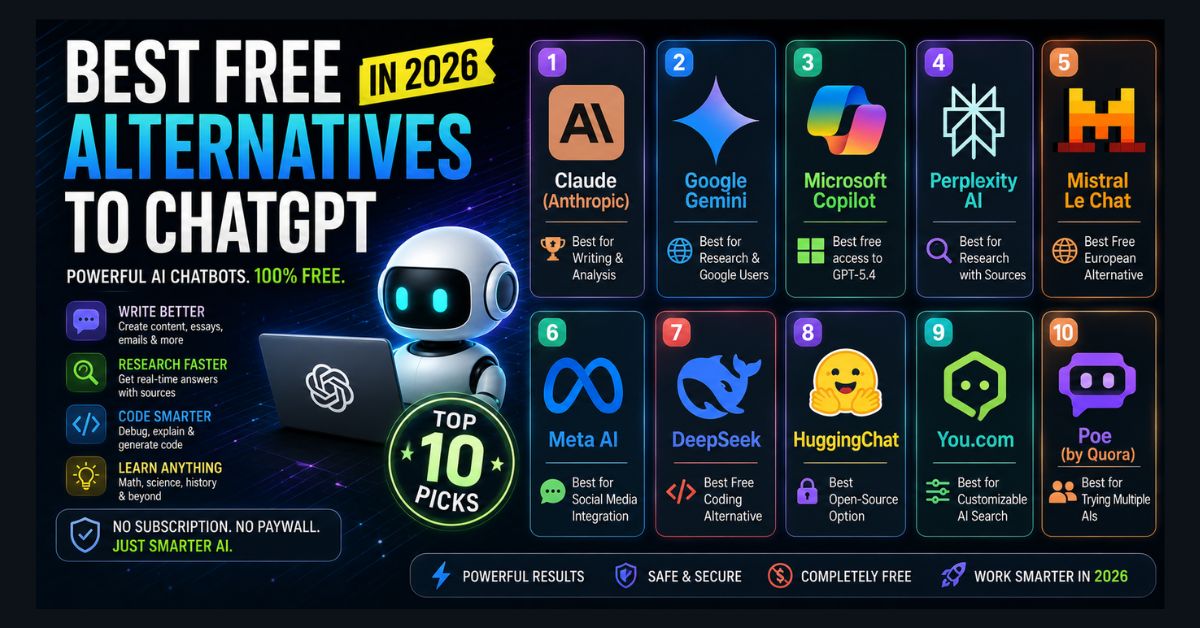
The best free ChatGPT alternative for most people is Claude for writing and analysis, Gemini for research and Google users, and Perplexity for cited answers. All three have capable free tiers with daily limits. Free model tiers change often, so confirm the current model on each provider’s own page.
Key Takeaways
- Claude’s free tier runs Claude Sonnet 5, the default for free users since July 1, 2026, and is the strongest all-round free pick
- Free AI model tiers change monthly, so any specific model named here should be reconfirmed on the provider’s page before you rely on it
- ChatGPT’s own free tier has also moved up, so “free alternative” now means a different tool, not a weaker model
- For research with sources, Perplexity and Gemini beat a plain chatbot; for coding on a budget, Claude and DeepSeek lead
- Keep sensitive personal, financial and work data out of any free AI chatbot regardless of provider
ChatGPT changed how millions of people work, learn and create, but it is not the only option. Whether you are hitting message limits on the free tier, dealing with frequent errors, or simply want to see what else is out there, 2026 offers a strong lineup of free AI alternatives.
One thing to set up front, because it changes how you should read every roundup like this: free AI model tiers move fast. The specific model a service gives free users can change within weeks, and it did for several tools on this list during 2026. Every model named below was accurate at the time of writing, but treat the exact version as a snapshot and confirm it on the provider’s own page before relying on it. The rankings by use case are far more stable than the model numbers.
What is the best free ChatGPT alternative overall?
Claude is the best free ChatGPT alternative overall for writing, analysis and coding. Built by Anthropic, Claude produces natural, less “AI-sounding” writing, follows complex instructions reliably, and tends to hallucinate less than lighter free models.
The free tier runs Claude Sonnet 5, which became the default model for free and paid users on July 1, 2026, with daily message limits that reset every few hours. For coding, Claude also offers Claude Code, a terminal agent that can read and edit a whole codebase, though heavy use of it runs into free-tier limits quickly.
Where Claude leads: writing quality, instruction-following, long-document analysis, and clean code. Where ChatGPT is stronger: native image generation (Claude does not generate images), voice conversations, and a broader third-party ecosystem. For a full head-to-head, see our Claude vs ChatGPT vs Gemini breakdown.
What is the best free AI alternative for writing refinement?
Quillbot is a strong ChatGPT alternative when the main goal is improving writing rather than using one chatbot for everything. I found it particularly useful for taking an existing idea or draft and working through the next stages — reorganizing thoughts, rewriting sections, summarizing information, and making the final content clearer and more natural.
Quillbot’s AI Chat adds a conversational layer to that workflow. It can help brainstorm ideas, explore different approaches, organize information, and work through a draft before moving into Quillbot’s broader writing and refinement tools. That makes the experience feel less like generating a one-off response and more like working through the writing process from idea to finished communication.
Where Quillbot stands out is specialization. ChatGPT and Claude are stronger if I need one assistant for everything from coding and research to broad problem-solving. But when the task is centered on writing — especially refining an existing draft, improving clarity, adjusting tone, or summarizing content — Quillbot provides a more focused workflow.
For students, writers, marketers, and professionals who spend a large part of their AI usage working with text, that focus can be more useful than having another general-purpose chatbot.
Which free AI is best for research and Google users?
Gemini is the best free AI for research and anyone already inside Google’s ecosystem. Its defining feature is native integration with Google Search, so questions about current events or recent news draw on up-to-date, sourced results rather than stale training data.
The free tier gives you Google’s Flash-class Gemini model with compute-based daily limits, while the flagship Pro model and its very large context window sit behind Google AI Pro at $19.99/month (US pricing, confirm on Google’s plans page). Google’s image generation, via its Nano Banana line, is among the best free AI image generators available, and Gemini connects to Docs, Sheets and Slides for Workspace users.
Where Gemini leads: real-time information, Google integration, image quality. Where ChatGPT is stronger: conversational voice mode and some creative writing tasks.
Can I get the latest GPT model for free?
Partly. Microsoft Copilot is the simplest way to use OpenAI’s GPT-5 series without paying, because it runs on a current GPT-5 model rather than an older or lighter one. OpenAI confirmed GPT-5.6 as the preferred model across Microsoft 365 Copilot on July 9, 2026, and the consumer Copilot app tracks OpenAI’s current generation closely.
OpenAI’s newest model, GPT-6 Astra, is not part of any free tier. OpenAI began rolling it out on September 3, 2026 to ChatGPT Plus, Pro, Business and Enterprise users and through its API and Amazon Web Services, according to CNBC. On Microsoft’s side, GPT-6 Astra is rolling out to Copilot Cowork and Copilot Studio, which are business products rather than the free consumer app. For most people, this means a free Copilot account still provides a capable GPT-5 model, while the newest OpenAI model requires a paid plan.
Copilot is built into Windows 11, Edge and Microsoft 365, so it is the path of least resistance for anyone in the Microsoft ecosystem. The exact GPT variant and limits vary by surface and change over time, so check what your Copilot app reports. Our explainer on the newest OpenAI models covers the GPT-5.6 Sol, Terra and Luna tiers if you want the detail.
Where Copilot leads: free access to a current GPT-5 model, Windows and Edge integration. Where ChatGPT is stronger: its own app’s memory, custom GPTs, and voice experience.
What is the best free AI for cited, verifiable answers?
Perplexity is the best free AI for research that needs sources, because every answer includes inline citations linking to the pages it drew from. That transparency makes it the strongest free option for fact-checking, academic work and market research.
The free tier provides unlimited basic searches plus a limited number of Pro searches per day on more advanced models. Where Perplexity leads: source citations and verifiability. Where ChatGPT is stronger: creative writing, coding and open-ended conversation. If verifiable answers matter most to you, Perplexity plus a general chatbot is a strong free combination.
What is the best free coding alternative to ChatGPT?
DeepSeek is the best free coding alternative for developers on a strict budget, because DeepSeek V4 performs competitively with paid models on coding and math benchmarks while staying free through the web interface. Claude is the stronger pick for code quality and instruction-following, but DeepSeek’s free limits are more generous.
One caution belongs in the first line, not a footnote: DeepSeek processes prompts under Chinese data jurisdiction, so keep proprietary code, credentials and personal data out of it. That is a data-governance issue, not a quality one. Our is DeepSeek safe guide covers the details, and our best AI coding assistants comparison ranks the coding options including paid tools.
Which free AI is best for privacy and open-source?
Mistral Vibe and HuggingChat are the best free options for privacy-conscious users. Both reduce the amount of data leaving your control compared with mainstream US chatbots.
Mistral Vibe, the assistant Mistral AI renamed from Le Chat on August 12, 2026, comes from the leading European AI company and offers a free plan for quick answers, web search and simple tasks. It runs on Mistral’s own models, with strong multilingual quality across French, German, Spanish and Italian, and processes data under European privacy regulations. HuggingChat, Hugging Face’s free interface, lets you choose among open models such as Llama, Mistral and Qwen, and does not train on your conversations, with more transparency about how data is handled than most commercial services. Quality varies by the model you pick, but the strongest open options are competitive with a mainstream free tier for everyday tasks.
What are the best free AI tools for casual and multi-model use?
The final group wins on accessibility and variety rather than raw capability. Match them to convenience.
- Meta AI — most accessible. Built into WhatsApp, Instagram, Messenger and Facebook, Meta AI is the easiest assistant to reach if you already live in those apps. The assistant is now powered by Muse Spark, a proprietary model that Meta Superintelligence Labs introduced on April 8, 2026; Meta says Muse Spark powers the Meta AI app and website and is rolling out to its other apps. It handles casual questions and quick creative ideas well, but will not replace Claude or a current GPT model for professional work.
- You.com — most customizable. Adjustable modes let you switch between models, toggle source citations on or off, and tune the level of detail in responses, giving more control than any single fixed chatbot.
- Poe — best for sampling many models. Quora’s Poe gives daily credits across Claude, GPT, Gemini, Llama and Mistral through one interface, which is the easiest way to compare answers side by side. The free daily credits are limited, but for trying several models without multiple sign-ups it is the best sampling platform.
Which free AI alternative should you choose?
The right pick depends on your main task rather than any single “best” verdict. This table maps common needs to the strongest free option and what you trade off.
| Your main use | Best free pick | Trade-off to know |
|---|---|---|
| Overall ChatGPT replacement | Claude (Sonnet 5) | No image generation; daily message limits |
| Research with live data | Gemini | Best model is paid; free tier is Flash-class |
| Cited, verifiable answers | Perplexity | Limited Pro searches per day on free tier |
| Current GPT-5 model, free | Microsoft Copilot | Newest GPT-6 Astra is paid-only; variant and limits vary by surface |
| Coding on a budget | Claude or DeepSeek | DeepSeek: data processed under Chinese jurisdiction |
| Students | Gemini or Perplexity | See our students guide for the full breakdown |
| Casual everyday use | Meta AI or Copilot | Meta AI is weaker on professional tasks |
| Privacy priority | HuggingChat or Mistral Vibe | Open-model quality varies by model chosen |
| Writing refinement and communication | Quillbot | More specialized than a general-purpose chatbot |
For students specifically, our dedicated best AI tools for students guide goes deeper. For creative tasks, see our guides to AI image generators and AI video generators, and for how the leading models stack up beyond their free tiers, our top AI models overview. If you would rather skip sign-ups entirely, our no-sign-up AI chatbots roundup is the place to start.
How do you judge whether a free AI tier is actually worth using?
Judge a free AI tier on four things, not on the brand name: the model it serves, the message or compute limits, the data policy, and the features included. A generous limit on a weak model is worse than a tight limit on a strong one for most real work.
Run through these checks before you commit to any free tool:
- Which model does the free tier actually run? This is the detail that changed most across 2026, and providers rarely make it obvious. A free tier on a current flagship-adjacent model is a different product from one stuck on a year-old model. Confirm it on the provider’s own page.
- How do the limits reset? Some tiers cap messages per few hours (Claude), some use compute-based limits that vary with prompt complexity (Gemini), and some are effectively unlimited on a weaker model (several open-source options). Match the reset pattern to how you actually work.
- What happens to your data? Most major services do not train on your conversations by default, but data jurisdiction differs, and some free tiers have weaker protections than their paid equivalents. Assume anything you type could be reviewed, and keep sensitive material out.
- Which features are gated? Image generation, web search, file uploads, memory and voice are often the dividing line between free and paid. Decide which you actually need before assuming you have to pay.
The practical shortcut most people miss is combining two free tools rather than paying for one. Claude for writing plus Perplexity for cited research, or a current-GPT Copilot plus Gemini for Google-native tasks, covers most needs at no cost. If you want the models ranked beyond their free tiers, our DeepSeek vs ChatGPT vs Gemini comparison goes deeper on the free-tier matchups specifically.
FAQ
Is there a completely free AI as good as ChatGPT Plus?
Microsoft Copilot comes closest, giving free access to OpenAI’s current GPT-5 series without a subscription. Claude’s and Gemini’s free tiers are also competitive in quality, though each has daily message limits. No free option matches the full ChatGPT Plus feature set, which now includes OpenAI’s newest model, GPT-6 Astra, but for most everyday tasks the free alternatives are enough. ChatGPT’s own free tier has also improved, so the gap is smaller than it was.
Are free AI chatbots safe to use?
Free AI chatbots are generally safe for everyday use, but keep sensitive data out of them. Avoid entering passwords, financial details, or confidential business information into any chatbot. Most major services do not use your conversations for training by default, but data jurisdiction varies, so services such as DeepSeek process prompts under Chinese law. Read each provider’s terms.
Can free AI alternatives generate images like ChatGPT?
Yes. Gemini (Google’s Nano Banana line), Microsoft Copilot and Meta AI all offer free image generation. Quality and daily limits vary by tool. See our best free AI image generators guide for a current comparison of the available options.
Why use an alternative instead of paying for ChatGPT Plus?
Three reasons: saving the subscription cost, getting better results for specific tasks (Claude for writing, Gemini for research, Perplexity for cited answers), and reaching features ChatGPT lacks, such as Gemini’s Workspace integration or Claude Code’s terminal agent. Many people use two free tools together rather than paying for one.
Which free AI is best for coding?
Claude and DeepSeek are the strongest free options for coding. Claude’s free tier runs Sonnet 5, which produces clean code and follows instructions well. DeepSeek V4 is competitive on coding benchmarks with generous free limits, with the caveat that prompts are processed under Chinese jurisdiction. For a full comparison including paid tools, see our best AI coding assistants guide.