

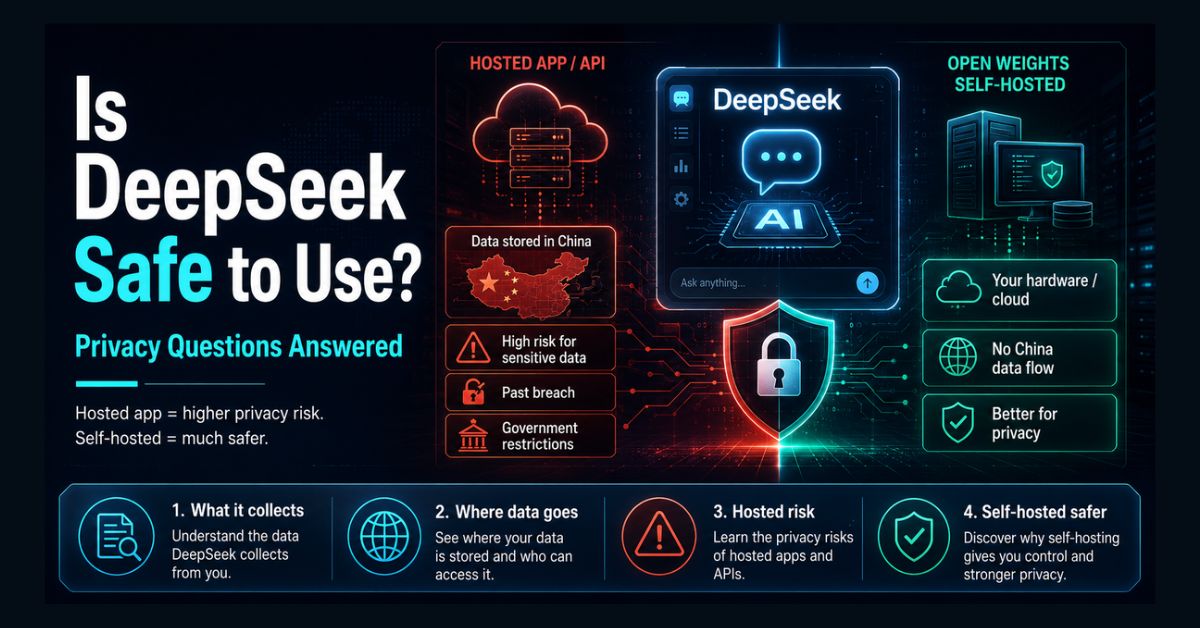
Whether DeepSeek is safe depends on how you use it. Its hosted app and API send your data to servers in China, where it is subject to Chinese law, making them a poor choice for personal, financial, or work data. The open-weight models, run on your own hardware, avoid that. For casual, non-sensitive questions, the risk is lower but not zero.
- Data location: the hosted service stores your data in China, per its own policy
- Jurisdiction: Chinese law can compel data access without notice or court appeal
- Track record: a 2025 breach exposed over 1 million records, including chats
- The key nuance: self-hosting the open weights removes the China data flow
- Bottom line: never feed the hosted app sensitive or work data
DeepSeek is genuinely capable and free, which is why it became one of the fastest-growing AI apps ever. It is also one of the most scrutinized, banned by governments on several continents and flagged by security researchers. So is it safe to use? The honest answer is that it depends on which version you use and what you put into it.
This guide separates the documented facts from the noise: what DeepSeek collects, where it goes, what researchers found, and the one distinction that changes the entire risk calculation.
Is DeepSeek safe to use?
For casual, non-sensitive questions on a personal device, DeepSeek’s hosted service carries roughly the same risk as any free foreign chatbot. For anything personal, financial, professional, or regulated, the hosted app and API are not a safe choice, because your data is stored in China under a legal system that offers users little protection or recourse.
There is an important exception. DeepSeek’s models are open-weight, so they can be downloaded and run on your own hardware or a Western cloud, which removes the cross-border data concern entirely. The safety question is really three questions: which surface you use, what data you feed it, and what your regulator or employer allows.
What data does DeepSeek collect?
Quite a lot, and the company is candid about it. According to DeepSeek’s own privacy policy, last updated February 10, 2026, the hosted service collects your account details (email, phone number, date of birth, username), every prompt and uploaded file, device and network information including your IP address, location data, and usage analytics. Some reporting notes it also logs keystroke patterns, meaning how you type, not just what you type.
In fairness, this level of collection is not wildly different from other AI chatbots. ChatGPT and others gather similar information, and the policy says data is retained as long as “necessary” with no fixed timeframe. What sets DeepSeek apart is not mainly what it collects, but where that data lives and which laws apply to it.
Where does DeepSeek store your data, and why it matters
DeepSeek’s policy states plainly that it collects, processes, and stores personal data in the People’s Republic of China. That single fact is the heart of the concern.
Under China’s 2017 National Intelligence Law, organizations operating in the country must support and cooperate with state intelligence work. In practice, that means authorities can compel a company to hand over user data, typically without notifying the user and without an independent court where the request can be challenged. This is the structural difference from US-based providers: when a US court demands data from a company like OpenAI, the company can appeal and push back, while a user of the hosted DeepSeek service has no equivalent protection. This dynamic is part of the wider tension we cover in our piece on US AI export controls.
The DeepSeek breach and security findings
Beyond policy, DeepSeek’s actual security record has drawn repeated scrutiny from independent researchers.
Shortly after launch, security firm Wiz Research found a misconfigured, unauthenticated DeepSeek database exposing more than one million log entries, including plaintext chat history and API keys. DeepSeek secured it after disclosure; it was an infrastructure lapse, not a model flaw, but a serious one. If you used DeepSeek early on, it is worth a quick data-breach check.
On model safety, testing by Cisco and the University of Pennsylvania reported that DeepSeek’s R1 model failed to block any of 50 jailbreak prompts, a 100% attack success rate, making it easier to coax into harmful output than several Western rivals. Separately, security firms including Feroot and NowSecure reported code in DeepSeek’s apps communicating with Chinese tech infrastructure, including links tied to the state-controlled carrier China Mobile and to ByteDance cloud services. These findings are what prompted much of the government action that followed.
DeepSeek’s surfaces compared
The most useful way to judge safety is by which version you use, because the risk profiles differ sharply.
| Surface | Where your data goes | Risk level | Best for |
| Hosted app / web | Servers in China | High | Casual, non-sensitive queries only |
| Hosted API | Servers in China | High | Same; avoid for regulated data |
| Open weights (self-hosted) | Your own hardware/cloud | Low (data) | Privacy-sensitive and offline use |
| Third-party host (e.g. R1 on US/EU servers) | That provider’s region | Medium | Capability without the China data flow |
The hosted app and self-hosted weights are almost different products from a privacy standpoint. The model’s own safety weaknesses still apply when self-hosted, but the cross-border data concern does not.
Which countries have banned DeepSeek?
The regulatory response has been unusually broad and fast. Italy’s data protection authority, the Garante, ordered the app blocked within days in early 2025 over GDPR concerns. Restrictions on government devices followed in Taiwan, Australia, South Korea, the Czech Republic, the Netherlands, and across numerous US federal agencies and states, with a bipartisan “No DeepSeek on Government Devices Act” moving through Congress.
According to analysis by the International Association of Privacy Professionals, investigations opened in 13 European jurisdictions, and the European Data Protection Board created a dedicated AI enforcement task force. The US House Select Committee on the CCP labeled the service a national security threat and cited heavy suppression of politically sensitive topics. Notably, despite all this, DeepSeek’s global downloads surged during the same period, especially across China and the Global South.
Is DeepSeek safe for work or sensitive data?
No. For any regulated or confidential information, health, legal, financial, government, client, or personnel data, the hosted DeepSeek service is not an appropriate tool, and several regulators have said so on the record. The combination of China-based storage and limited legal recourse makes it a compliance risk.
Before using it for anything work-related, check your employer’s AI policy. Many companies, universities, and public bodies have already added DeepSeek to their restricted-tools lists. If yours permits it, treat it like any untrusted external service and keep sensitive material out entirely.
How to use DeepSeek more safely
If you want to use DeepSeek’s capabilities while limiting exposure, these steps help.
- Never input sensitive data. No personal identifiers, financial details, passwords, client information, or unreleased work.
- Self-host the open weights if privacy matters and you have the hardware, which keeps data on infrastructure you control.
- Use a Western-hosted version where available, such as third parties running DeepSeek’s open models on US or EU servers.
- Sign up with minimal information and avoid linking Google or Apple accounts, which can share additional data.
- Check your employer’s policy before any professional use.
- Assume conversations are retained indefinitely and could be accessed under local law.
Safer alternatives
If the jurisdiction issue is a dealbreaker, you have good options. Western chatbots like ChatGPT, Claude, and Gemini keep data under legal systems with more user recourse, and you can compare them in our Claude vs ChatGPT vs Gemini guide. For privacy-first, no-account use, several tools in our best free AI chatbots roundup anonymize your requests.
And if it is specifically DeepSeek’s capability you want, running the open weights locally or using a reputable Western host gives you most of the benefit without sending your prompts to China. For a capability-first view, see our DeepSeek vs ChatGPT vs Gemini comparison.
The bottom line
Is DeepSeek safe? The model is capable and, run on your own hardware, can be a reasonable privacy-respecting choice. The hosted app and API are a different story: they store your data in China under laws that give users little protection, the service has a documented breach and weak jailbreak resistance, and governments worldwide have restricted it for these reasons. Use it for trivia if you like, never for anything sensitive, and self-host the open weights if privacy is the priority. For the bigger picture on protecting your information, see our cybersecurity and data privacy hub.
FAQ
Is DeepSeek safe to use?
It depends on the version. DeepSeek’s hosted app and API store your data on servers in China under laws that can compel access, so they are unsafe for sensitive, financial, or work data, though acceptable for casual queries. The open-weight models, run on your own hardware, avoid the cross-border data concern entirely.
What data does DeepSeek collect?
Per its privacy policy, DeepSeek’s hosted service collects account details, every prompt and uploaded file, device and network data including your IP address, location, usage analytics, and reportedly keystroke patterns. This is similar to other AI chatbots; the key difference is that DeepSeek stores it in China.
Why is DeepSeek banned in some countries?
Governments including Italy, Australia, Taiwan, South Korea, and many US agencies restricted DeepSeek over its China-based data storage, weak security, and links found in its code to Chinese state-connected companies. Italy’s regulator cited GDPR violations, and a US House committee labeled it a national security threat.
Did DeepSeek have a data breach?
Yes. In early 2025, Wiz Research discovered a misconfigured, unauthenticated DeepSeek database that exposed more than one million log entries, including plaintext chat history and API keys. DeepSeek secured the database after it was disclosed. The issue was a cloud infrastructure lapse rather than a flaw in the AI model itself.
Is it safe to run DeepSeek locally?
Running DeepSeek’s open-weight models on your own hardware is much safer for privacy, because your prompts and data never leave infrastructure you control, removing the China data-storage concern. The model’s own safety limitations, such as weaker jailbreak resistance, still apply, but the cross-border privacy risk does not.