

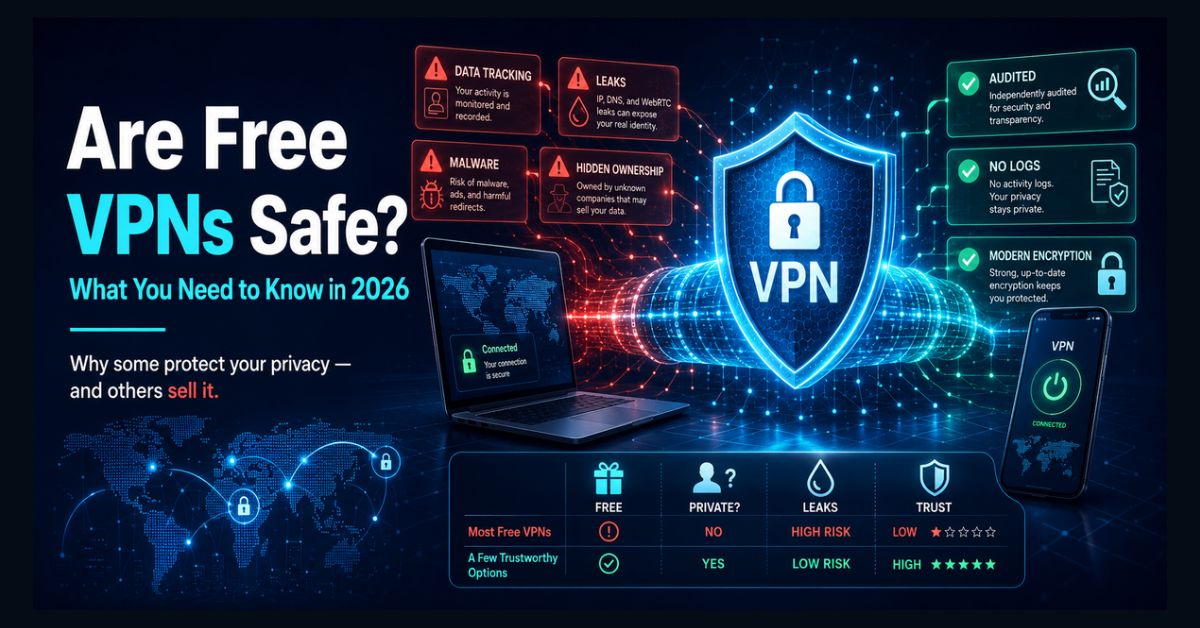
Most free VPNs are not safe. Independent research has repeatedly found that the majority leak data, share it with third parties, use weak encryption, or carry trackers and even malware. A few audited free tiers from paid providers, like Proton VPN, are trustworthy, but the typical “free unlimited VPN” app is a privacy risk, sometimes worse than using none.
- The model: if a VPN is free, your data is often the product
- The evidence: one study found 88% of top free Android VPNs leaked data
- The worst case: some free VPNs carry malware or hijack your bandwidth
- The exceptions: audited free tiers like Proton VPN Free and Windscribe Free
- The reality check: a VPN doesn’t make you anonymous or block viruses
A VPN is supposed to protect your privacy. The uncomfortable truth about the free end of the market is that many free VPNs do the opposite: they collect and sell the very data they promise to hide. That does not make every free VPN dangerous, but it does mean the category needs care, not blind trust.
Here is what the independent research actually shows, where the real risks are, the handful of free options worth trusting, and how to check a free VPN before you install it.
Are free VPNs safe?
Most are not. Large independent studies have found that the majority of popular free VPNs have at least one serious problem, from data leaks and tracking to weak encryption and malware. A small number of free tiers from reputable paid providers are genuinely safe, but they are the exception.
The core issue is the business model. Running VPN servers costs money, so a service with no subscription has to make revenue another way, and too often that way is your data. As the saying goes, if you are not paying for the product, you may be the product.
How do free VPNs make money?
Understanding the revenue model explains the risk. Free VPNs typically monetize in one of a few ways, and most of them work against you.
Some log your browsing activity, which sites you visit and when, and sell it to advertisers and data brokers. A Top10VPN investigation of 100 popular free Android VPNs found that half contained code sending data to third parties, including ByteDance and Yandex. Others inject ads or bundle tracking libraries. And some resell your bandwidth: Hola VPN, for example, has long enrolled free users into a residential proxy network, turning their devices into exit nodes for other people’s traffic, which has included criminal activity, often without meaningful consent. The legitimate free tiers, by contrast, simply use the free version as a funnel toward a paid upgrade.
By contrast, some free VPNs stick to the funnel model without selling data outright. Planet VPN (Free VPN Planet, based in Romania), for instance, funds its free tier through in-app ads rather than data resale, with unlimited traffic and no artificial data caps.
The biggest risks of free VPNs
The risks are well-documented across years of research from privacy labs and academics. These are the ones that matter most.
Data logging and selling. Many free VPNs record and monetize your activity. A Top10VPN investigation found that 71% of the top 100 free Android VPNs shared personal data with third parties such as data brokers and social media companies.
Weak or missing encryption. Encryption is the whole point of a VPN, yet many fail at it. A Zimperium zLabs analysis of more than 800 free VPN apps found that hundreds offered no real encryption despite claiming to protect traffic, which creates a false sense of safety that is worse than knowing you are exposed.
Malware. The most serious cases involve outright malicious software. An academic study of hundreds of Android VPN apps, led by Australia’s CSIRO, found that among the apps most likely to carry malware, the majority were free, and antivirus scanners have flagged a meaningful share of free VPNs as malicious. If your device shows signs of infection, our guide to removing malware for free can help.
Data leaks. Even without malice, poor engineering exposes you. That same Top10VPN research found 88% of the top free Android VPNs leaked data in some form, through IPv4, IPv6, DNS, or WebRTC leaks that reveal your real identity or location.
Excessive permissions. A privacy tool should ask for very little. A 2026 review of 18 popular free Android VPNs found that nearly all contained embedded trackers, and many requested access to the camera, microphone, contacts, call logs, and precise location, behavior one report said resembles spyware more than a privacy tool.
Hidden ownership. You cannot trust a provider you cannot identify. Investigations have repeatedly found large shares of popular free VPN apps quietly owned by opaque companies, including many with undisclosed links to mainland China, where you have no way to know who handles your data or under what law.
Free vs paid VPN: what’s the difference?
The gap is not just speed. It is the safety architecture itself.
| Feature | Typical free VPN | Reputable paid VPN |
| Revenue source | Ads, data sales, bandwidth resale | Your subscription |
| No-logs policy | Often vague or untrue | Independently audited |
| Encryption | Sometimes weak or absent | Modern (WireGuard, AES-256) |
| Kill switch | Rarely included | Standard |
| Data cap / speed | Limited and throttled | Unlimited, faster |
| Ownership transparency | Frequently hidden | Named company and leadership |
If you decide a VPN is worth paying for, our guide to the most trustworthy VPNs covers options that pass independent audits.
Can a free VPN be worse than no VPN?
Yes, and this is the part people miss. Without a VPN, your internet provider and the sites you visit can see your activity, but at least you know who they are. A shady free VPN inserts an unknown middleman who may log everything, sell it, and leak your real IP anyway, while making you feel protected enough to take risks you otherwise would not.
Even security agencies urge caution about personal VPNs in general. CISA’s mobile guidance notes that a personal VPN does not remove risk so much as shift it from your provider to the VPN company, and can expand your attack surface. With an untrustworthy free app, that shift is squarely the wrong way.
Are there any safe free VPNs?
A few, yes. The credible exceptions share a pattern: they are run by companies whose main business is paid subscriptions, they publish independently audited no-logs policies, they show no ads and embed no trackers, and they use modern encryption.
Proton VPN Free is the standout, operating under Swiss privacy law with no ads, no data caps, and audited no-logs infrastructure. Windscribe Free is another reasonable option. The trade-off is intentional: fewer server locations and capped speeds, designed to nudge you toward the paid tier. That is a fair deal, and a very different one from a “free unlimited VPN” that monetizes your data. Treat audited, paid-primary providers as the only free VPNs worth trusting.
When is a free VPN okay to use?
For light, low-stakes tasks, a reputable free tier is fine. Reading the news on coffee-shop Wi-Fi, masking your IP from a local network, or testing whether a VPN works for you are all reasonable uses, provided the app itself is trustworthy.
What a free VPN is not suited for is anything sensitive: online banking, logging into important accounts, handling confidential work, or any activity where your safety depends on the connection. For those, use an audited provider, free or paid, whose ownership and infrastructure you can actually verify.
How to check if a free VPN is safe
Before you install any free VPN, run through this quick checklist. If it fails on the first two, stop there.
- Identify the owner and jurisdiction. Look for a named company, a real leadership team, and a clear legal home. Anonymous or hidden ownership is a dealbreaker.
- Look for independent audits. A published, third-party audit of the no-logs claim carries weight; a generic “no logs” banner does not.
- Test for leaks. After connecting, run an IP and DNS leak test, check for WebRTC leaks, and toggle the kill switch to confirm traffic actually stops if the connection drops.
- Review permissions. On Android, check what the app requests. Access to your camera, contacts, or call logs has nothing to do with a VPN and is a red flag.
- Check performance at peak hours. Free servers get crowded; if it is unusable when you need it, move on.
For the broader picture on protecting your data, see our cybersecurity and data privacy hub, and if you suspect your information has already been exposed, you can check your email against known breaches.
What a VPN can’t do
Even a good VPN is not a cloak of invisibility, and free apps often oversell this. A VPN hides your IP and encrypts traffic on the local network, but it does not make you anonymous to services you log into, so Google still knows it is you when you sign in to Gmail.
It also does not erase cookies, stop browser fingerprinting, or protect you from viruses and malware in files you download. Treat a VPN as one layer of privacy, paired with good habits and, on Windows, a reliable free antivirus, rather than a complete security solution.
The bottom line
Are free VPNs safe? Mostly no. The research is consistent: the typical free VPN leaks data, tracks you, or monetizes the information it promised to protect, and the worst carry malware. The good news is that the exceptions are real and easy to name, audited free tiers from paid-first providers like Proton VPN. If you stick to those, vet any app against the checklist above, and keep your expectations realistic, a free VPN can be safe. Just assume that most are not until proven otherwise.
FAQ
Are free VPNs safe to use in 2026?
Most are not. Independent studies continue to find that the majority of free VPNs leak data, share it with third parties, use weak encryption, or contain trackers and malware. A small number of audited free tiers from paid providers, such as Proton VPN Free, are genuinely safe, but they are the exception rather than the rule.
Why are free VPNs risky?
Running VPN servers costs money, so free providers often monetize differently, by logging and selling your browsing data, injecting ads, bundling trackers, or reselling your bandwidth. Research has also found weak encryption, data leaks, excessive permissions, and hidden ownership across much of the free VPN market.
Is a free VPN better than no VPN?
Not necessarily. A trustworthy free VPN adds protection, but a shady one can be worse than none, because it inserts an unknown party that may log and sell your activity while leaking your real IP. Without a VPN, at least you know your provider and the sites you visit can see your traffic.
What is the safest free VPN?
Proton VPN Free is widely regarded as the safest, with Swiss jurisdiction, audited no-logs infrastructure, no ads, and no data cap. Windscribe Free is another reasonable choice. Both are run by companies whose main business is paid subscriptions, which is why they do not need to monetize your data.
Can a free VPN steal my data or give me a virus?
Some can. Investigations have found free VPN apps that log and sell user data, embed spyware-like trackers, and in some cases bundle malware. Antivirus scanners have flagged a notable share of free VPNs as malicious, which is why vetting a provider’s ownership, audits, and permissions matters before installing.