

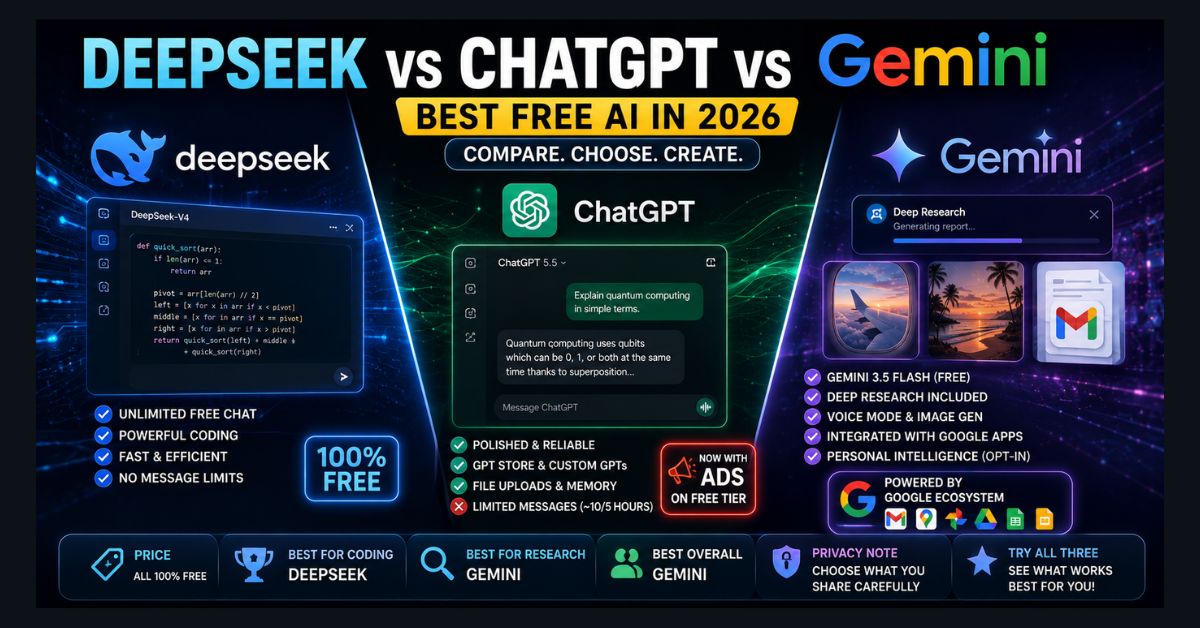
The best free AI in 2026 depends on how you use it. ChatGPT Free now offers unlimited everyday text chats but shows ads in the U.S.; Gemini Free includes Deep Research and Google app integration but routes most prompts to the lightweight Flash-Lite model since October 9, 2026; DeepSeek remains free with no published message cap.
- ChatGPT Free: Unlimited everyday text chats since August 2026; uploads, images, voice, and deep research have separate limits
- ChatGPT ads: OpenAI began showing labeled sponsored ads to U.S. Free users in February 2026
- Gemini Free: Auto mode sends most prompts to Flash-Lite, with harder prompts routed to Flash or Pro
- Gemini features: Deep Research, Canvas, and image generation stay free; video generation requires a paid plan
- DeepSeek: Free V4.1-generation model with no published message cap, but data is stored in China
If you refuse to pay for AI in 2026, you have three serious options: DeepSeek, ChatGPT, and Google Gemini. The short answer: Gemini offers the most complete free feature set, with Deep Research, Canvas, image generation, and voice mode included; DeepSeek is the most generous on raw usage, with essentially unrestricted free chat and standout coding ability, but real privacy caveats; and ChatGPT is now the most generous on everyday chat, with unlimited text chats on its free tier since August 2026, although its tools remain capped and it shows ads in the U.S.
We compared all three free tiers across everyday use, research, coding, images, limits, and privacy. Here’s the full breakdown, and which one to pick for your situation. (For the paid-tier and overall capability battle, see our separate Claude vs ChatGPT vs Gemini comparison — this guide is strictly about what $0 gets you.)
What you get free with each
ChatGPT (Free): You get unlimited everyday text chats, subject to abuse-prevention safeguards, after OpenAI removed the earlier cap of roughly 10 flagship messages every five hours in August 2026 (see our GPT-6 Sol and Luna launch report). OpenAI’s Free tier FAQ describes a Think option for harder questions (the Free chat model has been GPT-6 Luna since October 2026) and states that file uploads, image generation, voice, data analysis, and other tools have separate usage limits. Free users keep chat history, get limited memory, can use existing GPTs, upload files, and generate a limited number of images. Video is no longer part of the package, because OpenAI shut down the Sora app on April 26, 2026. The big change of 2026: OpenAI began showing ads on the free tier in the U.S. in February — labeled sponsored links, mostly under product and local-service queries, but ads nonetheless.
Gemini (Free): Since October 9, 2026, Google’s free tier uses Auto model selection: most prompts go to Flash-Lite, Google’s fastest model, and prompts that need deeper reasoning may go to Flash or Pro, according to Google’s Gemini Apps Help. Turning off smart model selection keeps every free response on Flash-Lite. Usage is compute-based and refreshes every 5 hours until you reach a weekly limit, and the free context window is 32,000 tokens, according to Google’s limits page. Free users also get Deep Research (web-browsing research reports), Gemini Live voice conversations, image generation, Canvas, Skills (formerly Gems), and — uniquely — Personal Intelligence, which can connect your Gmail and Photos for personalized answers, now free in nearly 200 countries. No ads. The free tier’s real superpower is integration: Gemini lives inside Search, Android, Chrome, and Docs, Sheets, and Slides.
DeepSeek (Free): The Chinese lab’s app and website are simply free — the current V4.1-generation model, according to DeepSeek’s site, with no meaningful message caps and no consumer subscription at all. That makes it the only one of the three where heavy daily use costs nothing. The trade-offs: occasional slowdowns or capacity errors during peak demand (the company has publicly struggled to secure enough chips), a sparser feature set (no equivalent of Deep Research’s polish, weaker image tooling), and privacy considerations covered below.
Everyday questions and writing
For ordinary use — drafting emails, summarizing, explaining, brainstorming — all three are good, and the differences come down to limits rather than intelligence. ChatGPT’s answers remain arguably the most polished conversationally, and since August 2026 its free text chats are unlimited, which removes the main weakness this comparison originally identified. Gemini’s free tier is fast, but most prompts now go to the lightweight Flash-Lite model and heavy use counts toward a weekly limit. DeepSeek is the volume champion: if you’re a heavy user who asks dozens of questions a day, it’s the only free option that never nags you to upgrade.
Winner: ChatGPT for most people, DeepSeek for heavy users.
Research and homework
Gemini wins this category outright on the free tier. Deep Research is included free — give it a topic and it browses the web and assembles a cited, multi-page report — and Auto mode can route harder questions to Flash or Pro, although Google notes that Deep Research uses more of your limit. ChatGPT’s free plan includes only limited deep research, according to OpenAI’s pricing page, and DeepSeek’s web search is functional but more basic. For students, Gemini’s free package (plus free Pro upgrades for students in several countries) makes it the default recommendation in our best AI tools for students guide.
Winner: Gemini.
Coding
This is DeepSeek’s home turf. The lab built its reputation on extreme cost-efficiency for code and math, and its free model punches at or near frontier level for everyday programming tasks — debugging, explaining, generating boilerplate — without usage anxiety. Gemini is also capable, although its free 32,000-token context window is far smaller than the 1 million tokens Google gives AI Pro and Ultra subscribers, which limits how much of a large file it can read at once. ChatGPT is excellent for code and no longer caps everyday text chats on the free tier, but file uploads and data analysis remain limited. For serious work you’ll eventually want a dedicated tool from our best AI coding assistants roundup, but for free casual coding, DeepSeek is the pick.
Winner: DeepSeek.
Images and media
Gemini and ChatGPT both generate images free with daily limits; Gemini’s allotment is generally friendlier, and Google lists image generation with Nano Banana 2 on the free tier while reserving video generation for paid plans. ChatGPT no longer offers Sora video at all after OpenAI closed the Sora app on April 26, 2026. DeepSeek isn’t competitive here. If image generation is your main goal, dedicated options in our best free AI image generators guide beat all three chatbots’ built-in limits anyway.
Winner: Gemini, narrowly.
Privacy and trust
The category where the three diverge most sharply. DeepSeek is China-based, and its consumer service stores data on servers in China — a dealbreaker for some users and many workplaces, fine for others asking casual questions. Its planned commercialization, following its $7.4 billion funding round, also means today’s unlimited free ride may not last forever. ChatGPT’s new ads introduce a commercial layer into a product millions treat as a confidant. Gemini’s Personal Intelligence is opt-in and Google says it doesn’t train directly on your Gmail or Photos — but connecting your inbox to an AI is inherently a bigger data relationship than a standalone chatbot.
There’s no clean winner; it depends on what you’re sensitive about. Rough guidance: most privacy-cautious → ChatGPT or Gemini without connected apps; most convenience → Gemini with Personal Intelligence; least data comfort for sensitive topics → think twice with any of them, but especially DeepSeek for anything you wouldn’t want stored abroad.
The verdict: which free AI should you use?
Pick Gemini if you want the best all-around free AI. Deep Research, Canvas, image generation, and voice mode are included, there are no ads, and the Google integration means it’s already wherever you are. For most people in 2026, it’s the strongest $0 package — part of why Google’s assistant is having such a moment, from Search’s AI Mode to its expanding ecosystem. The trade-off since October 9, 2026 is that most free prompts run on Flash-Lite, so users who need the strongest model on every question will notice the difference.
Pick DeepSeek if you’re a heavy user or coder who refuses limits. Nothing else free matches its volume, and its coding value is real. Just go in clear-eyed about data storage and the possibility that monetization arrives eventually.
Pick ChatGPT if you’re invested in its ecosystem — existing GPTs, its particular voice, your existing history — or if you want unlimited everyday text chat. Free text chats are now unlimited, although uploads, images, voice, and deep research remain capped and ads appear in the U.S. (And if it’s misbehaving, our ChatGPT error fix guide covers the common issues.)
On raw model capability, the three trade blows month to month — see where each sits in our top AI models ranking and what OpenAI’s flagship offers at the high end in our GPT-6 Astra report. But on the free tier specifically, the October 2026 picture is clear: Gemini for the broadest free feature set, ChatGPT for unlimited everyday chat, and DeepSeek for coding without limits. And since all three cost nothing to try, the smartest move is the simplest one: spend a day with each on your actual tasks and let your own workflow break the tie. For more $0 options beyond these three, our free ChatGPT alternatives roundup has the full field.
FAQ
Which free AI is best overall in 2026?
Gemini offers the most complete free feature set in 2026: free Deep Research, Canvas, image generation, voice mode, no ads, and integration across Google’s apps, although most free prompts now run on the lightweight Flash-Lite model. ChatGPT is the strongest free choice for unlimited everyday text chat, while DeepSeek is better for heavy coding use.
Is DeepSeek really completely free?
Yes, DeepSeek’s consumer app and website are free with no meaningful message caps and no paid consumer tier as of mid-2026. The trade-offs are occasional capacity slowdowns, a smaller feature set, and data stored on servers in China. Its recent $7.4 billion funding round raises the possibility of future monetization.
Does free ChatGPT have ads now?
Yes. OpenAI began showing ads to free-tier users in the U.S. in early 2026, appearing as labeled sponsored links, typically under product or local-service queries. Plus and higher paid tiers are ad-free, the $8-per-month Go plan may include ads, and OpenAI says ads don’t influence the AI’s answers.
What are ChatGPT’s free limits in 2026?
ChatGPT Free has unlimited everyday text chats in 2026, subject to abuse-prevention safeguards, after OpenAI removed the earlier cap of roughly 10 flagship messages every five hours in August 2026. File uploads, image generation, voice, data analysis, and deep research still have separate usage limits, and ChatGPT notifies you when you reach one.
Is the free version of Gemini good enough to skip paying?
Yes, the free version of Gemini is good enough for most everyday tasks. The free tier includes Deep Research, image generation, Canvas, and voice conversations, and its Auto mode sends most prompts to Flash-Lite while routing harder ones to Flash or Pro. Paying mainly buys higher usage limits, direct access to Flash or Pro, a larger context window, video generation, and extra storage.