

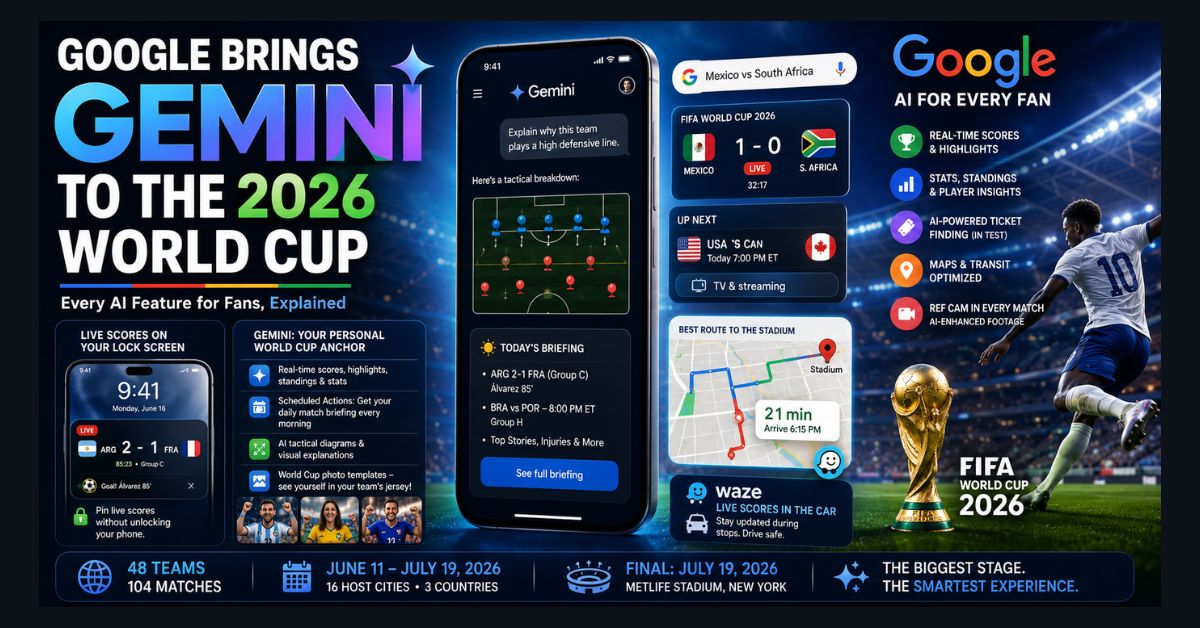
Google has turned the 2026 FIFA World Cup into the biggest public showcase AI has ever had. As the tournament kicks off June 11 with Mexico vs. South Africa at Mexico City’s Estadio Azteca, Google is rolling out a coordinated wave of Gemini-powered features across Search, Maps, Waze, and the Gemini app — live scores pinned to your lock screen, AI match briefings at breakfast, tactical diagrams generated on demand, and even photo templates that drop you into your team’s jersey. Here’s every feature, how to use it, and what Google is really testing.
With 48 teams playing 104 matches across 16 host cities in the United States, Canada, and Mexico — and the final set for MetLife Stadium on July 19 — this is the largest World Cup ever staged, and the first since AI tools went mainstream. Google announced its full fan lineup in a June 8 blog post, three days before kickoff.
Live scores on your lock screen
The simplest and probably most-used feature: lock-screen score pinning. Search for a match in Google on Android or iOS and you can pin live scores directly to your phone’s lock screen, so you can follow the game without unlocking your phone or juggling apps. Goals, red cards, and wins trigger quick real-time score animations in Search, and a FIFA-themed match bar shows upcoming games and kickoff times. Google has also made streaming clearer, with “TV & streaming” icons that show exactly which broadcaster carries each match — genuinely useful in a tournament spread across three countries and multiple networks.
Gemini becomes your personal sports anchor
The Gemini app’s World Cup upgrade turns it into something closer to a real-time sports dashboard than a chatbot. Ask about a match and it can pull live scores, highlights, standings, and stats, presenting them as a visual hub with images and video around games as they happen rather than walls of text.
Two features stand out. First, Scheduled Actions (on paid tiers) lets you set up an automated daily match briefing — a customized morning summary of your favorite teams delivered at breakfast, no prompting required. It’s one of the more practical uses yet of the agentic capabilities Google introduced at I/O 2026. Second, interactive tactical visuals: ask Gemini to explain a formation or why a team plays a high line, and it generates AI tactical diagrams and visual explanations instead of a text lecture — soccer tactics as an interactive learning tool, powered by the Gemini 3 Pro models.
There’s a fun layer too: the Gemini Images tab offers World Cup photo templates that place your uploaded photo into team-style photography scenes — your face in the team picture, effectively. Expect these to flood social feeds, in line with the AI-content wave reshaping social media in 2026.
Maps and Waze for match day
For anyone attending in person, Google updated Street View imagery at host stadiums and optimized local routing around the 16 host cities to handle match-day transit crush. Waze adds live scores in the car — surfacing updates during stops so drivers aren’t checking phones at 70 mph. And inside Search’s AI Mode, Google is testing agentic ticket booking, where the AI handles the steps of finding and booking match tickets — an early glimpse of the agent-driven future every platform is chasing. Some AI Mode Pro and Ultra visual features are going free for all Search users this summer, timed to give everyone access during the tournament.
If you’re new to AI Mode, our explainer on how AI Mode uses Gmail and Photos for personalized answers covers the underlying system these World Cup tools build on.
Gemini on the pitch: the Argentina and France deals
Google didn’t stop at software. Gemini is a main global sponsor of Argentina’s national team — the defending champions — with Gemini branding on the training kit, plus a parallel partnership with France, and Google says more team deals are coming. YouTube, meanwhile, is an official FIFA partner with select streaming rights for some channels.
Add FIFA’s own tech — the body-worn “Ref Cam” is now in every match, with Lenovo using AI to cut motion blur from referee footage — and this World Cup doubles as a six-week, billion-viewer experiment in how much AI fans actually want. Features that survive on novelty will fade by the group stage; anything still being used at the final tells Google exactly where AI fits in ordinary life.
The quieter story: not everyone is cheering
Worth knowing as a fan: more than 120 civil-society groups, including the ACLU and Amnesty International, have issued a travel advisory for the tournament, raising concerns about facial recognition, device searches, and social-media screening around border crossings and stadium security. It’s a reminder that the same AI wave powering fun fan features also powers surveillance infrastructure — and that attending mega-events in 2026 comes with a digital footprint. If you’re traveling to matches, basic digital hygiene (strong device locks, awareness of what’s on your phone at borders) is sensible.
Why Google is doing this
Strategically, the World Cup is the perfect stage for Google’s AI ambitions. Gemini has had a monster spring — new models at I/O, deep Workspace integration, and even a reported deal to power Apple’s rebuilt Siri — and a global tournament puts those capabilities in front of billions of casual users who’ve never deliberately “tried AI.” It’s also a competitive flex: while rivals demo agents at developer conferences, Google is shipping consumer AI to the biggest audience on Earth. For how Gemini stacks up against the competition beyond soccer, see our Claude vs ChatGPT vs Gemini comparison and our guide to using Gemini in Docs, Sheets, and Slides.
For fans, the practical upshot is simple: whether you’re at Azteca tomorrow or following from your couch, your phone just became a much better World Cup companion — and you don’t need to pay anything to use most of it.
FAQ
1. What AI features did Google launch for the 2026 World Cup?
Google rolled out coordinated features across Search, Maps, Waze, and the Gemini app: live scores pinned to phone lock screens, real-time score animations, AI-generated tactical diagrams, automated daily match briefings via Gemini Scheduled Actions, World Cup photo templates, updated stadium Street View, optimized match-day routing, and live scores in Waze.
2. How do I get World Cup scores on my lock screen?
Search for a match on Google using Android or iOS and use the pin option to add live scores to your lock screen. Scores update in real time with animations for goals, red cards, and results, so you can follow matches without unlocking your phone.
3. What are Gemini’s daily World Cup briefings?
On paid Gemini tiers, the Scheduled Actions feature can deliver an automated daily soccer briefing customized to your favorite teams — scores, news, and upcoming fixtures — at a time you choose, with no prompting needed each day.
4. Is Google sponsoring any World Cup teams?
Yes. Gemini is a main global sponsor of Argentina’s national team, the defending champions, with branding on their training apparel, and Google has a parallel partnership with France. The company says more team announcements are coming.
5. When does the 2026 World Cup start and end?
The tournament opens June 11, 2026, with Mexico vs. South Africa at Estadio Azteca in Mexico City, and runs 104 matches across 16 host cities in the US, Canada, and Mexico. The final is scheduled for July 19, 2026, at MetLife Stadium near New York.