

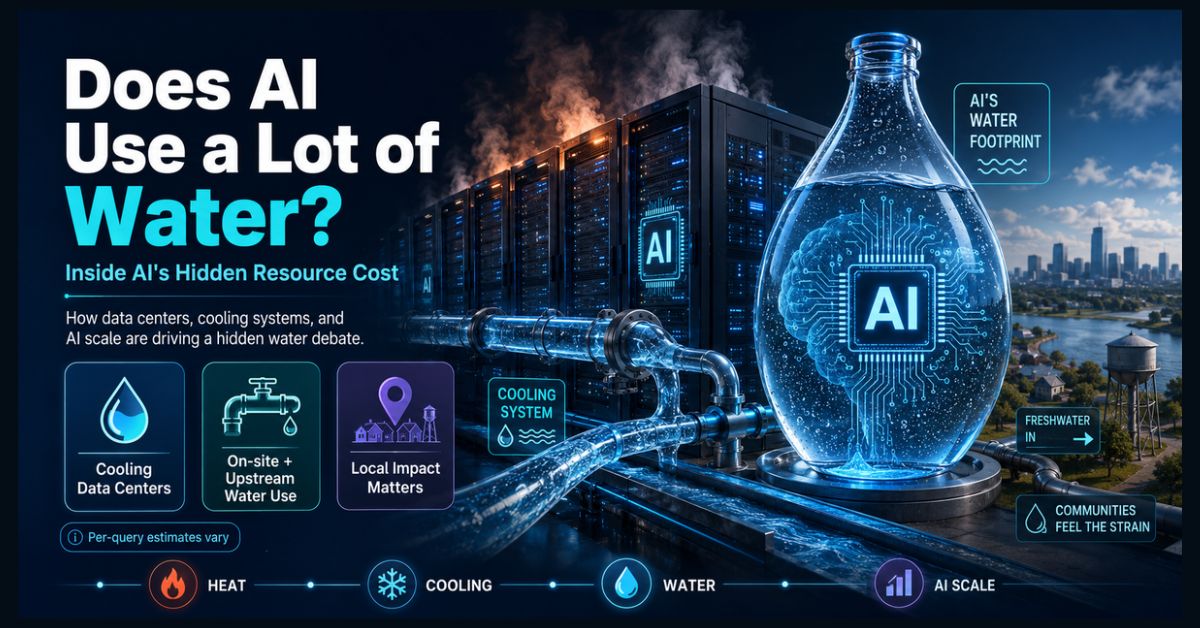
Yes, AI uses a significant amount of water, mostly to cool the data centers that run it, but the per-prompt amount is much smaller than the viral figures suggest. Current estimates range from about 0.26ml per Gemini prompt (Google) to roughly 15ml per GPT-4 prompt (UC Riverside’s revised figure), while company-wide use is rising fast.
- Why water: AI chips run hot, and cooling them often evaporates fresh water
- The viral number: ~519ml per 100-word email (2024), since revised by its author to ~15ml per GPT-4 prompt
- The company figures: Google reports ~0.26ml per median Gemini prompt; OpenAI’s CEO says ~0.32ml per ChatGPT query
- The disclosures: Google used ~10.9B gallons in 2025, up 34%; Microsoft ~2.2B gallons in fiscal 2025
- The real issue: concentrated local strain, where one site can rival a town’s use
Every AI prompt has a physical cost. Behind a chatbot’s reply sit racks of processors running hot enough to need constant cooling, and that cooling often runs on fresh water. As AI scales to billions of daily queries, that quiet cost has become one of the most contested environmental debates of 2026, sharp enough that even SpaceX has flagged water access as a risk to building AI infrastructure.
This guide lays out what is actually known, where the popular numbers come from, why credible people disagree about them, and where the real concern lies.
How much water does AI use?
AI uses water mainly to cool data centers, and estimates of the per-query amount vary widely depending on what is measured. The best-known figure comes from UC Riverside research on AI’s water footprint: in 2024, The Washington Post, working with UC Riverside researchers, estimated that writing a single 100-word email with GPT-4 could consume roughly 519ml, about a standard bottle of water. That estimate went viral, but it is now dated. In August 2026, The Atlantic reported that the lead researcher, Shaolei Ren, had revised his estimate for a GPT-4 prompt down to roughly 15ml, of which only about 5ml is on-site cooling.
Company figures are lower still. In June 2025, OpenAI’s Sam Altman wrote that an average ChatGPT query uses about 0.000085 gallons of water, roughly 0.32ml or one-fifteenth of a teaspoon, although OpenAI has not published the methodology behind that number. In August 2025, Google reported that a median Gemini text prompt uses about 0.26ml of water, roughly five drops. These figures are not directly comparable, because each one measures a different model, prompt length, and boundary. The number you cite depends on the boundary you draw.
Why does AI need water at all?
The short answer is heat. AI chips draw far more power than ordinary servers and convert most of it to heat. A rack of the newest AI accelerators can draw well over 100 kilowatts, versus roughly 5 to 10 kilowatts for a typical server rack, and all that heat has to go somewhere.
Many data centers remove it with water. Chilled water absorbs heat from the servers, then some of it evaporates in cooling towers, which requires continuous fresh water to replace what is lost. There is also an indirect cost: the power plants supplying the electricity use water for their own cooling. So even a facility that uses little water on-site can have a large water footprint upstream.
The 519ml vs 0.3ml debate: why the numbers disagree
This is the heart of the confusion, and understanding it is the key to reading any AI water statistic critically. Researchers describe AI’s water use in three “scopes,” and most arguments are really about which scopes are being counted.
Scope 1 is on-site water for cooling the servers. Scope 2 is off-site water used to generate the electricity the data center consumes. Scope 3 is embodied water in the supply chain, such as the roughly 2,200 gallons of ultra-pure water used to make a single microchip, according to OECD.AI analysis of AI’s water consumption.
Altman’s small figure reflects roughly scope 1 per query under efficient cooling. The bottle-of-water estimate reflected a longer 100-word output, an older model, and broader cooling and electricity assumptions, which is why its own author has since cut it sharply. Altman has also argued that many data centers have shifted away from water-heavy evaporative cooling. None of this makes the topic trivial, but it does mean a single scary statistic rarely tells the whole story.
The debate resurfaced in September 2026, when Altman said on a podcast that 38,000 ChatGPT queries use as much water as growing a single California almond. PolitiFact rated that claim Mostly False, finding that it paired a low, unverified per-query estimate with a high estimate for almonds. PolitiFact’s own math put the figure closer to 1,000 to 10,000 prompts per almond, which shows how much the answer moves with the assumptions on each side.
AI water use by company
Aggregate disclosures are more reliable than per-query math, because companies report them directly. The latest numbers are large and still rising.
| Company | Latest reported water consumption | Trend | Notable detail |
| ~10.9B gallons (2025) | Up 34% vs 2024 | Says it replenished ~7.7B gallons (78%); its Council Bluffs, Iowa campus averaged ~2.8M gallons a day in 2024 | |
| Microsoft | ~2.16B gallons (fiscal 2025) | Rising with AI buildout | Says it became “water positive” in fiscal 2025 by replenishing more than it withdrew |
| Meta | ~813M gallons (2023, latest verifiable total) | Rising | One Georgia site equals ~10% of its county’s water |
| Amazon | Not disclosed | — | Reports water efficiency, not aggregate consumption |
The Google figures come from Google’s 2026 Environmental Report, and the Microsoft figures come from its 2026 Environmental Sustainability Report. Replenishment claims measure water returned to watersheds through outside projects, so they do not reduce the water a specific data center draws from its local supply.
For scale, the AI buildout driving these numbers is enormous, as our coverage of Nvidia’s record AI economy shows, and the capital pouring in keeps growing alongside the broader AI spending boom.
Training vs inference: where the water goes
There are two phases, and both consume water. Training, building the model in the first place, is intensely concentrated. According to Associated Press reporting, Microsoft pumped about 11.5 million gallons of water into its Iowa data center cluster in July 2022, the month before OpenAI says it finished training GPT-4. That was about 6% of all the water used in the local water district, which also supplies the city’s drinking water.
Inference, serving answers to users, is smaller per request but never stops. As usage scales to billions of daily prompts, researchers expect the cumulative water cost of running deployed models to eventually exceed the one-time cost of training them. Both phases compound with every new model generation.
The local impact: when a data center competes with a town
The national totals matter less than where the water is drawn. The largest data centers can use up to 5 million gallons a day, comparable to a town of 10,000 to 50,000 people, according to the Environmental and Energy Study Institute, and the strain lands on specific communities.
The clearest example, documented by the Lincoln Institute of Land Policy, is a Meta facility in Newton County, Georgia that uses about 500,000 gallons per day, roughly 10% of the entire county’s water, with newer permit requests seeking far more. Northern Virginia’s “Data Center Alley” hosts hundreds of facilities with more under construction, and roughly one in five US data centers draws from watersheds that are already stressed. This is why AI water use is as much a local water-rights story as a climate one.
Why SpaceX just warned about water
The debate reached the financial pages when SpaceX, in a June 2026 amendment to its IPO filing, flagged water access as a growing factor in operating and expanding large-scale AI infrastructure, a notable signal given the company’s prominence in this year’s record IPO. The filing warned that water scarcity, drought, competition for local supply, or regulatory limits could constrain data center cooling, raise costs, or delay expansion.
It also helps explain the interest in unconventional fixes, including the idea of moving compute off the planet entirely, which we examine in our piece on orbital data centers. When water and power become the binding constraints, even space starts to look like an option worth studying.
Is AI’s water use actually a crisis? The case on each side
Reasonable people disagree, and a fair read holds both views at once.
The case for concern
- Cooling competes directly with drinking water, since many facilities use potable fresh water.
- The strain is concentrated, so a single site can dominate a small community’s supply.
- Usage is rising fast, with Google’s reported consumption up 34% in a single year.
- Transparency is thin, leaving the public dependent on incomplete corporate reporting.
The case for context
- Per-query water use is small, and the researcher behind the bottle-of-water figure has since revised it sharply downward.
- Many operators are shifting to recycled water, non-potable sources, and less thirsty cooling.
- Other everyday industries, from agriculture to apparel, use far more water than AI.
- Efficiency is improving, with new direct-to-chip and closed-loop cooling cutting water needs.
The honest synthesis: AI’s total water use is real, rising, and locally significant, but the per-prompt guilt-trip statistics are often the least reliable part of the conversation.
Can AI’s water footprint be reduced?
Yes, and several approaches are already in use. Direct-to-chip and immersion cooling move heat with far less evaporation. Operators increasingly use reclaimed or non-potable water rather than drinking water, site facilities in cooler climates, and shift heavy training runs to more water-efficient times and places.
Microsoft offers one concrete example. The company says every data center it designed from August 2024 onward uses a closed-loop, chip-level cooling design that does not evaporate water, starting with sites in Phoenix and Mount Pleasant, Wisconsin, that are expected online from late 2027. Microsoft estimates the design saves more than 125 million liters of water per data center each year.
The catch is demand. Even as each task gets more efficient, the sheer growth in AI use can offset those savings, so absolute water consumption may keep climbing even as efficiency improves. The most concrete near-term fix experts call for is simple: better public disclosure, so communities can make informed decisions before a data center arrives.
The bottom line
AI does use a lot of water, primarily to keep its data centers cool, and the amount is growing as the technology scales. But the most useful way to think about it is by scope and by place, not by viral per-query statistics, which have shrunk as better data has arrived. The real pressure point is local, where a single facility can strain a community’s supply, and the most practical demand from researchers is transparency. Until disclosure improves, the precise size of AI’s thirst will remain genuinely contested.
FAQ
How much water does ChatGPT use per query?
ChatGPT’s per-query water use is estimated at anywhere from under 1ml to about 15ml, depending on the model and what is counted. OpenAI’s CEO puts an average query at about 0.32ml, while UC Riverside’s Shaolei Ren has revised his widely cited 519ml bottle-per-email estimate down to roughly 15ml for a GPT-4 prompt, including about 5ml of on-site cooling.
Why do AI data centers use water?
AI data centers use water because AI chips generate intense heat, and many facilities cool them by circulating water that absorbs the heat and then partly evaporates in cooling towers, requiring constant fresh water. The power plants supplying electricity to those data centers also use water for their own cooling, adding an indirect footprint.
Which tech company uses the most water?
Google reports the largest total among the major AI companies that disclose, at about 10.9 billion gallons in 2025, up 34% from 2024. Microsoft reported about 2.16 billion gallons in fiscal 2025, Meta’s latest verifiable total is about 813 million gallons for 2023, and Amazon does not publish an aggregate consumption figure.
Is AI’s water use an environmental crisis?
Whether AI’s water use is a crisis is debated. AI’s water use is real, rising, and locally significant, especially where facilities draw from stressed watersheds, but per-query use is small, much water is recycled, and other industries use far more. The strongest concern is concentrated local impact rather than the global total.
Can AI be made to use less water?
Yes, AI can be made to use less water through direct-to-chip and immersion cooling, closed-loop designs that do not evaporate water, recycled or non-potable water, cooler locations, and scheduling heavy workloads for water-efficient times. Rising overall demand for AI can offset these gains, so total consumption may still grow.