

Quick Answer
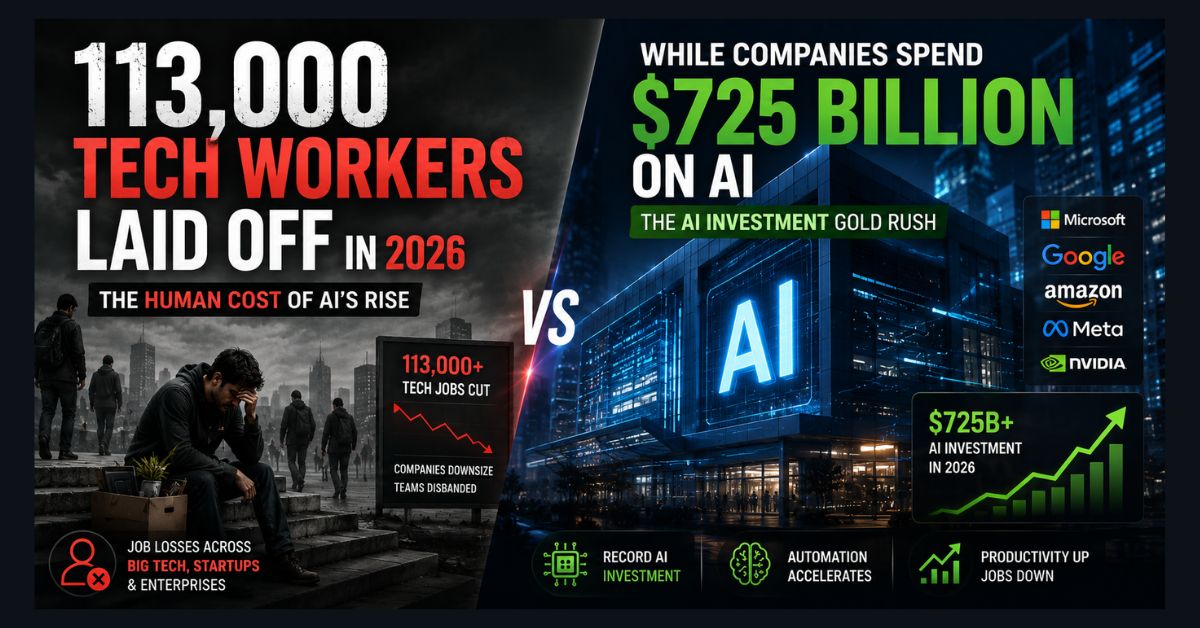
Tech companies have cut roughly 170,500 jobs in 2026, about 832 a day, while committing record sums to AI infrastructure. Around half of layoff announcements name AI as a factor — but that share jumped from 7% in January to 40% by May, which suggests AI is partly a rationale, not only a cause.
Key Takeaways
- Roughly 170,500 tech jobs cut across about 480 layoff events so far in 2026, or around 832 people per day
- Oracle’s roughly 30,000-role reduction is the single largest cut of the year
- Trackers disagree by tens of thousands depending on which sectors and event types they count
- AI was cited in about 40% of May’s cuts, up from 7% in January, per Challenger, Gray & Christmas
- The same companies cutting staff have committed hundreds of billions to AI data centres and chips
How many tech workers have been laid off in 2026?
As of July 26, 2026, tech layoff trackers put the year-to-date total at roughly 170,500 people across about 480 separate layoff events — an average of around 832 job losses every day since January 1. For comparison, the same tracker recorded about 246,000 tech layoffs across the whole of 2025, at a slower daily rate of roughly 674.
So the headline is not that 2026 is the worst year on record. It is that the pace has accelerated even as the industry reports strong revenues. May was the heaviest single month for tech job cuts in years, and the reason companies gave for them shifted noticeably toward AI.
The single largest cut of the year so far is Oracle’s, at roughly 30,000 roles. Meta, Amazon, Microsoft, Alphabet, Intuit, Cisco, and Block have all made significant reductions, many with AI named explicitly in the rationale. We covered one of the larger individual rounds in our report on Meta’s 8,000-job cut.
The pace, however, has stopped accelerating. The same tracker that showed roughly 835 cuts a day in mid-July now records about 832 — a total still climbing, but a daily rate that has flattened for the first time this year. Two of the newest entries also cut against the AI narrative: Amazon is preparing cuts of more than 600 roles at a Florida warehouse it is closing for renovation, with employees offered relocation to other facilities, and Samsung is reported to be trimming some US roles while offering relocations ahead of a headquarters move. Neither is an AI story. Both will be counted in the AI-era layoff totals anyway.
Why do the layoff numbers disagree?
If you check two trackers and get two very different figures, you are not misreading them. One widely cited tracker reports about 170,500 tech workers affected in 2026. Another reports 205,832 as of late July — but that figure spans tech, finance, healthcare, and other industries. A third analysis, counting differently again, lands far lower.
Three things drive the gaps. Trackers differ on which sectors count as tech, on whether they include global or US-only cuts, and on how they treat announcements given only as percentages rather than headcounts — some exclude those entirely from totals. There is also a lag problem: layoffs are usually counted when announced, not when they take effect, and smaller companies often never get counted at all.
The practical takeaway is to read the methodology note before quoting a number, and to treat any single figure as an estimate with a wide margin rather than a census. Anyone presenting one tracker’s total as the definitive count is overstating what the data can support.
Is AI really causing these layoffs?
This is the question the headlines skip, and the honest answer is: partly, but less than the framing suggests.
The strongest evidence for AI as a driver is that companies keep saying so. Roughly half of 2026’s layoff events explicitly cite AI, automation, or machine learning, and outplacement firm Challenger, Gray & Christmas found AI was the most-cited reason during the heaviest month of cuts.
But look at how fast that share moved. Per Challenger’s data, compiled in Computerworld’s 2026 layoff timeline, AI was blamed for about 7% of job cuts in January and roughly 40% by May. Actual AI capability did not improve fivefold in four months. What changed was the explanation. “We are restructuring around AI” is a forward-looking story that investors reward; “we over-hired and demand softened” is not. When a stated reason shifts that quickly while the underlying technology moves incrementally, some of that shift is narrative.
That does not mean AI is irrelevant — it is genuinely absorbing work in support, QA, content production, and routine coding. It means “AI-cited” and “AI-caused” are different measurements, and only the first one is actually being tracked. The debate over how far the displacement really goes is one we explored in our look at the argument over AI and jobs, and the productivity evidence remains genuinely mixed, as we covered in does AI actually make you more productive.
What about the pandemic hiring bubble?
The confound most coverage omits. Many of the teams being cut in 2026 are the same teams that ballooned during the 2021–22 hiring surge, when tech companies expanded headcount aggressively against demand that later normalised.
That matters for interpretation. A company that doubled a division in 2021 and trimmed it in 2026 is partly correcting an old mistake, regardless of what its press release says about AI. The 2023 layoff wave was openly framed as post-pandemic rightsizing; much of the 2026 wave affects similar functions but arrives with a different label attached. Some of the difference is real change in the work. Some of it is the same correction, rebranded.
Are companies really cutting jobs while spending more?
Yes, and this is the genuine paradox at the centre of the story. The largest tech companies have collectively committed hundreds of billions of dollars in capital expenditure this year, the overwhelming majority earmarked for AI data centres, chips, and infrastructure — a sharp increase over 2025 — while simultaneously reducing headcount.
Put bluntly, payroll is being converted into compute. Money that funded salaries is funding GPUs and buildings. That is a deliberate reallocation rather than a company in distress, which is why you see record revenue and mass layoffs announced in the same quarter without contradiction. The scale of that infrastructure bet shows up on the other side of the trade in results like Nvidia’s record AI-driven earnings, and we examine whether the spending is sustainable in the 2026 AI spending reckoning.
The open question is whether it works. Companies that cut deeply on the assumption AI would cover the gap will either be vindicated or will quietly rehire. Both outcomes have precedent, and the answer will not be clear for another year or two.
Will tech layoffs continue in 2026?
The current run rate suggests the year finishes below 2025’s total headcount but above it on daily pace, though forecasting this is genuinely uncertain and anyone offering a confident number is guessing. Three signals are worth watching rather than any single prediction.
Watch whether AI-cited cuts keep rising or plateau — a plateau would suggest the narrative has peaked. Watch for rehiring in cut functions, which is the clearest evidence a company cut too deep. And watch capital expenditure guidance: if AI infrastructure spending slows, the pressure to fund it from payroll slows with it.
What should you do if you work in tech?
Practical steps, not reassurance. Assume the roles most exposed are those built around routine, well-documented, high-volume tasks — first-line support, basic QA, template content, boilerplate code — and move deliberately toward work that requires judgement, context, or accountability that a model cannot carry.
Learn the tools rather than avoiding them, because in the near term the displacement is falling hardest on people who cannot use AI, not on those who can. Keep your network warm before you need it, since the majority of roles at this level are still filled through referrals. And keep your materials current — our guide to using ChatGPT for a job search and resume covers doing that efficiently.
One closing note worth stating plainly, because the numbers in this article are large enough to feel abstract: 170,500 job losses is 170,500 households. If you are in that number, the market is difficult but not closed, and the pace of cuts says more about how these companies are allocating capital right now than about the value of your work.
FAQ
How many tech layoffs have there been in 2026?
Tech layoff trackers put the 2026 year-to-date total at roughly 170,500 people across about 480 layoff events as of July 26, an average of around 832 job losses per day. Totals vary between trackers depending on which sectors and event types each one counts, so treat any single figure as an estimate.
Which company had the biggest layoff in 2026?
Oracle’s reduction of roughly 30,000 roles is the largest single tech layoff recorded in 2026 so far. Meta, Amazon, Microsoft, Alphabet, Intuit, Cisco, and Block have also announced significant cuts during the year, with many explicitly naming AI or automation among the reasons.
Are AI tools actually causing tech layoffs?
Partly. About half of 2026’s layoff events cite AI or automation, but the share of cuts blamed on AI rose from roughly 7% in January to 40% by May, far faster than the technology itself advanced. That suggests AI is functioning partly as a rationale investors reward, alongside pandemic-era over-hiring and broader cost pressure.
Why do different layoff trackers report different numbers?
Trackers differ on which industries count as tech, whether they include global or US-only cuts, and how they handle announcements given as percentages rather than headcounts. Layoffs are also usually counted when announced rather than when they take effect, and smaller companies often go uncounted. Always check the methodology note.
Are tech companies cutting jobs while increasing spending?
Yes. Major tech firms have committed hundreds of billions in capital expenditure in 2026, almost entirely for AI data centres, chips, and infrastructure, while reducing headcount. It is a deliberate reallocation of payroll into compute rather than a sign of financial distress, which is why record revenue and large layoffs can be announced together.