

Quick Answer
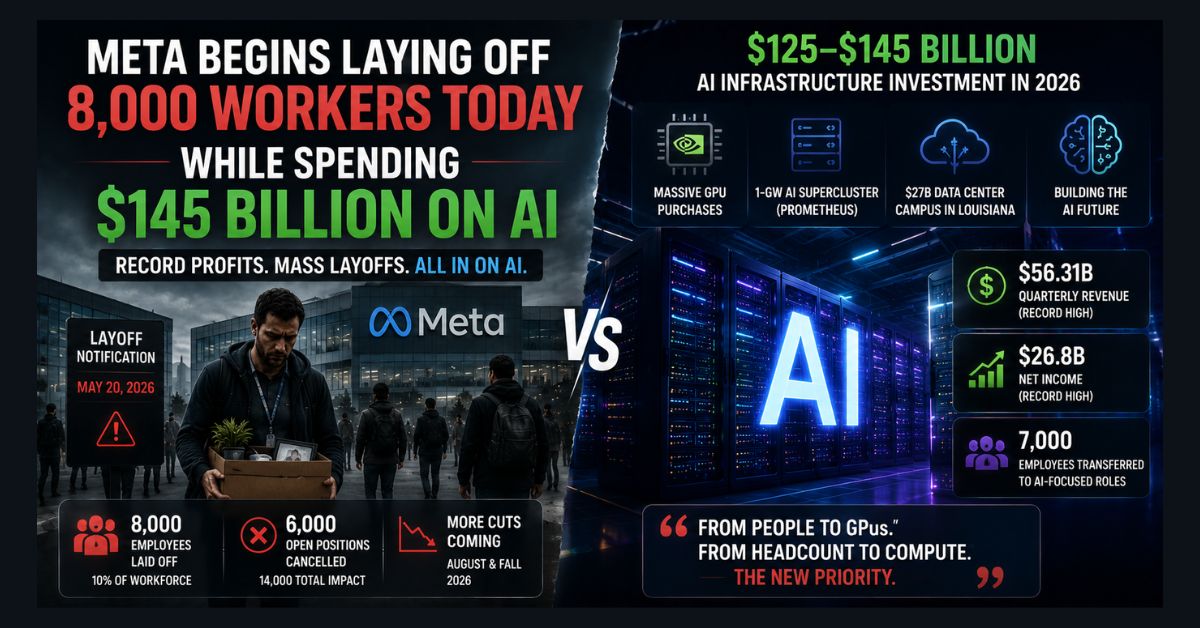
Meta cut about 8,000 jobs on May 20, 2026, roughly 10% of staff, to help fund a $125-145 billion AI buildout. Weeks later Zuckerberg said Meta expects no more company-wide layoffs in 2026 and admitted the restructuring made mistakes, though a targeted 1,400-role Washington cut still followed in July.
Key Takeaways
- Meta laid off about 8,000 people on May 20, 2026, canceled 6,000 open roles, and moved roughly 7,000 staff into new AI teams
- On June 12, Zuckerberg told staff Meta does not expect further company-wide layoffs in 2026 and acknowledged mistakes in the AI restructuring
- A separate, targeted cut of about 1,400 Washington-state roles followed via WARN filings starting July 22
- Meta’s 2026 capital expenditure guidance is $125-145 billion, up from $72.2 billion actually spent in 2025
- The predicted “up to 20% / 16,000” total did not materialize as a company-wide plan after the June reversal
Meta’s May 2026 layoffs were framed at the time as the opening move in a long campaign of cuts. Two months later, that framing needs updating, because the company partly walked it back. This is what actually happened, what Meta said next, and where the AI-spending paradox at the center of the story now stands.
What did Meta’s May 2026 layoffs actually involve?
Meta laid off about 8,000 employees on May 20, 2026, roughly 10% of its global workforce, in its largest company-wide cut since the 2022-23 “Year of Efficiency.” The company also canceled about 6,000 open job requisitions and moved roughly 7,000 remaining employees into new AI-focused teams.
The mechanics were blunt. Notifications went out worldwide starting with Singapore at 4 a.m. local time, North American staff were told to work from home, and Meta confirmed the affected employees had been notified, with California WARN filings documenting specific cuts at Meta’s Burlingame and Sunnyvale offices as part of the wider total. The roughly 7,000 redeployed staff went into groups such as Applied AI Engineering, Agent Transformation Accelerator, and Central Analytics, with new internal role categories like “AI builder” and “AI org lead.” Between the layoffs and the transfers, the reorganization touched close to a fifth of Meta’s workforce.
This was not Meta’s first 2026 cut. The company reduced its Reality Labs division earlier in the year, shutting several VR game studios, and shed about 700 roles across five divisions in March. The May round was different in kind: company-wide, structural, and explicitly built to reorganize Meta around AI.
Did Meta keep cutting jobs after May, as predicted?
Not as a company-wide plan. This is the biggest change since the original reporting, and it runs opposite to what the May framing suggested. On June 12, 2026, Zuckerberg told employees in an internal memo that Meta does not expect further company-wide layoffs in 2026, and he acknowledged the restructuring had made mistakes.
His words were unusually direct for a CEO mid-restructuring. He wrote that given the complexity of the changes, the company had made mistakes and would almost certainly make more, per the internal memo as reported by Reuters. That is a meaningful walk-back from the earlier expectation, reported in May, of additional rounds in August and the fall and a possible total reduction reaching 20% of the workforce. Anyone who read the May coverage as a firm forecast of 16,000 cuts was reading a projection that the company itself then softened.
One important qualifier keeps this honest: “no company-wide layoffs” is not “no cuts anywhere.” Meta filed WARN notices for about 1,400 Washington-state roles across Seattle, Bellevue, and Redmond, with terminations starting July 22, framed as targeted restructuring tied to AI priorities rather than a broad round. So the pace slowed and the framing changed, but the reshaping of specific teams continued.
Why is Meta cutting jobs while spending record sums?
Meta is converting payroll into compute. The company is reducing headcount in some areas while committing far more to AI infrastructure, because the strategy treats salary budgets and GPU budgets as substitutable.
The numbers frame the trade. Meta guides to $125-145 billion in 2026 capital expenditure, a figure it raised twice, against $72.2 billion actually spent in 2025 and $39.2 billion in 2024. The layoffs generate an estimated $7-8 billion in annualized savings, per Bank of America, a fraction of the capex plan but meaningful for the operating margins investors expect. Specific projects include a one-gigawatt AI supercluster in Ohio and a multibillion-dollar data-center joint venture in Louisiana, feeding the Nvidia GPU supply chain that powers Meta’s Llama models. We put this reallocation in context in our look at the 2026 AI spending reckoning and at Nvidia’s record AI-driven earnings.
This article is reporting, not investment advice. Nothing here is a recommendation to buy or sell any security.
How did Meta’s earnings and stock respond to the AI spending?
Investors have been more nervous about the spending than reassured by the revenue. When Meta raised its capex range after Q1 2026, the stock fell more than 6% after hours even though revenue grew strongly, because the market is now scrutinizing whether the AI buildout will earn a return.
Meta’s first-quarter 2026 report, around the time of the layoffs, showed record quarterly revenue in the mid-$50-billion range, but the reaction focused on cost. Free cash flow is under visible pressure as spending moves from the cash-flow statement into the income statement through depreciation and cloud costs. Meta was scheduled to report Q2 2026 results on July 29, 2026, with capex guidance and any detail on a possible cloud business the numbers most likely to move the stock; those results and any guidance change should be read from Meta’s official release rather than pre-earnings estimates. The sustainability of this spending across Big Tech is the through-line in our coverage of Google’s 2026 capex and Tesla’s spending cap.
What was the Meta employee surveillance controversy?
Meta deployed monitoring software on US employee laptops in April 2026 that tracked mouse movements, keystrokes, clicks, and periodic screen captures, using the data to train AI systems that replicate how employees perform digital tasks. Meta said the data would not feed individual performance reviews and included privacy safeguards.
Employees were not reassured. More than 1,000 signed petitions against the program, and the fear stated openly on internal forums was that the company was training its replacement AI on how staff do their jobs, then cutting those staff. Performance reviews began factoring in whether employees use AI tools, which workers described as a “use the tool that replaces you or be first to go” dynamic. Whether that characterization is fair is contested, but the morale effect was real: Meta later raised budgets for team events and planned a company-wide hackathon, and Zuckerberg said the company would scale back the unusually wide management ratios some teams had adopted.
What does Meta’s restructuring mean for tech workers?
Meta’s cuts are one instance of an industry-wide pattern, not an isolated event, so the lesson generalizes: the roles being preserved and created are AI-adjacent. The same record-revenue, high-capex, payroll-funded-cuts pattern has repeated across Big Tech in 2026.
We track the full picture in our 2026 tech layoff analysis, which finds AI cited as a cause far more often than it can be cleanly proven as one. The debate over how far AI displacement really reaches is covered in our look at the argument over AI and jobs, and the mixed productivity evidence in whether AI actually makes you more productive. For workers positioning for the roles that survive, familiarity with AI coding tools and building with AI has moved from optional to expected. The knock-on effects reach students too, as we covered in the computer science enrollment shift.
Will Meta’s AI-first bet actually work?
That is the open question, and it will not resolve for a year or more. Meta’s stated goal is a leaner, AI-first organization where small teams working with AI agents do what large departments once did.
Two outcomes have precedent. Either the bet pays off and Meta emerges more efficient, or it cuts too deep, loses institutional knowledge, and quietly rehires, which several companies in prior cycles have done. Zuckerberg’s June admission of mistakes, and CFO commentary that Meta retains flexibility to adjust future-year spending to align with returns, both suggest the company itself sees the risk. The honest verdict for now is that the reorganization is real, the reversal on further company-wide cuts is real, and the payoff is unproven.
FAQ
How many employees did Meta lay off in 2026?
Meta laid off about 8,000 employees, roughly 10% of its workforce, on May 20, 2026, and canceled about 6,000 open roles. A separate, targeted cut of about 1,400 Washington-state roles followed in July. Around 7,000 other employees were moved into new AI-focused teams rather than laid off.
Did Meta say it would stop laying people off?
Partly. On June 12, 2026, Zuckerberg told staff that Meta does not expect further company-wide layoffs in 2026 and acknowledged mistakes in the restructuring. That wording reflects the company’s expectation rather than a guarantee, and targeted cuts to specific teams, such as the July Washington-state reductions, still occurred afterward.
Why is Meta laying off workers while reporting record profits?
Meta is reallocating payroll savings into AI infrastructure. It guides to $125-145 billion in 2026 capital expenditure for data centers, GPUs, and AI development, up from $72.2 billion in 2025. The layoffs generate an estimated $7-8 billion in annual savings that helps fund that buildout, which is why record revenue and mass layoffs appeared in the same period.
What is Meta’s Model Capability Initiative?
It was monitoring software deployed on US employee laptops in April 2026 that tracked mouse movements, keystrokes, and periodic screen captures, with the data used to train AI to replicate how employees perform digital tasks. Meta said it would not be used for individual performance reviews, but more than 1,000 employees signed petitions protesting it.
How much is Meta spending on AI in 2026?
Meta guides to $125-145 billion in capital expenditure for 2026, a range it raised twice, driven mainly by data centers, GPUs, and AI infrastructure. That is up from $72.2 billion actually spent in 2025 and $39.2 billion in 2024. Investors have focused heavily on whether that spending will earn a return, and the stock has been volatile around capex updates.