

Quick Answer
Nvidia invests in AI startups that then buy its chips, a flywheel that boosts both its revenue and its investment gains. In its most recent reported quarter it deployed $18.6 billion into AI companies. But in March 2026, CEO Jensen Huang signaled a pullback, calling recent OpenAI and Anthropic stakes likely its last big checks.
Key Takeaways
- Nvidia’s strategy funds companies that become Nvidia customers, increasing chip demand as it invests
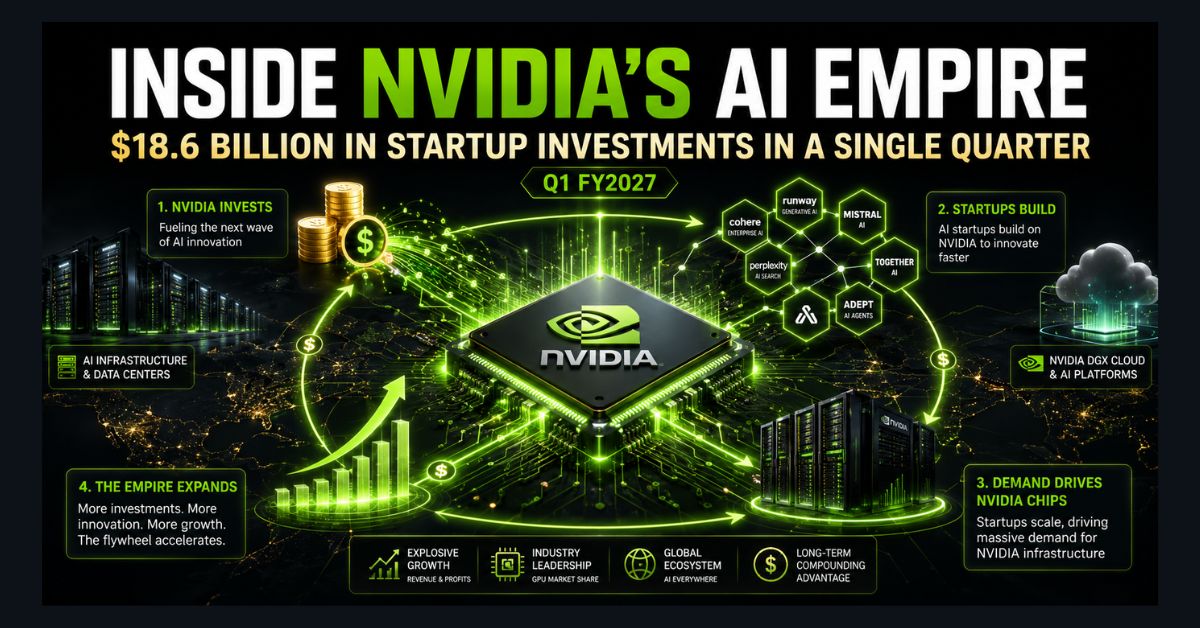
- In Q1 fiscal 2027 (ended April 2026), Nvidia reported $18.6 billion invested in AI companies and $15.9 billion in portfolio gains
- In March 2026, Huang said recent OpenAI ($30B) and Anthropic ($10B) stakes were probably Nvidia’s last major private bets
- The OpenAI commitment was cut from a $100 billion framework to about $30 billion amid circularity and bubble concerns
- Critics call the invest-in-your-own-customers loop a risk; Nvidia frames it as backing the AI buildout
Nvidia doesn’t just sell chips to the AI industry; for the past two years it has been buying pieces of it. But the story has two halves now. The first is the flywheel that made Nvidia both the arms dealer and an investor in the war: fund AI companies, watch them buy your chips, book the revenue and the investment gains. The second, newer half is that Nvidia itself started stepping back from that game in early 2026.
This is how the investment engine works, what the most recent numbers show, and why the company that built the machine has begun easing off it. Figures here are from Nvidia’s reported results and public statements, and this article is reporting, not investment advice.
How does Nvidia’s investment strategy actually work?
Nvidia’s investment strategy funds companies that will become Nvidia customers, so each dollar invested tends to increase demand for Nvidia chips. The logic is circular by design, and Nvidia has described it plainly in its own filings.
The pattern repeats across the AI stack. When Nvidia invests in an AI training company, that company runs on Nvidia GPUs. When it backs a cloud AI provider, that provider fills data centers with Nvidia hardware. When it funds a model lab, that lab’s training runs generate chip orders. Nvidia’s SEC filings acknowledge the loop directly, noting that some investments include AI model makers that may indirectly purchase or use its products in the cloud. That creates a self-reinforcing cycle: investments drive chip demand, which drives revenue, which funds more investments. The debate, covered below, is whether that cycle is a durable flywheel or a warning sign.
How much has Nvidia invested, and what did it earn back?
In its most recent reported quarter, Q1 of fiscal 2027 (the three months ending April 26, 2026), Nvidia reported deploying $18.6 billion into private AI companies and infrastructure funds, and booked $15.9 billion in gains on its existing AI holdings. Those investment figures sat alongside record chip revenue.
The scale is easier to grasp next to the operating numbers. Nvidia reported record Q1 FY2027 revenue of $81.6 billion, up 85% year over year, with data-center revenue of $75.2 billion. The $15.9 billion investment gain meaningfully padded reported net income; without it, operating profit from chip sales alone was still a record, but the portfolio added a large layer on top. Nvidia guided to about $91 billion in revenue for the following quarter, again assuming no China data-center compute revenue. Its Q2 FY2027 results, covering the quarter ending in late July, are expected in late August 2026, so the figures here are the latest reported rather than the latest that will exist. We covered the earnings in detail in our piece on Nvidia’s record AI-driven quarter.
Why is Nvidia pulling back from AI startup investments?
Nvidia signaled a pullback because its two biggest investees, OpenAI and Anthropic, are heading toward IPOs, and because the invest-in-your-own-customer loop drew scrutiny. This is the biggest shift since the original reporting, and it complicates the tidy “empire compounds forever” narrative.
Speaking at a Morgan Stanley conference in March 2026, Huang said Nvidia’s recent stakes in OpenAI and Anthropic would likely be its last major checks to either company. The OpenAI investment tells the story: an original framework of up to $100 billion, announced in September 2025, was finalized at about $30 billion as part of OpenAI’s funding round, a steep reduction. Nvidia’s Anthropic stake, roughly $10 billion committed alongside Microsoft in late 2025, was described as probably its last as well. Huang’s stated reason was that both companies are going public, reducing the chance to invest privately, which ties into the wave of listings we track in our SpaceX, OpenAI, and Anthropic IPO coverage and the OpenAI confidential filing. Reporting suggests internal doubts and concern about deal circularity also played a role. Either way, the direction is a step back toward Nvidia’s core role as the industry’s hardware supplier.
Is the invest-in-your-customers loop a bubble risk?
It’s contested, and the honest answer is that credible people disagree. The same circularity that powers the flywheel is what critics point to as a systemic risk, so the feature and the flaw are the same mechanism viewed from two sides.
The concern has a clear articulation. MIT Sloan professor Michael Cusumano described the arrangement as close to a wash, observing that Nvidia invests billions in a company like OpenAI while OpenAI says it will buy a comparable sum of Nvidia chips. When a supplier funds a customer that uses the money to buy the supplier’s products, both the revenue and the investment returns can look stronger than underlying demand alone would support. Institutional investors and regulators have raised this since late 2025, and Bloomberg has mapped the web of circular deals among Nvidia, OpenAI, Microsoft, and others. It is part of why the OpenAI check shrank. The counter-case is Nvidia’s: it is backing the largest infrastructure buildout in history, the chip demand is real regardless of who funds it, and the investments simply put capital where the growth is. We weigh both sides in our look at the 2026 AI spending reckoning. Readers should treat the bubble question as an open debate with evidence on both sides, not a settled call.
Where does Nvidia’s money actually go?
Nvidia’s portfolio spans every layer of the AI stack, from model labs to the physical infrastructure that powers them. The breadth is the point: it holds positions across the whole supply chain that its chips run through.
- AI model labs: stakes in frontier labs including OpenAI and Anthropic, though Nvidia has now signaled these were likely its last such bets before those companies list.
- Neocloud providers: GPU-rental platforms such as CoreWeave, Nebius, and Nscale, which aggregate large GPU purchases. Nvidia has both invested in and committed to buy capacity from CoreWeave.
- AI infrastructure: optical, cooling, power, and data-center supply-chain companies, including a reported investment in Corning for optical-fiber capacity.
- Semiconductor ecosystem: design tools, testing, and manufacturing capacity that support Nvidia’s own production.
- Vertical AI applications: healthcare, finance, and autonomous-vehicle startups that demonstrate real-world demand for AI compute.
Nvidia’s venture pace rose sharply through 2025 and into 2026 before the signaled slowdown, with its NVentures arm alone making dozens of deals. Much of the record AI capital expenditure committed by Big Tech in 2026 flows through this Nvidia-centric ecosystem, including OpenAI’s multi-gigawatt Nvidia commitments and even proposed orbital data centers.
What is Nvidia’s real moat?
Nvidia’s real moat is CUDA, its proprietary software platform, not the chips themselves. Most AI training code is written for CUDA, and moving off it means rewriting code and retraining models.
That software lock-in is why the investment strategy compounds. Companies that take Nvidia capital tend to standardize on CUDA, and every new startup that builds on it becomes another node that is expensive to migrate away. Switching to AMD’s ROCm or Google’s TPUs is possible but costs months of engineering and significant compute. AMD’s open ROCm stack is the most viable alternative, and hyperscaler custom chips (Google TPU, Amazon Trainium, Meta MTIA) are the bigger long-term threat, but the same customers still use Nvidia GPUs for their most demanding training runs today. The hardware underneath most AI you touch, from the models you use to the coding tools you run, is still very likely Nvidia.
What is the China gap in Nvidia’s empire?
The one major hole is China, where US export controls have cut Nvidia’s data-center revenue to effectively zero, taking its investment leverage with it. No China sales means no CUDA lock-in and no investment relationships in the Chinese market.
China is building a parallel ecosystem around Huawei’s Ascend processors, and if that matures, the global AI market could split into US-aligned and China-aligned camps, as we detail in our US-China chip war coverage. Nvidia’s flywheel works brilliantly in the US-aligned world and has little leverage in the Chinese one. That is a structural limit on the empire that money cannot currently fix, since the constraint is policy, not capital.
What does Nvidia’s position mean for the AI economy?
Nvidia sits at the center of the AI buildout as supplier, investor, and beneficiary at once, which is both its strength and the source of the scrutiny it now faces. The scale is not in dispute; the interpretation is.
Huang frames it as backing the largest infrastructure expansion in history. Critics see a concentration of power and a circular financing structure that could unwind if AI sentiment turns, exposing Nvidia to a double hit of falling chip orders and falling portfolio value at the same time. The signaled pullback from startup equity suggests Nvidia itself is managing that exposure ahead of its investees’ IPOs. What is undeniable is the position: a company that books record chip revenue, record investment gains, and a central stake in nearly every layer of the AI economy it helped build. Whether that is a durable flywheel or a concentrated risk is the question worth watching over the next several quarters.
FAQ
How much has Nvidia invested in AI startups?
In Q1 fiscal 2027 (the quarter ending April 2026), Nvidia reported deploying $18.6 billion into private AI companies and infrastructure funds, alongside $15.9 billion in gains on existing holdings. Its largest single commitments include about $30 billion in OpenAI (reduced from a $100 billion framework) and roughly $10 billion in Anthropic. The next quarter’s figures are expected in late August 2026.
Is Nvidia still investing in OpenAI and Anthropic?
Nvidia has signaled it is stepping back. In March 2026, CEO Jensen Huang said the recent OpenAI and Anthropic stakes were likely Nvidia’s last major private investments in those companies, citing their planned IPOs. The OpenAI commitment was finalized at about $30 billion, well below the up-to-$100 billion framework announced in 2025.
Why does Nvidia invest in companies that buy its chips?
Nvidia acknowledges in SEC filings that some investments include AI model makers that may buy or use its products. The strategy creates a loop: investment drives chip demand, which drives revenue, which funds more investment. Supporters call it backing real growth; critics, including some academics and regulators, warn the circularity can inflate reported results beyond underlying demand.
Is Nvidia bigger than Intel now?
By a wide margin. Nvidia’s most recent reported quarterly revenue of $81.6 billion exceeds Intel’s entire 2025 annual revenue, and Nvidia’s market capitalization reached roughly $5 trillion in mid-2026, making it among the most valuable companies in the world. The two now operate at completely different scales and largely different markets.
What happens to Nvidia if the AI market corrects?
Nvidia would face a double risk: falling chip orders and falling investment-portfolio value at the same time, and its large investment gains could reverse into writedowns. Its substantial free cash flow and buyback capacity provide a cushion, and its signaled pullback from startup equity may reduce that exposure. Whether a correction comes, and how deep, is genuinely uncertain and debated. This is reporting, not investment advice.