

Quick Answer
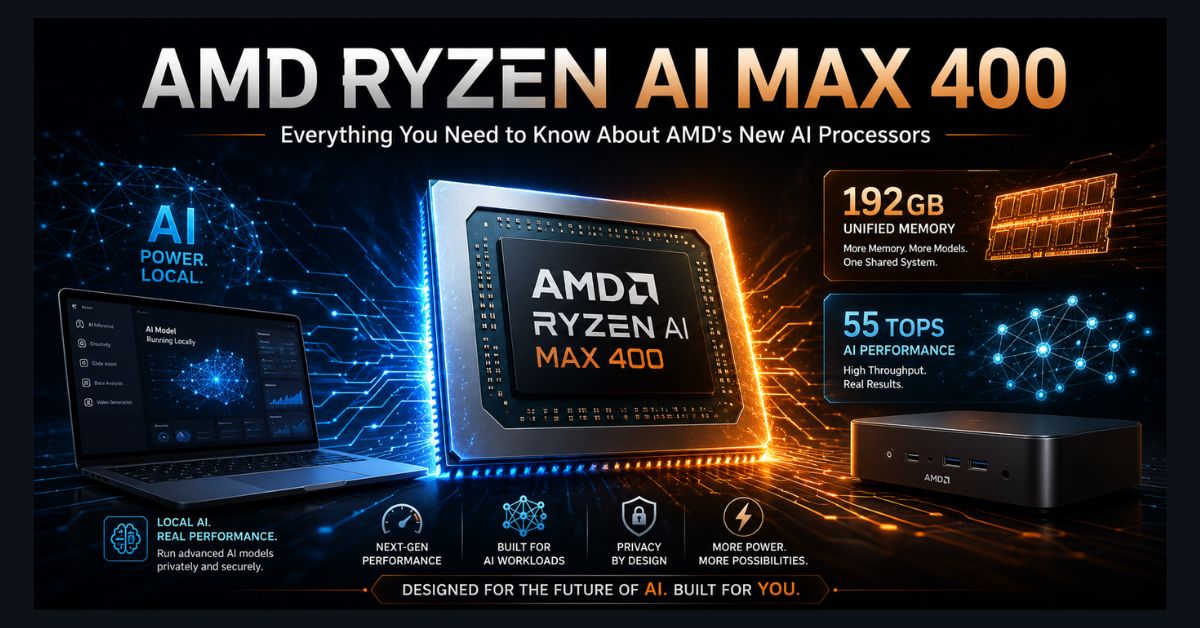
AMD’s Ryzen AI Max 400 “Gorgon Point” is a refresh of its Strix Halo chip that AMD says supports up to 192GB of unified memory and 55 TOPS of NPU performance. Its real edge is memory for running large AI models locally, not NPU speed, where Qualcomm now leads. Broad systems arrive Q3-Q4 2026.
Key Takeaways
- The Ryzen AI Max 400 is a mid-generation refresh of Strix Halo, not a new architecture
- AMD states it supports up to 192GB unified memory with up to 160GB usable as VRAM, up from 128GB before
- The memory capacity is the real story, since it decides how large a model you can run locally
- AMD’s ~55 TOPS NPU does not lead the category; Qualcomm’s Snapdragon X2 Elite is rated far higher
- The global DRAM shortage makes shipping 192GB consistently an open question, and pricing a moving target
AMD has refreshed its most powerful laptop and workstation processors. The Ryzen AI Max 400 series, built on silicon AMD codenames “Gorgon Point,” is a mid-generation update to the Strix Halo chips behind the Ryzen AI Max 300. The headline claim is memory: AMD says the platform supports up to 192GB of unified memory, up from the 128GB ceiling on the previous generation.
That extra capacity is what matters, because for running AI models on your own hardware, memory is usually the limit, not raw speed. AMD frames the chip as a way to run large open-source models locally, without a cloud subscription or an Nvidia GPU server, an alternative to sending data to ChatGPT, Claude, or Gemini. This is what AMD has confirmed, what is still a claim rather than a tested result, what it costs, and the memory-supply catch that hangs over the whole launch.
What is new in the Ryzen AI Max 400?
The Ryzen AI Max 400 is a focused refresh, not a redesign, keeping the same Zen 5 CPU, RDNA 3.5 GPU, and XDNA 2 NPU building blocks as the 300 series. The changes are higher clocks and much more memory, tied to improved silicon rather than new architecture.
These figures come from AMD’s own presentation materials and are not yet independently benchmarked, so treat them as vendor claims. The table compares the two generations as AMD describes them.
| Spec | Ryzen AI Max 300 (Strix Halo) | Ryzen AI Max 400 (Gorgon Point) |
|---|---|---|
| CPU | Up to 16 Zen 5 cores, 5.0 GHz | Up to 16 Zen 5 cores, 5.2 GHz |
| GPU | Up to 40 RDNA 3.5 CUs | Up to 40 RDNA 3.5 CUs, 3.0 GHz |
| NPU (AMD-stated) | 50 TOPS (XDNA 2) | 55 TOPS (XDNA 2) |
| Memory | Up to 128GB LPDDR5X | Up to 192GB LPDDR5X |
| VRAM (shared) | Up to 96GB | Up to 160GB |
| PRO features | No | Yes (vPro-class) |
The flagship is the Ryzen AI Max+ PRO 495: 16 cores, 32 threads, a 5.2 GHz boost, 40 RDNA 3.5 compute units, an AMD-stated 55 TOPS NPU, and support for up to 192GB of unified memory. Below it sit the Max PRO 490 (12 cores, 32 GPU CUs) and the Max PRO 485 (8 cores). The CPU and GPU clock bumps are minor, roughly 100-200 MHz on the top SKU. As Tom’s Hardware noted, you could almost scratch the “4” off the name and write “3” based on the specs alone; the exception is the memory.
Why does 192GB of memory matter for AI?
Memory capacity matters because it sets the ceiling on how large a model you can run locally, and running a bigger model is mostly a question of having enough memory to hold it. AMD’s move from 128GB to 192GB is aimed squarely at that ceiling.
The rough memory needs give the picture: a 70B-parameter model needs roughly 35-40GB, a 200B model needs around 100-120GB, and a 300B-plus model needs about 150-180GB. AMD says the 400 series, with up to 160GB allocatable as VRAM, can run models up to 300B parameters locally, a class that previously needed expensive professional GPUs or a cloud API. That capability claim is AMD’s and awaits independent testing, but the underlying logic, that more unified memory lets you load bigger models, is sound. This appeals to three groups: developers who want to build and test AI locally without per-token cloud costs, privacy-sensitive organizations that can’t send data to external APIs, and researchers or students without cloud budgets. For developers weighing tools, running models locally makes bring-your-own-model options in our AI coding assistants roundup more practical, and open-weight models like those in our Kimi K3 self-hosting guide are the natural fit.
Does the Ryzen AI Max 400 have the fastest NPU?
No. This is where the earlier framing needs correcting: AMD’s roughly 55 TOPS NPU does not lead the 2026 field, because Qualcomm’s Snapdragon X2 Elite is rated much higher. Raw NPU throughput is not where AMD wins.
By mid-2026 the NPU numbers had moved well past where they sat at the start of the year. Independent coverage rates Qualcomm’s Snapdragon X2 Elite Extreme at roughly 80-85 TOPS, AMD’s Ryzen AI 400 at around 55-60 TOPS, and Intel’s Panther Lake (Core Ultra Series 3), which replaced Lunar Lake as Intel’s mainstream AI-PC baseline in January 2026, at about 50 TOPS. Apple stopped publishing a Neural Engine TOPS figure with the M5 generation, so any number quoted for it is an estimate. All of these clear Microsoft’s 40 TOPS Copilot+ requirement comfortably.
Two honest caveats matter here. TOPS figures are not standardized, since vendors measure at different math precisions and some quote a combined CPU-plus-GPU-plus-NPU “platform” figure that inflates the headline. And for actually running local AI models, analysts widely note that memory capacity and bandwidth decide performance more than the NPU TOPS number does. That is precisely why AMD’s memory advantage, not its NPU, is the real selling point, though Qualcomm’s X2 Elite now also reaches 128GB, narrowing the gap.
What is the Ryzen AI Halo mini PC, and what does it cost?
The Ryzen AI Halo is AMD’s own mini PC for local AI development, and it is the first system you can actually buy in this family. The current model uses the previous-generation Ryzen AI Max+ 395 with 128GB of memory, and a 192GB version with the newer 495 chip is planned for later in 2026.
The specifics, as AMD and its retail partner have stated them: the current Ryzen AI Halo starts at $3,999 in the US, ships with 128GB of LPDDR5X memory and a 2TB SSD, and is a Micro Center retail exclusive that reached stores around July 10, 2026 after opening for pre-order. It comes pre-configured with AMD’s ROCm software stack for AI inference and runs Windows 11 or Linux, positioned as AMD’s answer to Nvidia’s DGX Spark. The upgraded configuration with the Ryzen AI Max+ PRO 495 and 192GB is described as “coming soon” rather than shipping. Pricing is US-stated and pre-launch for the newer model, so confirm current figures before buying, especially given the memory-cost pressure described below.
When can you actually buy a Ryzen AI Max 400 laptop?
Broadly, not yet. AMD says systems from OEM partners will be announced starting in Q3 2026, and some reporting points to actual availability slipping toward Q4 2026. As of late July 2026, the AMD-built Ryzen AI Halo is the only confirmed machine.
The rollout looks likely to be conservative, the way the previous Strix Halo generation was: that chip appeared in only a handful of machines, such as the Framework Desktop, the ASUS ROG Flow Z13, and a GMKtec mini PC. AMD has said several partners are interested but has not named laptop models or firm dates for Gorgon Point systems. If you are shopping now, that means the practical choice today is the Ryzen AI Halo mini PC, not a laptop. For most buyers, the mainstream Ryzen AI 300 series in ordinary laptops remains the sensible pick, as we cover in our budget laptop guide; the Max 400 is a professional and developer part, not a consumer one.
How does the memory shortage affect this launch?
The global DRAM shortage is the catch that hangs over the whole product, because a chip whose main selling point is 192GB of memory is uniquely exposed when memory is scarce and expensive. This is the single biggest practical caveat, and the original coverage did not flag it.
Multiple hardware outlets have noted that shipping 192GB configurations consistently may be difficult while DRAM prices climb across the industry. Apple has reportedly pulled its highest-memory Mac Studio options in the same environment, which shows the pressure is real and affects even the largest vendors. For a buyer, that means both availability and price on the 192GB models are genuinely uncertain, and the memory that makes this chip interesting is also the component most likely to be constrained or costly. We cover the wider squeeze in our pieces on the memory shortage pushing device prices up and whether to buy a laptop now given RAM prices.
Where does AMD fit against Nvidia and the others?
AMD is targeting local AI compute for professionals and developers, a different market from the data center Nvidia dominates. It is not trying to beat Nvidia in the cloud; it is aiming at the on-device edge.
The strategy is coherent. Nvidia’s data center position is self-reinforcing through CUDA lock-in and its scale, documented in our coverage of Nvidia’s record earnings, and AMD cannot win that fight head-on. But the market for local AI inference, driven by privacy, latency, and cost, is growing and structurally different. There is also a trade angle: while Nvidia’s China data center sales collapsed under export controls, and AMD faces similar limits on its MI308 data center chips, AMD’s consumer and professional processors like Ryzen AI Max are not subject to the same restrictions. The NPU upgrade also clears Microsoft’s 40 TOPS Copilot+ bar with headroom, which matters for Windows 12 AI features whenever that ships. If you would rather optimize the machine you have than buy new, our laptop speed guide covers that.
FAQ
What is “Gorgon Point”?
Gorgon Point is AMD’s codename for the silicon behind the Ryzen AI Max 400 series, a mid-generation refresh of the Strix Halo (Ryzen AI Max 300) chip. It keeps the same Zen 5 CPU, RDNA 3.5 GPU, and XDNA 2 NPU design, adding higher clock speeds and support for up to 192GB of unified memory. AMD’s marketing has used “Gorgon Halo” for the Halo-class variant.
When can I buy a Ryzen AI Max 400 system?
The AMD Ryzen AI Halo mini PC, in its current 128GB Ryzen AI Max+ 395 form, reached stores around July 10, 2026 as a Micro Center exclusive starting at $3,999. OEM laptops and workstations with Ryzen AI Max PRO 400 chips are expected to be announced starting Q3 2026, with some reporting suggesting availability may extend into Q4 2026. As of late July 2026, few systems are confirmed.
Does AMD’s Ryzen AI Max 400 have the fastest NPU?
No. AMD’s stated 55 TOPS NPU trails Qualcomm’s Snapdragon X2 Elite, rated around 80-85 TOPS in independent coverage, and is closer to Intel’s Panther Lake at about 50 TOPS. All clear Microsoft’s 40 TOPS Copilot+ bar. AMD’s real advantage is memory capacity for running large models locally, not raw NPU throughput, and analysts note TOPS matters less than memory for local AI anyway.
Can I run ChatGPT or Claude locally on AMD hardware?
Not those specific services, which are cloud-only. You can run comparable open-weight models locally on Ryzen AI Max 400 hardware with enough memory, such as large Llama, Mistral, or DeepSeek variants. The experience is similar for many tasks but without internet dependency or per-token costs. See our guides to DeepSeek and free ChatGPT alternatives for model options.
Is the Ryzen AI Halo worth $3,999?
For developers or researchers who currently pay for cloud AI inference, which can run $100-1,000 or more per month at heavy use, a local workstation can pay for itself over many months. For casual AI users, it is overkill, and an ordinary laptop plus a $20/month AI subscription is far more cost-effective. This is a specialist tool, not a mainstream purchase.