

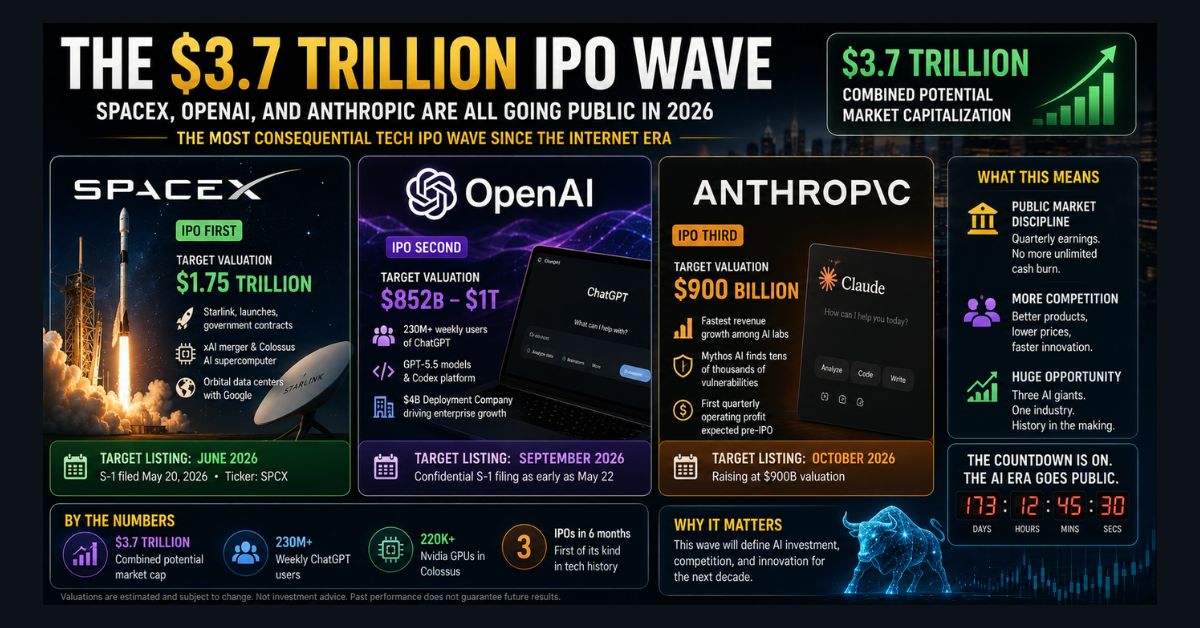
The 2026 AI IPO wave refers to SpaceX, OpenAI, and Anthropic going public within months of each other, a combined market value near $3.6 trillion. SpaceX listed on the Nasdaq on June 12 (~$1.75T), while OpenAI (~$852B–$1T) and Anthropic (~$965B) filed confidentially in early June.
- SpaceX: Listed June 12, 2026 on Nasdaq (SPCX) at ~$1.75T — the largest IPO in history
- OpenAI: Filed confidentially on June 8; ~$852B–$1T valuation target
- Anthropic: Filed confidentially on June 1; ~$965B valuation
- Combined value: ~$3.6 trillion — the biggest tech IPO wave since the dot-com era
- Why it matters: AI shifts from VC-funded experiment to public markets with quarterly scrutiny
Within the next six months, the three companies most responsible for the AI revolution will all go public. SpaceX filed its S-1 on May 20. OpenAI is filing its confidential S-1 with the SEC as early as today (May 22). Anthropic is targeting October. Combined, these three listings could represent $3.7 trillion in market capitalization — making this the most consequential wave of tech IPOs since the internet era.
This isn’t just three companies going public. It’s the moment the AI industry transitions from a venture-capital funded experiment into a publicly traded sector with quarterly earnings obligations, public scrutiny, and institutional investor expectations. How the market prices these companies will determine AI investment for a decade.
The Timeline: Who Goes First and Why It Matters
The sequencing is deliberate and strategic.
SpaceX — June 2026
SpaceX filed its public S-1 on May 20 and is targeting a Nasdaq listing under ticker SPCX, with pricing expected as early as June 11-12. The anticipated valuation is $1.75 trillion, potentially making it the largest technology IPO in history.
SpaceX goes first for a reason: it sets the market-clearing valuation for AI-adjacent infrastructure. SpaceX isn’t just a rocket company anymore. After merging with xAI in February 2026, the company encompasses Starlink (satellite internet), SpaceXAI (the merged AI division, formerly xAI), the Colossus data center (220,000+ Nvidia GPUs), and the emerging orbital data center partnership with Google. The IPO gives investors a reference point for how to price the intersection of launch infrastructure and AI compute.
OpenAI — September 2026
OpenAI is moving toward a September listing at a targeted valuation of $852 billion to $1 trillion, with OpenAI’s confidential IPO filing marking the formal start of that process. At the upper end, this would be the largest technology public offering in history, surpassing even SpaceX.
OpenAI’s pitch to investors centers on ChatGPT’s 230+ million weekly users, the GPT-5.5 model family that powers an expanding product ecosystem, the recently launched $4 billion Deployment Company targeting enterprise revenue, Codex (the cloud-based coding agent), and API revenue that has grown rapidly as businesses integrate AI into operations.
The company raised $40 billion from SoftBank in early 2026, giving it a war chest that reduces the urgency of the IPO — this is about market presence and liquidity for existing investors, not survival capital.
Anthropic — October 2026
Anthropic, the maker of Claude, is raising at a $900 billion valuation and targeting an October listing. Anthropic goes last strategically because it can position itself using SpaceX and OpenAI as reference points.
Anthropic’s pitch is differentiated: superior revenue growth rate compared to OpenAI, its first quarterly operating profit (expected before the listing), and a valuation discount to OpenAI on a forward revenue multiple. The company’s Mythos model — the cybersecurity AI that found tens of thousands of software vulnerabilities — demonstrates enterprise value that goes beyond chatbots. Claude’s strength in professional coding and enterprise deployment gives it a distinct market position from OpenAI’s consumer-first approach.
Coinbase prediction market data shows an 85% probability that OpenAI lists before Anthropic, confirming the expected sequence.
The Revenue Question
All three companies face the same investor scrutiny: are AI revenues real and sustainable, or are they venture-subsidized experiments that can’t survive public market discipline?
- SpaceX has the most diversified revenue: Starlink subscriptions (profitable and growing), government launch contracts (steady), and emerging AI infrastructure revenue from compute services. The xAI merger adds AI revenue but also AI costs — the Colossus data center is expensive to operate.
- OpenAI has grown revenue rapidly — estimates suggest annualized revenue approaching $10-15 billion by mid-2026. But costs are enormous: running GPT-5.5 across hundreds of millions of users requires massive Nvidia GPU infrastructure (OpenAI committed to 10+ gigawatts of Nvidia systems). The path to sustained profitability is unclear, and the company has historically operated at significant losses.
- Anthropic has the clearest near-term profitability story. Its enterprise focus commands higher per-customer revenue, Claude’s efficiency advantages reduce compute costs per query, and the company’s deliberately smaller user base means less infrastructure burden than OpenAI’s 230M+ weekly users. If Anthropic reports its first operating profit before the IPO, it becomes the only AI frontier company to demonstrate sustainable unit economics.
What Google’s Response Tells You
Google is conspicuously absent from this IPO wave — because it’s already public. But its actions tell you how seriously it takes the competitive threat. At Google I/O this week, Google announced Gemini 3.5 Flash (4x faster than competitors), Gemini Spark (a persistent AI agent), and a $100/month AI Ultra subscription that undercuts both OpenAI Pro ($200/month) and positions against Claude Max.
Google is not the only deep-pocketed incumbent responding to the IPO wave: Amazon founder Jeff Bezos is also pushing into frontier AI through Bezos’s Project Prometheus, adding another potential rival for investor attention, talent, and enterprise customers.
Google is the incumbent that these three IPO companies are trying to unseat. Its response — aggressive pricing, ecosystem integration, and a $725 billion industry-wide capex wave — suggests it views the IPO companies as genuine threats rather than passing hype.
What This Means for Different Audiences
- For retail investors: These IPOs will generate enormous attention and demand. SpaceX in particular has been one of the most anticipated public offerings of the decade — retail investors who’ve never had access to SpaceX equity will flood the listing. The risk is paying inflated first-day premiums. Historical data shows that mega-IPOs often trade below their first-day closing price within 6-12 months as institutional lock-up periods expire and insider selling begins.
- For the AI industry: Public market discipline changes everything. Quarterly earnings calls mean these companies can no longer burn cash freely. R&D timelines will face shareholder scrutiny. Model releases may be timed to boost quarterly numbers rather than purely for capability reasons. The “move fast and break things” era of AI development may give way to “move carefully and hit revenue targets.”
- For existing AI users: Competition is good. Three publicly traded frontier AI companies (plus Google) competing for users and enterprise customers means better products, lower prices, and faster innovation. The competitive dynamics between Claude, ChatGPT, and Gemini will intensify as each company fights for market share with public market investors watching.
- For tech workers: The IPOs create wealth for early employees and provide growth capital for hiring. But they also intensify the pressure to demonstrate ROI on every dollar spent — including salaries. The 2026 tech layoff wave may accelerate as public market pressure meets AI automation capabilities.
The Bigger Picture
We’ve never seen anything quite like this moment in technology history. Three private AI companies — each valued at close to or above $1 trillion — going public within six months of each other. The last comparable wave was 2004-2006, when Google’s IPO set off a series of Web 2.0 listings that defined the social media era. This wave will define the AI era.
The combined $3.7 trillion in potential market capitalization exceeds the GDP of most countries. It signals that the market believes AI isn’t a bubble — it’s the next fundamental layer of the economy, comparable to electricity, the internet, or mobile computing.
Whether that bet pays off depends on whether these companies can convert research breakthroughs and user growth into sustainable revenue. SpaceX has the most diversified business case. OpenAI has the largest consumer base. Anthropic has the clearest path to profitability. All three will be tested by public market scrutiny in ways they’ve never experienced before.
The countdown starts today with OpenAI’s confidential filing. By October, all three will be public — and the AI industry will never be the same.
FAQ
1. When is the SpaceX IPO?
SpaceX filed its public S-1 on May 20, 2026, targeting a Nasdaq listing under ticker SPCX. Pricing could happen as early as June 11-12, with the listing expected in late June 2026. The anticipated valuation is approximately $1.75 trillion.
2. When is the OpenAI IPO?
OpenAI is filing a confidential S-1 with the SEC as early as May 22, 2026, targeting a public listing in September 2026. The expected valuation range is $852 billion to $1 trillion. The confidential filing means financial details won’t be public until approximately 15 days before the roadshow.
3. When is the Anthropic IPO?
Anthropic is targeting an October 2026 listing, raising at approximately $900 billion valuation. The company has engaged investment banks and is expected to file after both SpaceX and OpenAI have listed, using their valuations as reference points.
4. Can retail investors buy these IPOs on day one?
Typically, IPO shares are allocated to institutional investors first. Retail investors can usually buy shares once trading begins on the exchange, but often at prices above the IPO price. All three companies will list on major exchanges (likely Nasdaq or NYSE), making shares accessible through any standard brokerage account once trading opens.
5. Will these IPOs affect ChatGPT and Claude pricing?
Possibly. Public market pressure to demonstrate revenue growth could push OpenAI and Anthropic to increase prices or reduce free-tier access. Conversely, competitive pressure among three publicly traded AI companies (plus Google) could keep prices in check. Google’s aggressive $100/month AI Ultra pricing at I/O suggests prices may actually decline as competition intensifies.
6. Is this an AI bubble?
The combined $3.7 trillion valuation demands extraordinary revenue growth to justify. SpaceX has diversified revenue streams that support its valuation. OpenAI and Anthropic’s valuations require continued rapid revenue growth and eventual profitability — neither has demonstrated sustained profits yet. Historically, mega-IPO waves (2000, 2021) have preceded corrections. Whether AI valuations are justified depends on whether these companies can convert user growth and enterprise adoption into sustainable cash flows.