

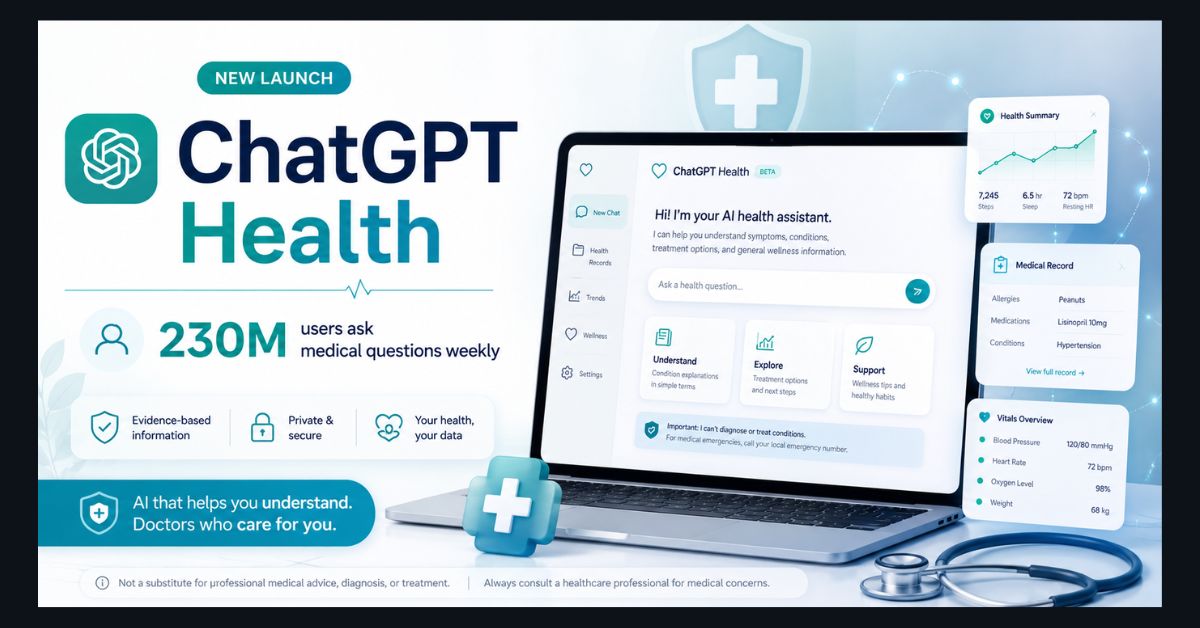
OpenAI has launched ChatGPT Health, a dedicated space inside ChatGPT for medical and wellness conversations that can connect to your actual health data. The move follows OpenAI’s disclosure that more than 230 million people ask the chatbot health-related questions every week — over 40 million per day, or roughly 5% of all messages on the platform. It’s a clear signal that AI has quietly become a primary health-information source for hundreds of millions of people.
Announced on January 7, 2026, ChatGPT Health is rolling out in stages and represents one of OpenAI’s biggest consumer bets of the year. Here’s exactly what it does, who can use it, and the real privacy tradeoffs you should weigh before connecting your medical records to a chatbot.
What is ChatGPT Health and how does it work?
ChatGPT Health is a separate, sandboxed tab within ChatGPT — not a standalone app — with its own chat history and “memories” kept apart from your regular conversations. The siloing is deliberate: the context of your health questions won’t bleed into everyday chats, and if you start a health-related conversation outside the Health space, ChatGPT nudges you to move it there.
The headline feature is data connection. Once onboarded, you can optionally link:
Medical records, via a partnership with the platform b.well, which aggregates records from roughly 2.2 million U.S. healthcare providers. Apple Health on iOS. Wellness and lifestyle apps including MyFitnessPal, Weight Watchers, Peloton, AllTrails, Instacart, and the testing platform Function. You can also upload files such as lab results or visit summaries directly.
With that data connected, a typical session feels less like a frantic Google search and more like a guided check-in: ChatGPT can summarize lab results, explain medical jargon, suggest questions to ask before a doctor’s visit, flag possible next steps, and offer nutrition or activity context grounded in your own numbers. OpenAI says the system was built in collaboration with more than 260 physicians across 60 countries to shape how it answers and when it escalates you toward professional care.
Who can actually use ChatGPT Health right now?
Access is staged. OpenAI started with a limited group of early users through a waitlist, with plans to expand to all web and iOS users “in the coming weeks.” Android support is planned for later.
There are important geographic limits. ChatGPT Health is available to Free, Go, Plus, and Pro users outside the European Economic Area, Switzerland, and the U.K., where stricter health and data regulations apply. Medical-record integrations and some connected apps are U.S.-only at launch. So while the announcement is global news, the full experience is, for now, largely an American product.
How does OpenAI handle the privacy of your health data?
This is the part that deserves the most scrutiny, because you’d be handing a chatbot some of your most sensitive information. OpenAI says ChatGPT Health adds layered protections on top of ChatGPT’s standard controls, including purpose-built encryption and isolation to keep health conversations compartmentalized. Critically, the company states that Health chats, files, and memories are not used to train its foundation models.
But there are caveats worth understanding. The consumer version of ChatGPT Health is not a clinical system governed by healthcare-specific regulations like HIPAA — that framework applies to OpenAI’s separate enterprise offering (more on that below), not the consumer tab. And like other consumer tech, Health data can still be subject to valid legal requests. Independent coverage, including a pointed piece in TIME asking whether uploading your records is wise, has flagged that convenience and data exposure are two sides of the same coin.
If you’re weighing this, treat it the way you’d treat any major data-sharing decision. Our guides to data privacy and data privacy management software are useful background for deciding how much of your personal information you’re comfortable centralizing in any single platform.
What is “OpenAI for Healthcare” and how is it different?
The day after the consumer launch, OpenAI introduced OpenAI for Healthcare, a separate set of products aimed at healthcare organizations — including ChatGPT for Healthcare, which is designed to support HIPAA compliance. OpenAI said this enterprise tier is already rolling out to major institutions including AdventHealth, Baylor Scott & White Health, Boston Children’s Hospital, Cedars-Sinai, HCA Healthcare, Memorial Sloan Kettering, Stanford Medicine Children’s Health, and UCSF.
The distinction matters: the institutional product carries the formal healthcare-data protections, while the consumer Health tab is a wellness and information tool. Don’t confuse the two.
Why is OpenAI pushing into health now?
Two reasons: usage and strategy. Health is already one of ChatGPT’s most common use cases, so OpenAI is formalizing behavior that’s happening anyway — and trying to make it safer in the process. Fidji Simo, OpenAI’s CEO of Applications, framed Health as a step toward turning ChatGPT into a “personal super-assistant” spanning every part of your life.
Strategically, healthcare is one of the biggest addressable markets in tech, and rivals are circling the same opportunity — Anthropic, for instance, has leaned on its constitutional-AI approach and long context windows as a different path to the same goal. The competitive dynamics are part of the broader assistant race we cover in our Claude vs ChatGPT vs Gemini comparison, and they fit OpenAI’s wider commercialization drive, including its $4 billion deployment company.
Should you trust ChatGPT with medical questions?
Used carefully, ChatGPT Health can be a genuinely useful tool for understanding terminology, preparing for appointments, and making sense of your own data. OpenAI says it’s tuned for more conservative behavior on sensitive topics, better detection of emergencies, reduced speculation, and clearer disclaimers — and it explicitly positions itself as a support tool, not a replacement for a clinician.
That said, AI still gets things wrong, and health is the worst place for a confident-sounding error. Treat its answers as a starting point for a conversation with a real professional, not a diagnosis. The stakes around AI reliability and accountability are exactly why companies face mounting legal scrutiny — as seen in cases like Florida’s suit against OpenAI — and why the risks of over-relying on emotionally persuasive AI, covered in our piece on the GPT-4o retirement backlash, apply doubly to health. If the chatbot itself is acting up, our guide to fixing ChatGPT’s “something went wrong” error covers the common technical hiccups, and our overview of OpenAI’s latest models explains what’s powering the responses under the hood.
FAQ
1. What is ChatGPT Health?
ChatGPT Health is a dedicated, sandboxed space within ChatGPT for medical and wellness conversations. It keeps health chats separate from regular ones and lets users optionally connect medical records, Apple Health, and wellness apps to get responses grounded in their own data, such as lab-result summaries and questions to ask their doctor.
2. Is ChatGPT Health free?
ChatGPT Health is available to users on Free, Go, Plus, and Pro plans, though access is being rolled out gradually through a waitlist. It is not offered in the European Economic Area, Switzerland, or the U.K., and medical-record integrations are currently U.S.-only.
3. Is it safe to give ChatGPT my medical records?
OpenAI says Health data gets layered protections, including dedicated encryption and isolation, and that health chats are not used to train its models. However, the consumer version is not a HIPAA-governed clinical system, and data can still be subject to legal requests, so users should weigh the convenience against the sensitivity of the information.
4. Can ChatGPT Health replace a doctor?
No. OpenAI positions ChatGPT Health as an educational support tool, not a substitute for professional care. It is designed to avoid making diagnoses or treatment decisions and to direct users toward a clinician for anything serious or urgent.
5. How is ChatGPT Health different from OpenAI for Healthcare?
ChatGPT Health is a consumer wellness tool, while OpenAI for Healthcare (including ChatGPT for Healthcare) is a separate enterprise product for hospitals and health systems that is built to support HIPAA compliance. The institutional version carries the formal healthcare-data protections; the consumer tab does not.