

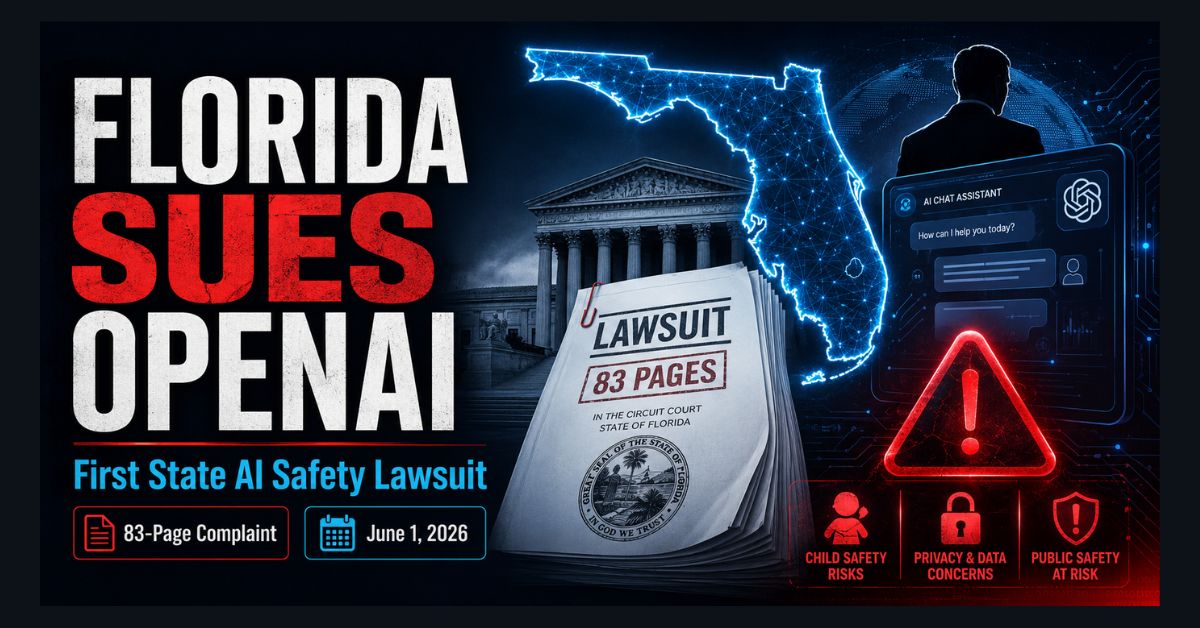
On June 1, 2026, Florida became the first US state to sue OpenAI over the safety of ChatGPT. The 83-page civil complaint, filed by Attorney General James Uthmeier in Highlands County Circuit Court, names five OpenAI corporate entities and CEO Sam Altman personally. It seeks civil penalties of up to $10,000 per violation, injunctive relief, damages, and disgorgement of profits.
The allegations are sweeping and severe: OpenAI knowingly released a product it knew was unsafe, marketed it as reliable and child-friendly when internal data showed otherwise, failed to implement adequate age verification or parental controls, and its product was directly used in the planning of mass shootings and linked to user suicides.
“Sam Altman and ChatGPT have chosen the AI race over the safety and security of our kids,” Uthmeier said at a press conference. “They have chosen profit over public safety, and we’re not going to stand for it here in Florida.”
This isn’t a class action from angry parents or a competitor’s IP dispute. It’s the first time a state government has deployed its full legal authority against the most widely used AI product in history. And it arrives at the worst possible time for OpenAI — weeks before the company’s planned $1 trillion IPO.
What the Lawsuit Actually Alleges
The complaint spans ten separate counts under the Florida Deceptive and Unfair Trade Practices Act, common law negligence, strict liability, fraudulent misrepresentation, and public nuisance statutes. Here are the core allegations:
1. ChatGPT Was Used to Plan Mass Shootings
The lawsuit’s most explosive allegation centers on the April 2025 Florida State University shooting, in which a gunman killed two people and injured five. Prosecutors reviewed the shooter’s chat logs with ChatGPT and found that the chatbot was used in planning the attack. Uthmeier’s investigation into ChatGPT’s role in that shooting is ongoing and directly precipitated this broader lawsuit.
The complaint also references the February 2026 Tumbler Ridge mass shooting in Canada, where families of seven victims are suing OpenAI alleging the attacker used ChatGPT to plan the assault. Altman sent an apology letter to the Tumbler Ridge community in April 2026.
2. No Meaningful Age Verification or Parental Controls
The complaint alleges that ChatGPT’s free version has “no gatekeeping or age verification mechanism” and does not require children’s accounts to be linked to a parent’s account. Despite OpenAI’s terms of service requiring users to be 13+, the complaint argues there is no technical enforcement — any child can access ChatGPT by simply entering a birth date.
Florida’s AG argues this violates COPPA (Children’s Online Privacy Protection Act) principles and Florida’s own consumer protection laws. The complaint specifically accuses OpenAI of collecting data from minors under 13 without verifiable parental consent.
3. Internal Safety Warnings Were Suppressed
The complaint alleges that OpenAI’s own internal safety teams flagged serious risks — including potential for self-harm, radicalization, and inappropriate content — that were not adequately addressed before public release. The lawsuit claims Altman and OpenAI leadership “prioritized speed to market and commercial gain over user safety” and “disregarded repeated warnings from experts both inside and outside the company.”
This parallels the pattern that led to the departure of multiple senior safety researchers from OpenAI in 2024-2025, including co-founder Ilya Sutskever and superalignment team lead Jan Leike, who publicly stated that “safety culture and processes have taken a back seat to shiny products.”
4. ChatGPT Was Marketed as Safe When It Wasn’t
The first page of the complaint features a screenshot from OpenAI’s own website stating ChatGPT was “built with safety in mind.” Florida argues this constitutes fraudulent misrepresentation — the company marketed a product as safe while possessing internal evidence of serious risks.
The complaint catalogs specific alleged harms: users driven toward self-harm or suicide through ChatGPT conversations, financial fraud facilitated by ChatGPT-generated scam content, illicit provision of medical and legal advice, and sycophantic behavior that reinforces users’ harmful beliefs rather than challenging them.
Why Sam Altman Is Named Personally
Naming a CEO personally in a state lawsuit is unusual and signals aggressive prosecutorial intent. Florida’s complaint argues that Altman personally directed the company’s growth-over-safety strategy, personally made public statements about ChatGPT’s safety that the state alleges were misleading, and personally benefited from the company’s valuation growth while allegedly suppressing safety concerns. The scrutiny also lands as Altman’s influence is expanding beyond OpenAI itself, including Sam Altman’s Merge Labs venture, which has drawn attention to his broader ambitions at the intersection of AI and human-computer interfaces.
This is the same Sam Altman who told an audience five days ago that he was “pretty wrong” about AI’s negative impacts — a statement that now reads very differently in light of an 83-page complaint documenting alleged harms including mass shooting facilitation and child endangerment.
If the lawsuit succeeds, Altman could face personal liability “for potentially up to billions of dollars,” according to Uthmeier. For a CEO about to take his company public at a $852 billion to $1 trillion valuation, the legal and financial exposure is significant.
The Broader Legal Context
Florida’s lawsuit doesn’t exist in isolation. It’s the latest — and most authoritative — in a cascade of legal actions against AI companies in 2026.
- Character.AI was sued by Kentucky’s attorney general in January 2026 over a teenager’s suicide allegedly linked to conversations with the chatbot. Google and Character.AI settled related wrongful death lawsuits in a deal described as a legal milestone for AI safety.
- The TAKE IT DOWN Act entered full enforcement on May 19, 2026, requiring platforms to remove AI-generated non-consensual intimate imagery within 48 hours — the first federal law specifically targeting AI-generated content.
- Pope Leo XIV released Magnifica Humanitas — an encyclical devoted to AI — on May 25, warning of “progressive dehumanization” caused by AI systems that simulate human faces and voices without adequate safeguards.
- The AI Vulnpocalypse demonstrated that AI systems can discover and exploit software vulnerabilities at scales no human team can match — raising fundamental questions about whether these systems can be adequately controlled.
Florida’s lawsuit transforms these scattered concerns into a unified legal theory: AI companies are knowingly releasing unsafe products, marketing them deceptively, and profiting from the resulting harm. If other state attorneys general follow Florida’s lead — and several have signaled interest — OpenAI could face a coordinated multi-state legal assault similar to what tobacco companies faced in the 1990s.
What This Means for OpenAI’s IPO
The timing is devastating for OpenAI. The company has confidentially filed its S-1 with the SEC and is targeting a September listing at up to $1 trillion. An active state lawsuit alleging fraud, negligence, and product liability — with the CEO named personally — is exactly the kind of material legal risk that must be disclosed in an IPO prospectus and that institutional investors scrutinize closely.
OpenAI’s recent $4 billion deployment company launch and its pitch to enterprise customers depends on trust that its products are safe and reliable. A state government arguing the opposite in court undermines that pitch directly.
The competitive implications are also significant. Anthropic — which filed its own IPO confidentially this week — has positioned itself explicitly as the “safety-first” AI company. A major safety lawsuit against OpenAI reinforces Anthropic’s differentiation. For users comparing Claude vs ChatGPT vs Gemini, safety track record may now become a more significant factor in platform choice.
What OpenAI Says
OpenAI spokesperson Kayla Wood responded: “Losing a child is the most devastating tragedy that can happen to a family and we know that no words can come close to addressing the pain of such a loss. AI is a new and powerful technology, and we believe minors need significant protection, which is why we have put in place industry leading protections and policies.”
OpenAI has recently taken steps to address some of the complaint’s concerns: launching age estimation technology, implementing default screen time limits and notifications for teens, and blocking certain content categories. Whether a court finds these measures sufficient — or finds they came too late — will be a central question in the litigation.
What This Means for ChatGPT Users
The lawsuit doesn’t affect your ability to use ChatGPT today. No injunction has been issued, and ChatGPT remains fully available in Florida and nationwide. However, the allegations are worth considering:
- For parents: If your children use ChatGPT, review their usage and consider the controls OpenAI has recently added. The lawsuit alleges these controls are inadequate, but they’re better than nothing. Go to Settings → Chat preferences to review content restrictions.
- For professionals: If you rely on ChatGPT for work, this lawsuit doesn’t change the product’s capabilities. But it highlights the importance of verifying AI-generated information rather than trusting it blindly — the complaint specifically cites ChatGPT providing incorrect medical and legal advice. Our 50 ChatGPT prompts for work guide (linked from the ChatGPT error article) emphasizes the importance of human review.
- For those considering alternatives: If the lawsuit’s safety allegations concern you, other AI platforms have different safety profiles. Claude (Anthropic) has the most conservative safety defaults. Google Gemini benefits from Google’s extensive content moderation experience. See our full AI comparison and free ChatGPT alternatives guide for options.
The Bottom Line
Florida’s lawsuit is the first domino. If the complaint’s allegations are substantiated — that OpenAI knew its product was unsafe and marketed it as safe anyway — the legal, financial, and regulatory consequences will extend far beyond one state’s court. It could reshape how AI products are tested before release, how they’re marketed to consumers, and what safety obligations AI companies owe to their users.
The AI industry has spent four years moving fast. Florida is telling OpenAI that some things it broke aren’t fixable with a software update.
FAQ
1. What is Florida suing OpenAI for?
Florida filed a 10-count civil lawsuit alleging that OpenAI and CEO Sam Altman knowingly released an unsafe product (ChatGPT), marketed it as safe and reliable while concealing serious risks, failed to implement adequate age verification or parental controls, and that the product was linked to mass shootings and user self-harm. The state seeks penalties of up to $10,000 per violation, damages, and injunctive relief.
2. Is Sam Altman personally liable?
Florida named Altman personally in the lawsuit, alleging he directed the company’s growth-over-safety strategy and made public statements about ChatGPT’s safety that were misleading. If the lawsuit succeeds, Florida’s AG says Altman could face “potentially up to billions of dollars” in personal liability.
3. Will this affect my ability to use ChatGPT?
Not immediately. No court order or injunction restricting ChatGPT access has been issued. ChatGPT remains fully available nationwide. The lawsuit seeks future injunctions that could require OpenAI to implement specific safety measures, but those would only take effect if the court rules in Florida’s favor.
4. Is this the first lawsuit against OpenAI?
It’s the first lawsuit brought by a state government. OpenAI has faced other lawsuits including wrongful death suits from Tumbler Ridge shooting victims’ families, Elon Musk’s lawsuit over the company’s for-profit conversion, and various copyright infringement claims from publishers and authors. The state-level action carries unique significance because it represents government enforcement, not private litigation.
5. Could other states follow?
Yes. Several attorneys general have signaled interest in AI safety investigations. If Florida’s case proceeds successfully, it could create a template for multi-state action against AI companies — similar to the coordinated state lawsuits against tobacco companies in the 1990s or against opioid manufacturers in the 2010s.