

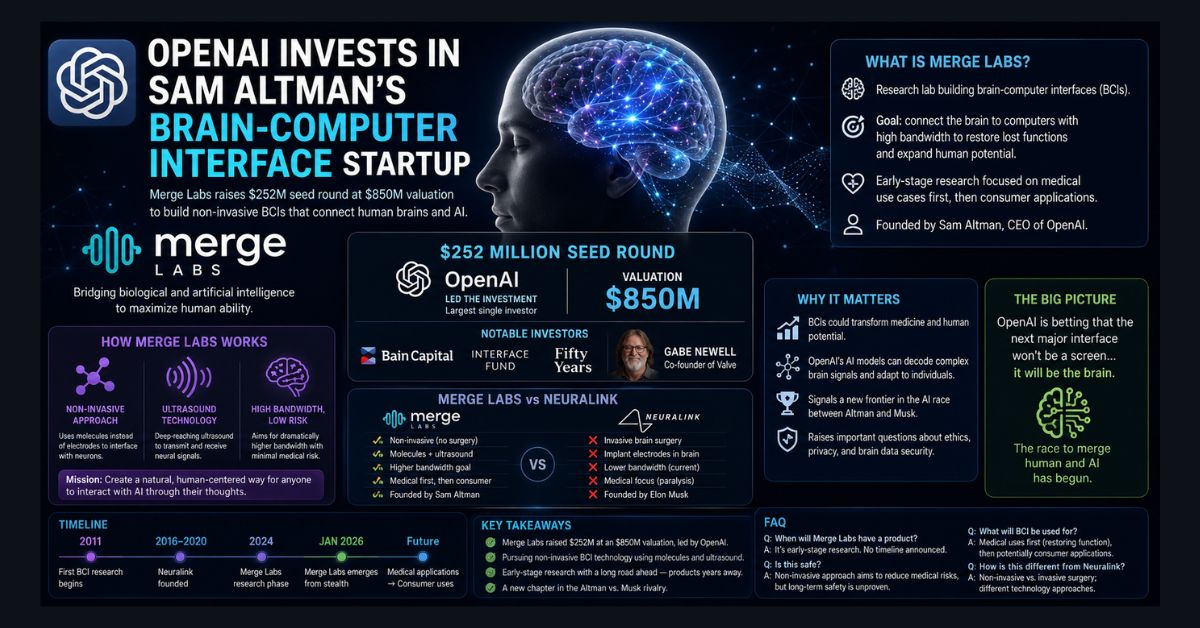
OpenAI led a roughly $252 million seed round for Merge Labs, a brain-computer interface (BCI) startup co-founded by OpenAI CEO Sam Altman, at a reported $850 million valuation. The company emerged from stealth in January 2026 with a non-invasive approach to linking human brains and AI — and OpenAI’s involvement instantly made it one of the most heavily funded BCI efforts in the U.S., second only to Elon Musk’s Neuralink. It also reignited the Altman-Musk rivalry on a startling new front: the human brain.
Here’s what Merge Labs is, how its technology differs from Neuralink’s, why OpenAI investing in its own CEO’s startup raised eyebrows, and what it all means.
What is Merge Labs?
Merge Labs describes itself as a research lab dedicated to “bridging biological and artificial intelligence to maximize human ability.” Its goal is to build BCIs that connect the brain to computers with far higher bandwidth than anything available today, while restoring lost functions and enabling more natural, direct interaction with machines.
The name is no accident. Altman has written for years about “the merge” — his belief that humans and AI will eventually fuse rather than remain separate. Merge Labs is the concrete expression of that idea. The company has been candid that it’s in an early research phase with a long road ahead, and that it’s too soon to say exactly what its first products will do, though it plans to target medical use cases first before pursuing consumer applications.
How much did OpenAI invest, and who else is backing it?
Merge Labs raised about $252 million in seed funding at a reported $850 million valuation, with OpenAI writing the single largest check. The round drew a notable roster of backers: venture firms Bain Capital, Interface Fund, and Fifty Years, plus Gabe Newell, the co-founder of Valve (the company behind Steam) — who, fittingly, runs his own brain-tech venture, Starfish Neuroscience.
OpenAI framed its participation as a strategic bet on a new frontier, writing that BCIs “open new ways to communicate, learn, and interact with technology” and could create a natural, human-centered way for anyone to interact with AI. This fits OpenAI’s broader expansion well beyond chatbots, from its $4 billion deployment company to its push into biology and medicine via ChatGPT Health.
How is Merge Labs different from Neuralink?
This is the core of the story. The two leading U.S. BCI companies are taking opposite technological paths:
Neuralink (Elon Musk) uses invasive surgery: a robot removes a small piece of skull and inserts ultra-fine electrode threads directly into brain tissue to read neural signals. It has focused on helping people with severe paralysis control devices with their thoughts, and last raised a $650 million round at a roughly $9 billion valuation in mid-2025 — making it about ten times larger than Merge Labs today.
Merge Labs (Sam Altman) is pursuing a non-invasive route, aiming to connect with neurons using molecules instead of electrodes, combined with deep-reaching modalities like ultrasound to transmit and receive neural signals. The pitch is to dramatically increase bandwidth and brain coverage while minimizing the medical risk and barrier-to-entry of brain surgery. If it works, the non-surgical approach could make BCIs far more scalable and accessible than implant-based systems.
The contrast extends to philosophy. Neuralink leans heavily on medical applications, while Merge appears more oriented toward the Silicon Valley ambition of augmenting healthy human cognition with AI. The rivalry is also personal — Altman was once an investor in Neuralink, making this a pointed escalation of his broader competition with Musk, whose empire-building maneuvers we cover in our look at the SpaceX, Tesla, and xAI merger talks.
Why is OpenAI investing in its own CEO’s startup controversial?
The deal drew immediate criticism for its circular structure: OpenAI used its investment arm to fund a company co-founded and personally backed by its own CEO. Skeptics pointed out the obvious conflict-of-interest questions and the “circular” feedback loop — Merge Labs’ success could drive more people toward OpenAI’s AI systems, which in turn helps justify OpenAI’s investment in Altman’s personal venture.
It’s part of a wider pattern of intertwined deals across the AI industry, where the same handful of companies and individuals invest in, supply, and buy from one another — dynamics also visible across the AI funding and IPO wave. Altman’s leadership has already drawn legal and regulatory scrutiny on other fronts, including Florida’s lawsuit against OpenAI, so governance questions around his ventures are likely to keep surfacing.
What does OpenAI actually bring beyond money?
OpenAI’s role goes past the check. The company plans to collaborate with Merge Labs on scientific foundation models and AI tools designed to accelerate research in neuroscience, bioengineering, and device engineering. Crucially, advanced AI is needed to interpret the brain’s incredibly complex neural activity — decoding intent and adapting to each individual’s unique neural patterns is exactly the kind of pattern-recognition problem modern AI models are suited to.
In other words, the AI and the hardware are meant to advance together: better models make the BCI more accurate, and richer neural data could help train better models. It’s the same capability frontier we track across the leading systems in our top AI models ranking and Claude vs ChatGPT vs Gemini comparison, now pointed at biology.
Should you be excited or skeptical?
Both. The promise is genuinely profound — high-bandwidth, non-invasive BCIs could transform how people with disabilities communicate and eventually change how everyone interacts with technology. But the caveats are equally real. Merge Labs is at an early research stage, the science of non-invasive high-bandwidth neural interfaces is unproven at scale, and meaningful consumer products are likely years away. There are also serious ethical, privacy, and safety questions that come with any technology designed to read from and write to the human brain.
For now, the significance is less about a shipping product and more about intent: the most powerful AI company in the world has decided that the brain is the next interface worth owning. Whether that future arrives as a medical breakthrough, a consumer gadget, or neither remains to be seen — but the race between Merge and Neuralink is now firmly on.
FAQ
1. What is Merge Labs?
Merge Labs is a brain-computer interface startup co-founded by OpenAI CEO Sam Altman that aims to connect human brains with AI using non-invasive technology. It emerged from stealth in January 2026 and describes its mission as bridging biological and artificial intelligence to expand human ability.
2. How much did OpenAI invest in Merge Labs?
OpenAI led Merge Labs’ roughly $252 million seed round, writing the single largest check, at a reported $850 million valuation. Other investors included Bain Capital, Interface Fund, Fifty Years, and Valve co-founder Gabe Newell.
3. How is Merge Labs different from Neuralink?
Neuralink uses invasive brain surgery to implant electrodes and focuses on medical uses like helping paralyzed patients. Merge Labs is pursuing a non-invasive approach using molecules and ultrasound to interface with neurons, aiming for high bandwidth with less medical risk and greater accessibility.
4. Why is OpenAI’s investment in Merge Labs controversial?
OpenAI invested in a company co-founded by its own CEO, Sam Altman, raising conflict-of-interest concerns and creating a “circular” dynamic where Merge Labs’ success could benefit OpenAI and vice versa. Such intertwined deals are increasingly common — and increasingly scrutinized — across the AI industry.
5. When will Merge Labs have a product?
Merge Labs is in an early research phase and has said it’s too soon to specify its first products. It plans to develop medical applications first before pursuing consumer uses, so practical products are likely years away.