
Quick Answer
Data privacy management software helps organizations find personal data, handle user data requests, manage consent, and prove compliance with laws like GDPR and CCPA. In 2026, the leaders are OneTrust, BigID, TrustArc, Securiti, and DataGrail, with pricing that runs from about $30,000 to $300,000 a year for enterprise platforms.
Key Takeaways
- Data privacy software automates data discovery, consent, DSAR fulfillment, and compliance reporting
- Enterprise platforms typically cost $30,000 to $300,000 per year, priced by company size and data volume
- The biggest 2026 shift is AI governance, extending privacy controls to AI models and training data
- OneTrust and BigID anchor most large programs; DataGrail and Transcend lead on automation and ease
- A business under about 50 employees usually doesn’t need dedicated software yet, and built-in tools suffice
Data privacy management software helps a business discover the personal data it holds, respond to user requests to see or delete that data, manage consent, and prove to regulators that it follows privacy laws. If your company handles customer data at scale, the right platform turns a manual compliance headache into an automated workflow.
Most “best privacy software” lists are written by vendors who rank themselves first, so this guide takes a different approach: vendor-neutral, criteria-based, with real pricing and an honest note on when you don’t need this software at all. Prices and features below were accurate at the time of writing, but enterprise pricing is custom and quoted per deal, so treat the ranges as guidance and confirm directly with each vendor.
What does data privacy management software actually do?
Data privacy management software automates the core tasks of a privacy program, so a small team can manage obligations that would otherwise require far more manual work. It centralizes what used to live in spreadsheets and email threads.
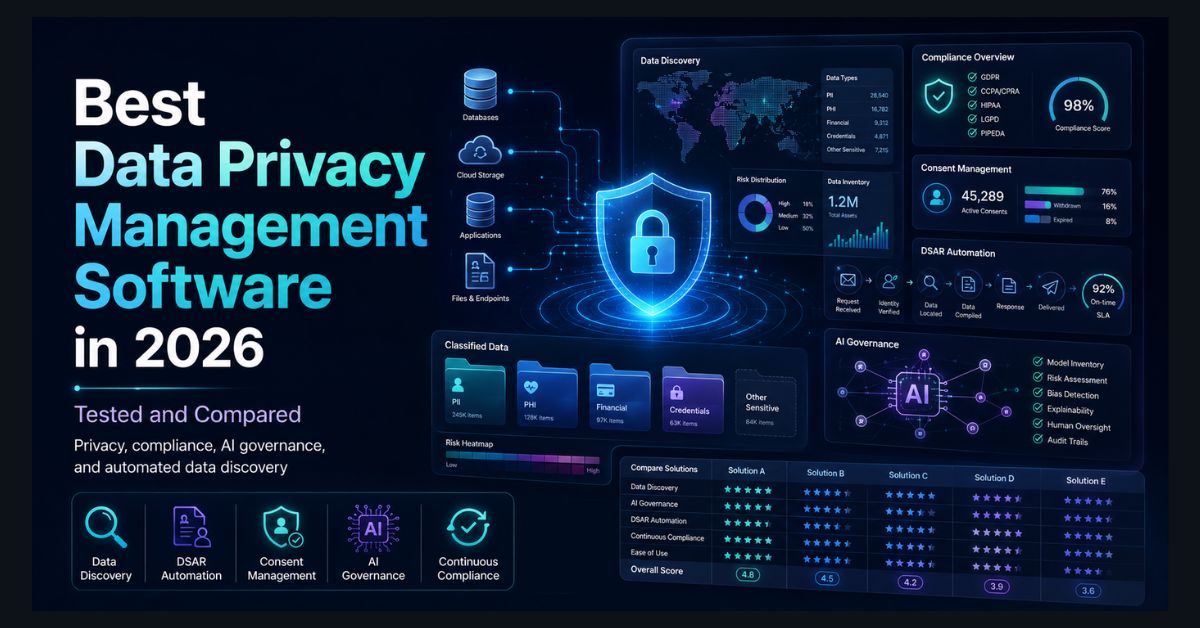
The main jobs these platforms handle are data discovery and mapping, which locate and classify personal data across your systems; consent management, which records and honors what users agreed to; data subject access request (DSAR) fulfillment, which handles requests to access, correct, or delete personal data within legal deadlines; assessment and reporting, which document compliance for regulators; and increasingly AI governance, which extends the same controls to AI models and training data. Data discovery is usually the foundation the rest depends on, because you cannot protect or report on data you haven’t found, and in practice most companies underestimate how much personal data sits in forgotten databases, old spreadsheets, and unstructured files. Not every tool does all of these equally well, which is why the right pick depends on your primary need. For the broader context of how privacy fits into security, see our cybersecurity and data privacy guide.
Which data privacy software is best in 2026?
The best platform depends on your size and primary goal, but a handful of tools lead the 2026 market across the main use cases. This table maps the leaders to what they do best and their rough pricing.
| Platform | Best for | Strength | Approx. annual cost |
|---|---|---|---|
| OneTrust | Large enterprises, full programs | Broadest suite: consent, DSAR, governance, AI modules | ~$40k-$300k+ |
| BigID | Data-first discovery, AI governance | ML-based discovery of structured and unstructured data | ~$30k-$250k+ |
| TrustArc | Global regulatory compliance | Regulatory intelligence plus managed services | ~$25k-$150k+ |
| Securiti | Heavy AI usage, PrivacyOps | AI-driven discovery and AI governance in one platform | ~$30k-$200k+ |
| DataGrail | Mid-market DSAR automation | Fast setup, strong integrations, easy UX | ~$15k-$100k |
| Transcend / Ketch | Engineering-led teams | Code-first privacy and orchestration workflows | Custom |
A few notes on the leaders. OneTrust is the most recognized and most comprehensive, extending beyond privacy into governance and third-party risk, at the cost of complexity that smaller teams find heavy. BigID leads on AI-driven discovery of sensitive data, especially the unstructured data other tools miss, which makes it strong for AI governance. TrustArc pairs its platform with managed services and deep regulatory intelligence, favored in heavily regulated sectors. DataGrail is the mid-market favorite for quick deployment and clean DSAR automation. Securiti is built around AI governance and PrivacyOps for organizations with heavy AI use. Newer engineering-first tools like Transcend and Ketch handle privacy as code, and lighter options like Osano and MineOS suit teams that want faster setup than the enterprise suites.
How much does data privacy management software cost?
Enterprise data privacy platforms generally cost between $30,000 and $300,000 per year, priced on company size, data volume, and the modules you enable. Most vendors use custom quotes rather than public pricing, so the figures here are ranges, not fixed prices.
The spread is wide because these tools scale with your data. A mid-market company automating DSARs on a tool like DataGrail might land in the low tens of thousands, while a large enterprise running OneTrust or BigID across consent, discovery, governance, and AI modules can reach several hundred thousand a year. Managed-service add-ons, extra integrations, and higher data volumes all push the number up. Because pricing is negotiated, get quotes from at least two vendors and size the contract to the modules you will actually use, since paying for an all-in-one suite you only half-deploy is a common and expensive mistake.
How is AI changing data privacy software?
AI is the biggest shift in the category, because privacy programs now have to govern AI models and training data, not just databases and web forms. The tools that will matter most in 2026 and beyond are the ones that extend privacy controls into AI systems.
The change runs in two directions. Vendors use AI to improve their own products, automating data discovery and classification far faster than rules-based scanning could. At the same time, buyers increasingly need to govern the AI their own companies deploy: knowing what personal data feeds a model, whether a training set contains regulated information, and how a generative-AI feature handles user data. Platforms like Securiti, OneTrust, and BigID now market dedicated AI-governance modules for exactly this. The regulatory backdrop is tightening too, with rules like the EU AI Act’s transparency requirements raising the compliance bar, and new risks emerging from autonomous systems that we cover in our look at agentic AI security risks. If your organization is adopting AI, treat AI governance as a required feature, not a bonus.
How do you choose the right privacy platform?
Choose based on your primary use case and team structure rather than on which tool has the longest feature list, since the “best” platform is the one that fits how you actually work. Match the tool to the job, not the marketing.
Use these buyer scenarios as a starting point:
- Enterprise with a privacy team: OneTrust for a comprehensive suite, or BigID for a data-discovery-first approach.
- Mid-market company handling DSARs: DataGrail for automated fulfillment, or TrustArc for regulatory intelligence.
- Engineering-led company: Transcend for code-first privacy, or Ketch for enforcement orchestration.
- Heavy AI usage: Securiti or OneTrust’s AI-governance modules.
- Startup needing compliance for sales: a compliance-automation tool such as Vanta that bundles privacy with broader security compliance.
Whichever you shortlist, insist on a live demo with your own data, confirm which regulations it covers (GDPR, CCPA and CPRA, HIPAA, and others relevant to you), and check integration with your existing stack before signing.
Which privacy laws does this software help you comply with?
Data privacy software is built to help you comply with the major data protection laws, chiefly the EU’s GDPR and California’s CCPA and CPRA, plus sector and regional rules like HIPAA. Knowing which laws apply to you is the first step in choosing a tool, because coverage varies by platform.
The two anchors are worth understanding. The EU’s General Data Protection Regulation (GDPR) governs how organizations handle the personal data of people in the EU and carries steep fines for violations; the full requirements are set out in the official EU legal text, with plain-language guidance on the European Commission’s data protection pages. In the US, the California Consumer Privacy Act (CCPA), strengthened by the California Privacy Rights Act (CPRA) effective January 2023, gives California residents rights to know, delete, correct, and opt out of the sale of their personal data, and created the California Privacy Protection Agency as a dedicated regulator. Good privacy software maps your data against these rules, automates the consumer-request workflows each one requires, and keeps the audit trail regulators expect. If you operate globally, prioritize a platform that covers every jurisdiction you touch, since a US-only tool won’t keep you compliant in Europe and vice versa.
Does a small business actually need this software?
Probably not yet, if you have fewer than about 50 employees, because dedicated privacy platforms are built for scale most small businesses haven’t reached. Buying enterprise software too early is a waste of budget, and it’s worth saying plainly even though it’s the opposite of what vendors want.
For a small business, start with the privacy features already built into the tools you use, such as the data controls in Google Workspace or the compliance features in Microsoft 365. Write a basic privacy policy using a reputable free template, keep a simple record of what personal data you collect and why, and handle the occasional data request manually. Move to dedicated software only when manual management becomes unsustainable, typically when request volume, data sprawl, or regulatory exposure grows beyond what a person can track in a spreadsheet. In the meantime, the higher-value security steps for a small team are covered in our guides to checking for data breaches and free antivirus, and if remote work is involved, setting up a VPN.
FAQ
What is data privacy management software?
Data privacy management software helps organizations discover personal data, manage user consent, fulfill data subject requests, and comply with privacy laws like GDPR and CCPA. It automates tasks that would otherwise be manual, centralizing privacy operations in one platform. Leading tools in 2026 include OneTrust, BigID, TrustArc, Securiti, and DataGrail.
What is the best data privacy tool?
There’s no single best tool; it depends on your needs. OneTrust suits large enterprises wanting a comprehensive suite, BigID excels at sensitive-data discovery and AI governance, DataGrail leads mid-market DSAR automation, and TrustArc is strong for global regulatory compliance. For heavy AI use, Securiti is built around AI governance. Match the tool to your primary use case.
How much does data privacy software cost?
Enterprise data privacy platforms typically cost $30,000 to $300,000 per year, priced by company size, data volume, and enabled modules. Most vendors use custom quotes rather than public pricing. Mid-market DSAR tools can start in the low tens of thousands, while full enterprise deployments across discovery, consent, and AI governance reach the higher end.
Do I need data privacy software for a small business?
Usually not if you have fewer than about 50 employees. Start with the privacy features in tools you already use, like Google Workspace or Microsoft 365, a free privacy-policy template, and manual handling of occasional data requests. Move to dedicated software once manual management becomes unsustainable as your data and request volume grow.
Does data privacy software cover AI governance?
Increasingly, yes. In 2026, leading platforms including Securiti, OneTrust, and BigID offer AI-governance modules that extend privacy controls to AI models and training data. If your organization deploys AI, prioritize a tool that can inventory personal data used in models and help you comply with emerging rules like the EU AI Act. Treat AI governance as a core requirement rather than an optional extra.