

If your Windows 11 update is stuck, first wait 2–3 hours, since large updates can stall at a percentage for a long time. If it’s truly frozen, restart your PC, run the Windows Update Troubleshooter (Settings > System > Troubleshoot), free up disk space, then reset Windows Update components by clearing the SoftwareDistribution folder. These steps fix the vast majority of stuck updates.
- Be patient first: Many “stuck” updates are just slow — wait before acting
- Easiest fix: Restart and run the built-in Windows Update Troubleshooter
- Most effective fix: Reset Windows Update components (clear SoftwareDistribution)
- Common causes: Low disk space, weak connection, corrupted update files, or malware
- Last resort: Install the update manually from the Microsoft Update Catalog
OpenAI moves fast. GPT-5.4, which launched on March 5, 2026 as “the most capable model for professional work,” was superseded just 49 days later by GPT-5.5 on April 23. Then on May 5, GPT-5.5 Instant became the default ChatGPT model, replacing GPT-5.3 Instant for all users.
If you’re trying to keep track of which model does what, which one you’re actually using in ChatGPT, and whether any of this matters for your work — here’s the complete picture as of May 2026.
The Current OpenAI Model Lineup
OpenAI’s model lineup has expanded rapidly. Here’s what’s currently available:
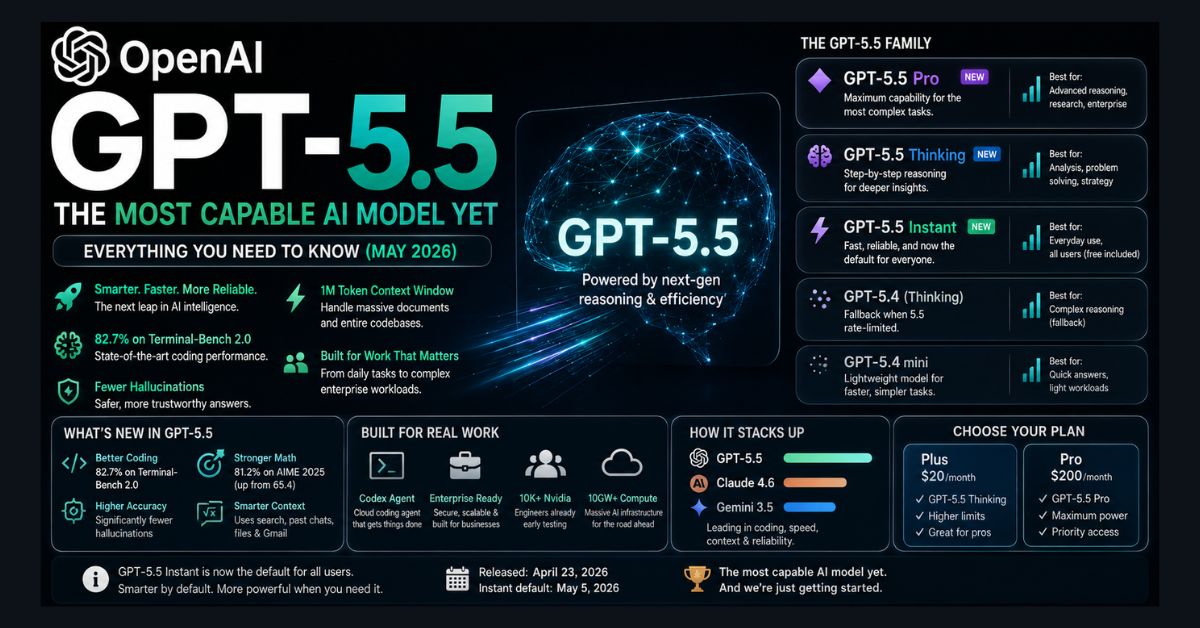
| Model | Released | Available To | Best For |
| GPT-5.5 Pro | April 23, 2026 | Pro, Business, Enterprise | Maximum capability, complex reasoning |
| GPT-5.5 Thinking | April 23, 2026 | Plus, Pro, Business, Enterprise | Step-by-step reasoning, analysis |
| GPT-5.5 Instant | May 5, 2026 | All users (including free) | Default ChatGPT, everyday use |
| GPT-5.4 Thinking | March 5, 2026 | Being phased out | Fallback when 5.5 rate-limited |
| GPT-5.4 mini | March 17, 2026 | Rate limit fallback | Lightweight tasks |
The naming is confusing — OpenAI uses “Instant” for fast everyday models, “Thinking” for reasoning-focused models, and “Pro” for maximum capability. GPT-5.5 Instant is what you’re using when you open ChatGPT and start typing.
What Changed from GPT-5.4 to GPT-5.5
GPT-5.5 (codename “Spud”) improves on GPT-5.4 in several measurable ways.
Benchmark performance: GPT-5.5 scored 82.7% on Terminal-Bench 2.0 (a coding evaluation), compared to GPT-5.4’s already-strong coding results. On FrontierMath, it scored 51.7% on difficulty levels 1-3 and 35.4% on level 4 — improvements over both GPT-5.4 and competing models from Anthropic and Google.
Reduced hallucinations: GPT-5.5 Instant reduces hallucination in sensitive areas like law, medicine, and finance while maintaining the low latency that makes it suitable as a default model. OpenAI reports improved safe-response performance: 52% improvement in harm-to-others cases and 39% in self-harm cases compared to previous defaults.
Math improvement: GPT-5.5 scored 81.2 on the AIME 2025 math test, up from 65.4 for the older model. On the MMMU-Pro multimodal reasoning benchmark, it scored 76 vs. 69.2 for its predecessor.
Context management: GPT-5.5 Instant can use its search tool to reference past conversations, uploaded files, and Gmail to deliver more personalized answers. This is a significant step toward persistent AI memory — the model doesn’t just respond to your current prompt, it can draw on your history with it.
Codex integration: OpenAI launched Codex, a cloud-based software engineering agent powered by GPT-5.5, designed to handle multi-file coding tasks autonomously. Over 10,000 Nvidia engineers got early access and reported results that were “blowing my mind,” according to Nvidia’s blog. For how this compares to other AI coding assistants including Claude Code, see our dedicated comparison guide.
What GPT-5.4 Introduced (Still Relevant)
GPT-5.4’s innovations carry forward into 5.5, so understanding them matters:
1 million token context window: The GPT-5.4 API introduced context windows up to 1 million tokens — the largest from OpenAI. This allows processing entire codebases, complete legal documents, and multi-hundred-page reports in a single prompt.
Token efficiency: GPT-5.4 completed tasks with fewer tokens than GPT-5.2, making it faster and cheaper per task. This efficiency carried into 5.5.
Tool Search: Instead of preloading all tool definitions (which consumed many tokens), GPT-5.4 introduced on-demand tool retrieval, reducing API costs for applications with many tools.
Professional benchmarks: GPT-5.4 topped Mercor’s APEX-Agents benchmark for professional skills in law and finance. Mercor CEO Brendan Foody said it “excels at creating long-horizon deliverables such as slide decks, financial models, and legal analysis.”
Chain-of-thought safety evaluation: OpenAI added monitoring of the model’s step-by-step reasoning process, finding that deception is less likely when the model’s thinking chain is visible and auditable.
How GPT-5.5 Compares to Claude and Gemini
The AI landscape shifted significantly at Google I/O on May 20, where Google announced Gemini 3.5 Flash (claiming 4x faster than competitors at half the cost) and Gemini Spark (a persistent AI agent that runs 24/7 in the cloud).
Here’s where things stand as of May 2026:
GPT-5.5 vs Claude Opus 4.6/4.7: Claude still leads in writing quality and instruction-following for long documents. GPT-5.5 has stronger coding benchmarks (82.7% Terminal-Bench vs. Claude’s 80.8% SWE-bench). Claude’s 200K context window is smaller but delivers more consistent quality than GPT’s 1M window at extreme lengths. For a full breakdown, see our Claude vs ChatGPT vs Gemini comparison.
GPT-5.5 vs Gemini 3.5 Flash: Google claims Gemini 3.5 is 4x faster and half the cost of competing frontier models. Independent benchmarks haven’t confirmed this yet. Gemini’s native Google Search integration gives it an advantage for real-time information. GPT-5.5’s strength is its broader tool ecosystem and voice mode.
The pricing battle: ChatGPT Plus remains $20/month, ChatGPT Pro is $200/month. Google AI Ultra launched at $100/month with more bundled features (30TB storage, Workspace AI, persistent Spark agent). Claude Pro is $20/month with Max plans at $100-200/month. The value proposition increasingly depends on which ecosystem you’re invested in.
OpenAI’s Enterprise Push
Beyond model improvements, OpenAI’s strategy has shifted dramatically toward enterprise deployment. That enterprise focus now sits alongside OpenAI’s planned IPO, which will put more pressure on the company to turn rapid model upgrades into durable business revenue. In May 2026, the company launched the OpenAI Deployment Company — a $4 billion standalone entity that embeds Forward Deployed Engineers inside client organizations to help them actually use these models in production.
This signals that OpenAI recognizes the next competitive battleground isn’t model quality — it’s deployment. Building a model that can score 82.7% on coding benchmarks is one thing. Getting a Fortune 500 company to use it reliably in production workflows is something else entirely.
OpenAI has committed to deploying more than 10 gigawatts of Nvidia systems for next-generation AI infrastructure — a buildout that puts millions of Nvidia GPUs at the foundation of OpenAI’s training and inference for years ahead.
The GPT-4o Retirement Lesson
One important context for understanding OpenAI’s rapid model releases: the company faced significant backlash when it retired GPT-4o. Users who had formed emotional attachments to the model’s “personality” signed petitions and described it as losing a “best friend.” OpenAI now handles model transitions more carefully, keeping older models available as fallbacks during transitions and providing longer sunset windows.
GPT-5.4 Thinking is currently used as a fallback when GPT-5.5 rate limits are reached, rather than being immediately retired. GPT-5.3 Instant was fully replaced by GPT-5.5 Instant as the default on May 5.
Should You Pay for ChatGPT Plus or Pro?
If you use ChatGPT occasionally (a few times per week): The free tier with GPT-5.5 Instant is now genuinely capable. For most people, there’s no need to pay.
If you use ChatGPT daily for work: Plus ($20/month) gives you access to GPT-5.5 Thinking and higher message limits. This is the sweet spot for most professionals. Our 50 ChatGPT prompts for work guide shows how to get maximum value from a Plus subscription.
If you do complex professional work (law, finance, engineering): Pro ($200/month) gives you GPT-5.5 Pro with maximum capability, highest rate limits, and priority access. Worth it if AI is central to your revenue-generating work.
If ChatGPT is unreliable for you: The “something went wrong” error remains common during peak hours. If you’re frequently hitting errors, consider free alternatives like Claude or Gemini as backup tools, or use multiple platforms depending on the task.
FAQ
1. What’s the difference between GPT-5.4 and GPT-5.5?
GPT-5.5 improves coding performance (82.7% on Terminal-Bench 2.0), reduces hallucination in sensitive topics, adds better context management (can reference past conversations and Gmail), and scores significantly higher on math benchmarks (81.2 on AIME 2025 vs. 65.4 for the previous model). GPT-5.4’s innovations — 1M token context, Tool Search, token efficiency — carry forward into 5.5.
2. Which GPT model am I using in ChatGPT right now?
If you’re a free user, you’re using GPT-5.5 Instant (the fast, everyday model). Plus subscribers use GPT-5.5 Thinking by default (the reasoning-focused model). Pro subscribers get GPT-5.5 Pro (maximum capability). You can check and change your model in the model picker at the top of the ChatGPT interface.
3. Is GPT-5.5 better than Claude Opus 4.6?
It depends on the task. GPT-5.5 leads on coding benchmarks and has a larger context window (1M vs 200K tokens). Claude leads on writing quality, instruction-following, and hallucination reduction. Gemini 3.5 Flash (announced at Google I/O on May 20) claims to beat both on speed and cost. See our full comparison for details.
4. Should I switch from ChatGPT to Gemini after Google I/O?
Not necessarily. Google’s I/O announcements were impressive, but independent benchmarks haven’t confirmed Gemini 3.5’s claimed advantages yet. ChatGPT’s ecosystem (plugins, GPTs, voice mode) is more mature. Gemini’s advantage is Google Workspace integration and real-time search. If you’re a Google Workspace user, Gemini deserves serious consideration. For everyone else, ChatGPT Plus remains the safer default.
5. What happened to GPT-5.4? Can I still use it?
GPT-5.4 Thinking is still available as a fallback when GPT-5.5 rate limits are reached. GPT-5.4 mini is used internally for lightweight tasks. The API still supports GPT-5.4 models, though OpenAI is encouraging migration to 5.5. GPT-5.4 is no longer the default model in ChatGPT.
6. How much does GPT-5.5 cost via the API?
GPT-5.5 and GPT-5.5 Pro are available through the API as of April 24, 2026. GPT-5.4 mini and nano are about 4x more expensive than their GPT-5 equivalents. Exact per-token pricing varies by model variant — check OpenAI’s pricing page for current rates.