

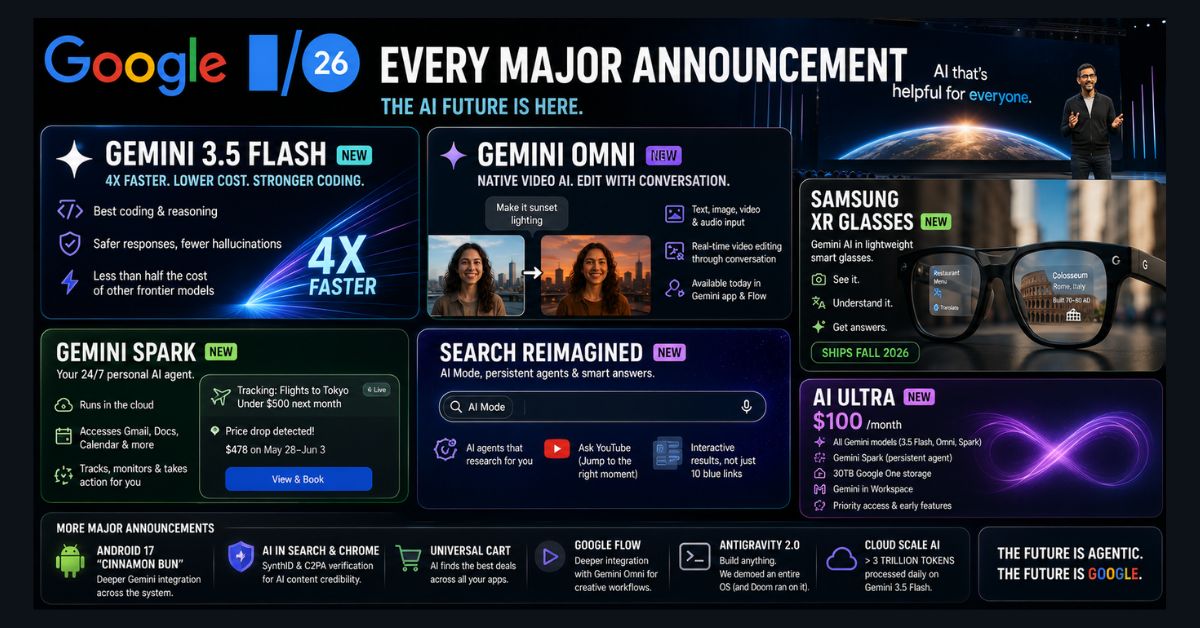
Google I/O 2026 wasn’t a developer conference — it was a declaration of war. Over two days (May 19-20), Google unveiled its most aggressive AI push ever: two new Gemini models, a personal AI agent that runs 24/7 in the cloud, native video creation and editing through conversation, the biggest redesign of Google Search in 27 years, a $100/month AI Ultra subscription, Samsung XR glasses, and a developer platform that had an AI build an entire operating system on stage.
The central message from CEO Sundar Pichai was unmistakable: AI should not be a destination you visit — it should be the infrastructure you live inside. Here’s every major announcement and what it actually means.
The New Gemini Models
Gemini 3.5 Flash — The New Workhorse
Gemini 3.5 Flash is Google’s new flagship model, and the numbers are impressive. Google claims it’s 4x faster than competing frontier models while matching or exceeding their quality across coding, reasoning, and multimodal tasks. Internally, Google is processing more than three trillion tokens per day using this model.
Key improvements: significantly better coding performance (Google called it their “strongest agentic and coding model yet”), improved safety measures with reasoning checks before responses, lower hallucination rates, and reduced cost — Google says developers can accomplish tasks “at less than half the cost of other frontier models.”
For anyone following the AI comparison landscape, this is Google’s direct response to both GPT-5.4 and Claude Opus 4.6. We’ll update our comparison guide once benchmarks from independent testers confirm Google’s claims.
Gemini Omni — Native Video AI
Gemini Omni is a new model family designed for multimodal creation, starting with video. The first model, Omni Flash, is available today in the Gemini app and Google Flow.
What makes Omni different: you can edit videos through conversation. Upload a selfie and Omni transforms it into a professional scene. Describe what you want changed — “make it sunset lighting,” “add a city skyline behind me” — and Omni makes the changes in real time. This goes beyond text-to-video generation (like Sora) into genuine conversational video editing.
Omni Flash handles mixed media inputs natively: text, images, video, and audio in any combination. It’s available today for Google AI Plus, Pro, and Ultra subscribers, with a free preview through YouTube Shorts and the YouTube Create app.
This directly challenges our current AI image generator rankings — Google just added native video editing on top of its already-strong Nano Banana 2 image generation.
Gemini Spark — Your 24/7 Personal AI Agent
The biggest announcement for consumers wasn’t a new model — it was a new product. Gemini Spark is a personal AI agent that runs continuously in the cloud, managing your digital life even when your phone or laptop is off.
Spark can access Gmail, Google Docs, Calendar, and other Workspace apps. It tracks tasks you’ve asked it to handle, monitors for information you’ve requested, and proactively surfaces relevant updates. It’s the concept of Google’s earlier AI Mode expansion taken to its logical extreme — an always-on AI that doesn’t wait for prompts.
This is fundamentally different from ChatGPT or Claude, which only work when you’re actively chatting with them. Spark is persistent: ask it to “track flights from SFO to Tokyo for under $500 next month” and it monitors, alerts you when prices drop, and can even book for you.
Spark runs on Gemini 3.5 and is included in the new AI Ultra subscription ($100/month). This substantially changes our Gemini vs ChatGPT vs Claude analysis — no competing platform offers anything equivalent to a persistent, cloud-based AI agent.
Google Search Gets Its Biggest Upgrade in 27 Years
Google Search now features AI Mode as a default option alongside traditional search results. The agentic search experience goes well beyond the AI Overviews introduced in 2025.
New features include persistent “information agents” that run on Google Cloud, continuously tracking research topics and building personalized dashboards. These agents handle complex multi-step research tasks — “Compare the top 5 electric SUVs under $40,000 on safety ratings, range, and total cost of ownership” — and deliver interactive results rather than ten blue links.
“Ask YouTube” lets users query concepts across all of YouTube, with AI automatically navigating video timelines and jumping to the most relevant moments. Instead of watching a 45-minute tutorial to find one answer, you ask your question and get taken directly to the 30 seconds that matter.
That same event-focused AI layer is already showing up in sports, with Gemini’s World Cup features demonstrating how Google can turn live schedules, match context, and fan questions into real-time AI-powered search experiences.
AI Ultra — The $100/Month Everything Plan
Google announced a new top-tier subscription: Google AI Ultra at $100/month.
What it includes: access to all Gemini models (3.5 Flash, Omni, Spark), 30TB of Google One storage, Gemini in Workspace (Docs, Sheets, Slides), persistent Spark agent, priority processing, and early access to experimental features.
For context, ChatGPT Pro is $200/month and Claude Max is $100-200/month. Google is positioning AI Ultra as a direct competitor at the lower end of the premium tier. Compared to the free ChatGPT alternatives we reviewed, AI Ultra sits at the premium end but bundles more services (storage, Workspace AI, persistent agents) than any competitor.
Samsung Intelligent Eyewear (XR Glasses)
Google partnered with Samsung to unveil Intelligent Eyewear — lightweight smart glasses powered by Android XR and Gemini AI. Unlike the bulky VR headsets that Meta is pivoting away from, these look like regular prescription glasses with built-in displays, cameras, and AI processing.
The glasses ship this fall and will run Gemini natively: point at a restaurant menu and get translations, look at a landmark and get historical information, or glance at a complex equation and get it solved. Samsung is handling hardware; Google provides the AI platform.
Google Antigravity 2.0 — Developer Platform
Google’s developer platform got a major upgrade: Antigravity 2.0 is “unabashedly agent-first,” powered by Gemini 3.5 Flash. On stage, Google demonstrated the platform building an entire operating system — and then running Doom on it.
Antigravity CLI, SDK, and Native Voice Support are available globally starting today. For developers evaluating AI coding tools, Google Antigravity is now a serious contender alongside GitHub Copilot, Cursor, and Claude Code. The combination of speed (3.5 Flash’s 4x advantage), cost (half the price of competitors), and Google Cloud integration makes it compelling for teams already in the Google ecosystem.
Other Notable Announcements
Android 17 preview: Codenamed “Cinnamon Bun,” with deeper Gemini integration at the system level. Stable release expected June 2026. This builds toward the larger Aluminium OS vision of merging Android and ChromeOS.
SynthID and C2PA in Search: Google is rolling out AI content verification to Search and Chrome, helping users identify AI-generated imagery. OpenAI has joined as a verification partner.
Neural Expressive design language: The Gemini app is getting a complete visual refresh with fluid animations, vibrant colors, new typography, and haptic feedback.
Universal Cart: An AI-powered shopping feature that tracks deals across apps and helps users buy at the best price — a direct shot at Amazon’s shopping dominance.
Google Flow improvements: Deeper integration with Gemini Omni for creative workflows including image, video, and audio production.
What This Means for the AI Race
Google I/O 2026 was Google’s strongest competitive statement since the original launch of Gemini AI. Three things stand out:
Distribution advantage: Gemini isn’t just a chatbot — it’s being embedded into Search (billions of users), Android (billions of devices), Chrome (billions of browsers), YouTube (billions of viewers), and Workspace (millions of businesses). No competitor can match this distribution. OpenAI has ChatGPT. Anthropic has Claude. Google has the entire internet. And if Apple continues moving toward deeper Gemini-powered Siri features in iOS, as suggested by the latest WWDC 2026 Siri, Gemini, and iOS 27 reports, Google’s AI reach could extend even further beyond its own ecosystem.
Agentic leadership: Gemini Spark is the first persistent, cloud-based AI agent from a major platform. It runs 24/7, accesses your apps, and takes actions on your behalf. This is a paradigm shift from the prompt-and-response model that every competitor (including Google itself until yesterday) has used.
Price war: Gemini 3.5 Flash at “less than half the cost” of competitors, combined with the $100/month AI Ultra tier, signals Google is willing to lose money on AI services to gain market share. This pressures OpenAI’s $200/month Pro tier and Anthropic’s $200/month Max tier.
For our full Gemini workspace tutorial updated with these new I/O features, and our broader AI assistant comparison, check the linked guides — we’ll be updating both this week with post-I/O analysis.
FAQ
1. When are the new Gemini features available?
Gemini 3.5 Flash and Gemini Omni Flash are available today (May 21, 2026) for Google AI Plus, Pro, and Ultra subscribers. Gemini Spark is rolling out to AI Ultra subscribers over the next few weeks. The Samsung XR glasses ship in fall 2026. Android 17 stable release is expected June 2026.
2. How much does Google AI Ultra cost?
$100/month. It includes access to all Gemini models, Gemini Spark (persistent agent), 30TB Google One storage, Gemini in Workspace, and priority processing. For comparison, ChatGPT Pro is $200/month, and Claude Max starts at $100/month.
3. Is Gemini 3.5 Flash better than GPT-5.4 and Claude Opus 4.6?
Google claims 3.5 Flash is 4x faster and half the cost of competing frontier models. Independent benchmarks haven’t been published yet. Based on Google’s claims, 3.5 Flash appears to close or eliminate the quality gap while winning significantly on speed and price. We’ll update our comparison guide when independent testing results are available.
4. What is Gemini Spark?
A persistent AI agent that runs 24/7 in Google’s cloud. Unlike traditional AI chatbots that only work when you’re chatting, Spark continuously monitors your tasks, tracks information you’ve requested, and takes actions across Gmail, Calendar, Docs, and other Google services. It’s included in the AI Ultra plan ($100/month).
5. Does this affect Aluminium OS and Googlebook laptops?
Indirectly yes. The Gemini models and Spark agent announced at I/O will be core features of Aluminium OS when Googlebook laptops launch in Q3 2026. Android 17 previewed at I/O also forms the foundation of Aluminium OS.