

Quick Answer
ChatGPT is the stronger standalone AI for writing, research, and coding. Notion AI is the better choice if you already work inside Notion, and it is now an agent platform, not just a writing helper. The big 2026 change: Notion’s standalone AI add-on is gone, so full Notion AI now needs a Business plan.
Key Takeaways
- ChatGPT wins for versatility, writing quality, web research, and coding; Notion AI wins for in-workspace work
- Notion AI became an agent platform in 2026, with autonomous agents that run multi-step tasks and Custom Agents on schedules
- Notion retired the standalone $10 AI add-on, so full Notion AI now requires the Business plan at $20/user per month
- Notion Custom Agents bill on credits at $10 per 1,000 credits since May 4, 2026, on top of the plan
- Notion now lets you pick the model (GPT, Claude, or Gemini families) or use Auto mode, which the older version did not
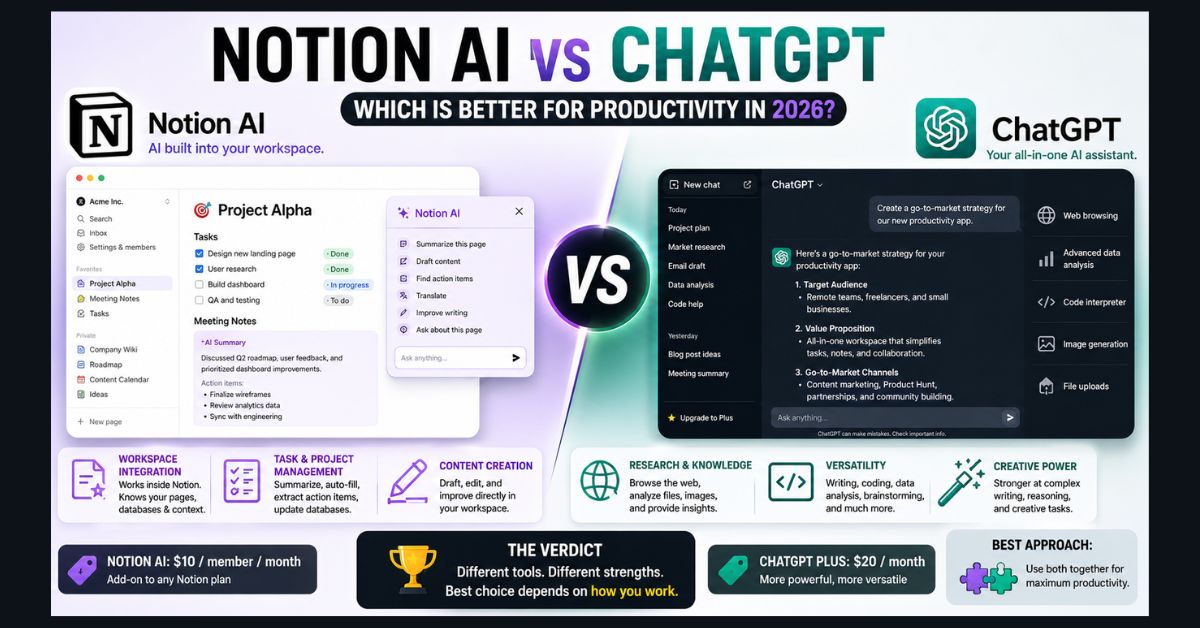
Notion AI and ChatGPT both use AI to help you work faster, but they solve different problems. ChatGPT is a general-purpose assistant you visit: you type, it responds. Notion AI is an AI layer that lives inside your Notion workspace, acting on the notes, databases, and documents already there.
The real question is not which is better in the abstract. It is which fits how you actually work. And the answer changed in 2026, because Notion AI stopped being a simple writing helper and became an agent platform with a completely different pricing model. This is the current comparison across every category that matters.
What is the difference between Notion AI and ChatGPT?
The core difference is that ChatGPT is an AI you visit, while Notion AI is an AI that lives where you work. ChatGPT is a standalone platform; Notion AI is embedded in a workspace app.
ChatGPT is OpenAI’s conversational assistant, running on the current GPT-5 series (GPT-5.6 as of mid-2026), covered in our GPT-5.6 breakdown. It writes, analyzes, codes, researches, generates images, browses the web, and runs Python, all through a chat interface. Notion AI is embedded directly inside Notion, and in 2026 it does far more than draft text: it runs autonomous agents that complete multi-step tasks, answers questions across your workspace and connected apps, fills database properties, transcribes meetings, and generates images, all without leaving the editor. The distinction still holds, but Notion’s side of it grew considerably.
How has Notion AI changed in 2026?
Notion AI became an agent platform in 2026, shifting from a writing assistant to an autonomous teammate that builds databases, drafts pages, and runs scheduled workflows. This is the single biggest change since earlier comparisons, and it reframes the whole matchup.
Three developments matter. Notion launched autonomous agents that run multi-step actions lasting 20 minutes or more with memory. It then added Custom Agents, team-wide bots that run on schedules or triggers and connect to outside tools such as Slack and Salesforce. And it opened a model picker, so you can choose a GPT, Claude, or Gemini model per task, or let Auto mode pick. In practice, Notion AI moved from “help me write this paragraph” to “run this workflow every morning without me.” ChatGPT has moved toward agents too, but Notion’s agents act directly on your structured workspace data, which a standalone chatbot cannot reach.
Which tool writes better?
ChatGPT writes better for polished, standalone prose, because its underlying model produces more nuanced and stylistically flexible output. Notion AI writes competently but leans toward simpler, shorter drafts that read as “good enough” rather than final.
For anything that needs to sound great, such as blog posts, client emails, or marketing copy, ChatGPT delivers a higher ceiling. Notion AI is fine for internal documents, meeting summaries, and quick drafts. But Notion AI has one contextual advantage ChatGPT cannot match out of the box: it writes using your actual workspace data. Ask it to draft a project update from this week’s completed tasks, and it pulls the real numbers from your databases. ChatGPT cannot see your Notion content unless you paste it in. For how ChatGPT’s writing compares with other assistants, see our Claude vs ChatGPT vs Gemini comparison.
Which is better for task and project management?
Notion AI wins for task and project management, because it operates inside a real project system with databases, boards, and timelines. ChatGPT can plan a project but cannot manage one; it has no database, no Kanban board, and no recurring tasks.
Notion AI can auto-fill database properties from page content, summarize project status across many pages, generate task lists from meeting notes, and answer plain-language questions such as “what tasks are overdue in the Marketing project?” With agents, it goes further and executes those updates on a schedule. ChatGPT is stronger for the initial planning stage, generating project plans, brainstorming milestones, and building frameworks, but once you need to track and manage execution, Notion AI wins because it lives inside the execution tool. This reflects the broader trend of AI being embedded into the tools you already use rather than bolted on separately.
Which is better for research?
ChatGPT wins for research, because it browses the web, reads uploaded documents and images, and runs data analysis. Notion AI’s research reaches only what is inside your workspace and connected apps.
For any task needing external or current information, ChatGPT is the clear choice. Notion AI cannot search the open web or analyze an external document you have not brought into Notion. If real-time information is the priority, Google’s Gemini is also strong here, as we cover in our guide to Gemini in Workspace. Notion’s Enterprise Search does connect across linked apps like Slack and Google Drive, so its “research” is really internal knowledge retrieval, which is useful but different from open web research.
How much do Notion AI and ChatGPT cost in 2026?
The pricing picture changed significantly, and this is where old advice is now wrong. Notion retired its standalone $10 AI add-on, so full Notion AI now requires the Business plan at $20/user per month, while ChatGPT keeps a free tier plus Plus at $20/month.
Here is the current comparison. Confirm figures on each vendor’s page before you commit, since both change. On the ChatGPT side, the free tier runs an older GPT-5.5 model, and Plus at $20/month unlocks the current GPT-5.6 flagship.
| Plan | ChatGPT | Notion AI |
|---|---|---|
| Free | Yes, current GPT model with daily limits | Basic AI writing only on Free/Plus |
| Individual paid | Plus at $20/month | Business at $20/user per month (entry point for full AI) |
| Higher tier | Pro at $200/month | Enterprise, custom pricing |
| Agent/usage cost | Included in plan limits | Custom Agents bill $10 per 1,000 credits, pooled monthly |
| Model choice | OpenAI models only | Pick GPT, Claude, or Gemini, or Auto |
Two things to flag. The old “$10 Notion AI add-on” advice no longer applies: a solo user who wants Notion’s agents and workspace AI now pays $20/month minimum on Business, and Plus keeps only basic writing. And Custom Agents consume credits on top of the plan, which reset monthly and do not roll over, so heavy automation adds cost your admin has to watch. For an individual, ChatGPT Plus gives the most capable standalone AI for $20. For a team already living in Notion, bundling AI into Business can be more cost-effective than buying separate ChatGPT seats, especially since Business includes multi-model access.
Should you use Notion AI, ChatGPT, or both?
Use ChatGPT if you need a versatile assistant for writing, research, coding, or anything beyond your workspace. Use Notion AI if you already run your work through Notion and want agents acting on your own data. Use both if the combined cost fits, since they cover different jobs.
The clean split for a two-tool setup is ChatGPT for research, complex writing, and external tasks, and Notion AI for internal documentation, project management, and workspace automation. Many productivity teams run exactly this pairing. Just note the math changed: “both” is now roughly $40/month for an individual (ChatGPT Plus plus Notion Business), not the $30 it was when Notion AI was a $10 add-on. If you are choosing tools for a company, our guides to AI tools for small business and whether AI actually makes you more productive are worth reading first. If ChatGPT throws errors mid-workflow, we have a fix guide, and our free ChatGPT alternatives roundup covers no-cost options including Claude and Perplexity.
FAQ
Can Notion AI replace ChatGPT?
Not for most users. Notion AI is excellent inside Notion and now runs autonomous agents, but it still cannot browse the open web, analyze arbitrary external files, or run code the way ChatGPT does. ChatGPT remains the more versatile standalone tool. Notion AI complements it rather than replacing it, especially for work that lives outside your workspace.
Which AI models does Notion AI use?
As of 2026, Notion AI lets you pick the model. The picker includes current GPT, Claude Opus, and Gemini models, plus an Auto mode that selects one per task, and Notion has added an External Agents API so other AI tools can plug in. This is a change from earlier, when Notion did not let users choose or disclose the model behind each feature.
Is Notion AI still a $10 add-on?
No. Notion retired the standalone $10 AI add-on, and full Notion AI now requires the Business plan at $20/user per month. Free and Plus keep only basic AI writing. On top of that, Custom Agents bill on Notion credits at $10 per 1,000 credits, pooled monthly with no rollover, so automation-heavy teams pay more.
Can I use ChatGPT inside Notion?
Not natively as a first-party feature, but it is closer than before. Notion’s model picker can use OpenAI models for Notion AI tasks, and its External Agents API lets tools like OpenAI Codex connect to your workspace. For using ChatGPT’s own interface with Notion content, you still copy between the two or use a third-party integration.
Which is better value for a solo user in 2026?
For a solo user who mainly wants a capable AI, ChatGPT Plus at $20/month is usually better value, since it is a full-featured standalone assistant. Notion Business at $20/month only makes sense if you also want Notion as your workspace, because you are paying for the whole platform, not just the AI. The solo Notion-AI-only bargain disappeared when the add-on was retired.