

In January 2026, TechCrunch documented something that had been happening quietly for months: non-developers were building their own apps instead of buying software. Rebecca Yu, a student tired of arguing with friends about where to eat, used ChatGPT and Claude to build “Where2Eat” — a custom dining recommendation app — in seven days. She’d never written a line of code before.
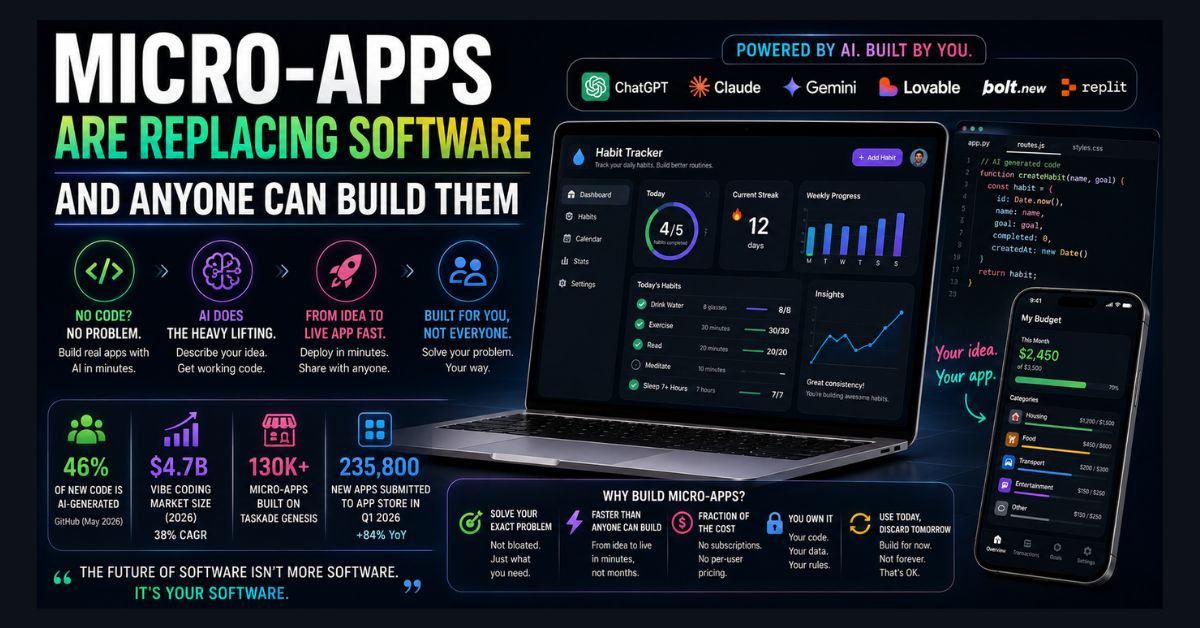
She wasn’t an outlier. By May 2026, GitHub reports that 46% of all new code is AI-generated. Gartner forecasts that 60% of all new code will be AI-generated by the end of this year. The vibe coding market — a term coined by AI researcher Andrej Karpathy in early 2025 — hit an estimated $4.7 billion, growing at 38% annually. Platforms like Taskade Genesis alone have seen over 130,000 micro-apps built. Apple’s App Store received 235,800 new app submissions in Q1 2026 — an 84% increase over the same period last year.
Software creation is no longer something that requires a computer science degree. It barely requires a weekend.
What Are Micro-Apps?
Micro-apps are small, purpose-built applications designed to solve one specific problem for one person or a small group. They’re not meant to scale to millions of users or compete with enterprise software. They’re built to fit a need that existing software doesn’t address — and they’re often discarded once that need passes.
The concept mirrors how social media democratized content creation and Shopify democratized e-commerce. Micro-apps are democratizing software itself. A marketing manager builds a custom client dashboard instead of paying $200/month for a SaaS tool that’s 90% features she doesn’t need. A teacher creates a quiz app tailored to her curriculum instead of adapting her curriculum to fit Kahoot. A freelancer builds a personal invoicing tool that works exactly the way he thinks about billing.
The difference between micro-apps and the “no-code” movement that’s been hyped for a decade is that micro-apps actually work. Previous no-code platforms let you drag and drop components, but the resulting apps were limited, slow, and fell apart when you needed anything beyond basic functionality. AI-powered vibe coding generates real code — full-stack applications with databases, APIs, and proper architecture — from natural language descriptions.
How People Are Actually Building Them
The tools fall into three categories, each suited to different skill levels.
For complete beginners (zero coding knowledge): Platforms like Lovable, Bolt.new, and Replit let you describe an app in plain English and get a working, deployed application in minutes. Bolt.new can take you from idea to live URL in 10 minutes. The trade-off is limited customization — the AI makes architectural decisions for you, and the generated code may not be production-quality for complex use cases. Pricing runs $25-29/month for the platforms that non-developers are using most.
For people willing to learn prompting: ChatGPT, Claude, and Gemini can generate complete application code when given detailed prompts. This requires more effort than the one-click platforms — you need to understand what you’re asking for, test the output, and iterate. But the results are more flexible and the tools are cheaper (most have generous free tiers). Our beginner’s guide to coding with AI walks through this approach step by step.
For developers who want to move faster: Professional AI coding assistants like GitHub Copilot, Cursor, and Claude Code don’t replace developer knowledge — they amplify it. A developer who previously built one micro-app per week can now build three. The quality ceiling is higher because the human understands architecture, security, and edge cases that pure AI generation misses. Enterprise adoption of AI coding tools grew 340% between 2024 and early 2026, and 87% of Fortune 500 companies now run at least one vibe coding platform.
Real Examples: What People Are Building
The range of micro-apps being built reflects how personal and specific software can be when anyone can create it.
Personal utilities: Restaurant recommendation apps, habit trackers, budget calculators designed around one person’s spending categories, family chore rotation systems, personal CRM tools for freelancers managing client relationships.
Seasonal and temporary apps: Holiday gift exchange coordinators that get used for two weeks in December then archived. Party planning apps for a single event. Fantasy sports drafting tools for one league.
Professional tools: Custom project dashboards that pull data from the specific combination of tools a team uses. Industry-specific calculators that existing software doesn’t support. Internal communication tools with workflows tailored to how one team actually works.
Educational tools: Students building study apps that quiz them on their specific coursework. Teachers creating interactive exercises customized to their class. Tutors building progress tracking tools for their individual students.
Small business solutions: Appointment scheduling apps that match a specific business’s hours and services. Customer feedback forms that feed into custom analysis dashboards. Inventory trackers built around a shop’s actual product categories rather than a generic retail template.
The Uncomfortable Truth: Quality and Security Gaps
The micro-app revolution has real problems that the hype tends to obscure.
Code quality is uneven. Several developers have noted that vibe-coded apps work great for prototypes but “have patterns you’ll regret at scale.” An app that works for 10 users may break at 1,000. AI-generated code often lacks proper error handling, input validation, and edge case management.
Security is a real concern. AI-generated apps frequently include hardcoded API keys, missing authentication, and SQL injection vulnerabilities. Apple noticed: app review times expanded from 24-48 hours to 7-30+ days as AI-generated submissions flooded the App Store. Apple removed three major vibe coding apps (Replit mobile, Vibecode, Anything) from the store entirely.
Maintenance becomes the user’s problem. Building an app in a weekend is fun. Maintaining it when a dependency breaks, a library gets deprecated, or a security vulnerability is discovered — that’s work. Most micro-app builders don’t account for ongoing maintenance, and many micro-apps become abandoned and insecure within months.
The professional developer isn’t going away. Despite breathless predictions, the tech layoff wave of 2026 is driven primarily by budget reallocation, not by non-developers replacing engineers. Complex software — the kind that handles payments, protects health data, or manages critical infrastructure — still requires professional engineering. What’s changing is who builds the simple stuff, and how much simple stuff exists.
Why This Matters for the Software Industry
The micro-app movement is reshaping multiple markets simultaneously.
The SaaS model is under pressure. Why pay $50/month for a project management tool with 200 features when you can build a custom tracker with the 5 features you actually use? SaaS companies that rely on lock-in rather than genuine value are most vulnerable. The ones that survive will be platforms that micro-apps are built on, not products that micro-apps replace.
The developer job market is bifurcating. The computer science enrollment exodus reflects students questioning whether traditional CS careers are worth pursuing when anyone can build an app. But the demand for engineers who can build secure, scalable, maintainable systems is actually increasing. The middle is hollowing out: simple app creation is being democratized while complex engineering becomes more valuable.
Software is becoming ephemeral. As one professor quoted in the original TechCrunch article noted, the trend mirrors social media — software itself is becoming temporary, appearing to fill a need and disappearing when that need passes. This is a fundamental shift from the “build once, use forever” assumption that has defined software for decades.
How to Build Your First Micro-App
If you’ve never built an app before, here’s the practical starting path:
Start with ChatGPT or Claude (both have free tiers). Describe what you want in plain language: “Build me a simple web app that tracks my daily water intake. It should have a button to add a glass, show today’s total, and display a weekly chart.” The AI generates working code that you can save as an HTML file and open in your browser.
Graduate to a platform if you want deployment. Bolt.new, Lovable, or Replit turn AI-generated code into live web apps with URLs you can share. These handle hosting, deployment, and basic infrastructure so you don’t have to.
Level up with real tools when you’re ready. Our complete guide to using AI for coding covers the full journey from first prompt to working project.
The barrier isn’t technical anymore. It’s imagination. The question is no longer “can I build this?” but “what should I build?”
FAQ
1. What’s the difference between micro-apps and no-code platforms?
No-code platforms (Bubble, Webflow, Airtable) use visual builders with drag-and-drop components. Micro-apps built with AI vibe coding generate actual code from natural language descriptions. The result is more flexible and less constrained by platform limitations. The vibe coding market ($4.7 billion) is growing nearly twice as fast as the traditional no-code market.
2. Do I need to know how to code to build a micro-app?
No. 63% of people engaged in vibe coding do not have a traditional development background. Platforms like Lovable and Bolt.new require zero coding knowledge. However, understanding basic programming concepts helps you write better prompts and troubleshoot issues.
3. Are micro-apps secure enough for business use?
For internal tools with non-sensitive data, generally yes. For anything handling customer data, payments, health information, or authentication, AI-generated code needs professional security review before deployment. Never deploy a vibe-coded app handling sensitive data without a security audit.
4. Will micro-apps replace professional developers?
No. They’re replacing simple, low-complexity software that shouldn’t have required a developer in the first place. Complex systems — enterprise software, financial platforms, healthcare tools, infrastructure — still require professional engineering. What’s changing is that the routine, simple tools are now being built by the people who use them.
5. How much does it cost to build a micro-app?
Free with ChatGPT or Claude’s free tiers for basic web apps. $20-29/month for platforms like Lovable, Bolt.new, or Replit that handle deployment. $0 if you use free hosting (GitHub Pages, Vercel free tier) with AI-generated code. The total cost is a fraction of what equivalent custom software development would cost.
Originally published: January 16, 2026. Updated: May 21, 2026 with latest market data, vibe coding statistics, and expanded coverage.