

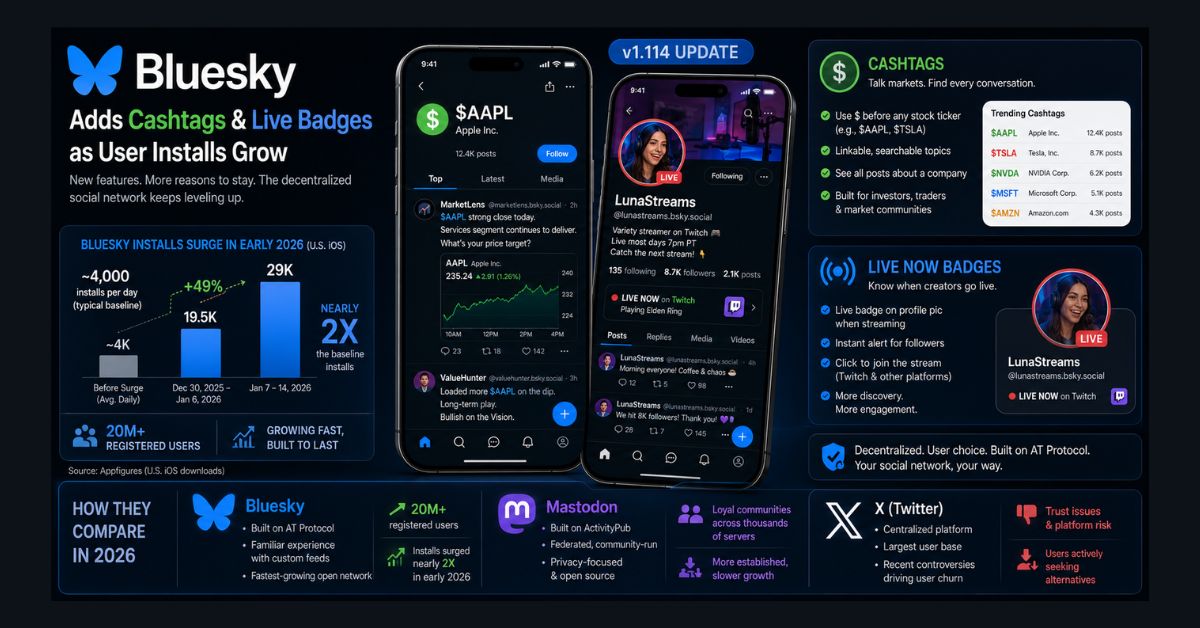
Bluesky — the decentralized social network built on the AT Protocol — added two features in early 2026 that pushed app installs sharply higher: cashtags for stock discussions and Live Now badges for streaming alerts. The update, version 1.114, landed right as users were fleeing X over a deepfake scandal, helping Bluesky nearly double its daily U.S. downloads. Here’s what the features do, the real growth numbers behind the headlines, and where Bluesky stands against X, Mastodon, and Threads in 2026.
What are Bluesky’s cashtags?
Cashtags bring a familiar finance convention to Bluesky. You create one by placing a dollar sign before a stock ticker — for example, $AAPL for Apple — turning it into a linkable, searchable topic that aggregates every post about that company or symbol. It works just like a hashtag, but purpose-built for markets and investing chatter.
The format isn’t new to social media. It was pioneered by the investing-focused network Stocktwits (now over 10 million users) and adopted by Twitter back in 2012. By adding cashtags, Bluesky is closing a gap with X and courting one of that platform’s most active communities: traders, investors, and finance commentators who organize conversations around tickers. The feature has since spawned a small ecosystem of third-party tools for organizing cashtag-based collections.
What are Live Now badges?
The second feature targets real-time engagement. Live Now badges are visual indicators that appear on a user’s profile picture when they’re actively livestreaming, letting followers jump straight to the broadcast. After a limited beta that began in May 2025 with select accounts — including the official NBA account — the v1.114 update opened the badge to all users.
There’s an important limitation: as of the rollout, Live Now badges only signal streams on external platforms like Twitch, not native broadcasting inside Bluesky itself. Clicking the badge takes you off-platform to the stream. It’s a discovery and notification tool for creators rather than a built-in live-video product — useful for streamers who want to alert their Bluesky following the moment they go live.
How much did Bluesky actually grow?
The feature launch coincided with a genuine install surge, and the numbers tell the story. According to app-analytics firm Appfigures, Bluesky normally sees around 4,000 U.S. installs per day. But between December 30, 2025 and January 6, 2026, U.S. iOS downloads hit roughly 19,500, then climbed to about 29,000 the following week (January 7–14) — a 49% jump and nearly double the pre-surge baseline. Bluesky has surpassed 20 million registered users overall.
What’s the real driver? Not just the new features. The spike lined up with a wave of users leaving X after a serious controversy: people were using X’s built-in Grok AI to generate non-consensual sexualized images of real women and, in some cases, minors — prompting an investigation by California’s attorney general. We covered that crisis in depth in our report on governments tackling non-consensual AI imagery on X and Grok. Bluesky’s timely feature update gave departing users extra reasons to stay.
Can Bluesky keep its new users?
This is Bluesky’s real challenge, and it’s worth being honest about. The platform has a history of boom-and-bust attention cycles: it surges whenever X stumbles, then struggles to retain those users once the news fades. In April 2025, Appfigures reported Bluesky’s downloads had hit record lows, and Similarweb data showed daily active mobile users had dropped nearly 40% by late October 2025.
So the 2026 install spike is encouraging, but installs aren’t engagement. Converting curious downloaders into habitual users — people who open the app daily out of routine rather than protest — is the metric that actually matters. Features like cashtags and live badges are part of that strategy: give niche communities (investors, streamers) a concrete reason to build a habit. Whether it works is the open question that will define Bluesky’s 2026.
Bluesky vs Mastodon vs X: how do they compare?
Bluesky sits in a crowded field of X alternatives, each with a different philosophy. Bluesky runs on the AT Protocol and offers a familiar, Twitter-like experience with portable identity and custom algorithmic feeds; it’s the fastest-growing of the open networks. Mastodon, which we explain in our guide to what Mastodon is and how it works, uses the older ActivityPub protocol and a federated, community-run model — more established but smaller in active users. X remains far larger than both but has driven away users through repeated controversies and trust issues.
The two open networks don’t natively interoperate (different protocols), so they’re competing for the same pool of X refugees rather than building one unified alternative. This fragmentation is part of the broader shift toward decentralized, user-owned platforms that we track in our overview of 2026 social media trends, where diversification away from any single platform has become a defining theme — much as ownership and platform-risk questions have shadowed other networks, including the saga aroundthe US TikTok deal.
Why these features matter for creators and brands
For creators, influencers, and brands, cashtags and live badges are practical engagement tools. Cashtags enable precise tagging and discovery of niche financial content, making it easier for finance creators to build an audience around specific tickers. Live Now badges let streamers instantly notify followers when they go live, driving traffic to their broadcasts. Both lean into the wider industry move toward real-time, community-driven discovery — the same priorities X and Threads have chased with their own feature updates. For a decentralized platform trying to prove it can be more than a protest destination, giving creators reasons to show up daily is exactly the right play.
FAQ
1. What is a cashtag on Bluesky?
A cashtag is a stock ticker preceded by a dollar sign — like $AAPL for Apple — that turns into a linkable, searchable topic aggregating posts about that company. Bluesky added cashtags in its v1.114 update in early 2026 to support finance and investing discussions, matching a popular feature on X.
2. What does the Bluesky Live Now badge do?
The Live Now badge appears on a user’s profile picture when they’re livestreaming, letting followers click through to the broadcast. As of the 2026 rollout it signals streams on external platforms like Twitch rather than native in-app video, working as a real-time alert tool for creators.
3. How many users does Bluesky have in 2026?
Bluesky has surpassed 20 million registered users. Its U.S. iOS installs nearly doubled in early 2026, jumping about 49% to roughly 29,000 per week during the surge, though sustaining daily active engagement remains its biggest challenge.
4. Why did Bluesky’s downloads surge?
The install spike coincided with users leaving X after a scandal involving its Grok AI being used to create non-consensual sexualized images, which drew a California attorney general investigation. Bluesky’s new cashtags and live badges gave departing users additional reasons to switch.
5. Is Bluesky better than Mastodon?
They serve similar goals differently. Bluesky uses the AT Protocol with a Twitter-like feel and is growing faster, while Mastodon uses ActivityPub with a federated, community-run model and a broader open ecosystem. The better choice depends on whether you prefer Bluesky’s familiarity or Mastodon’s decentralization.