

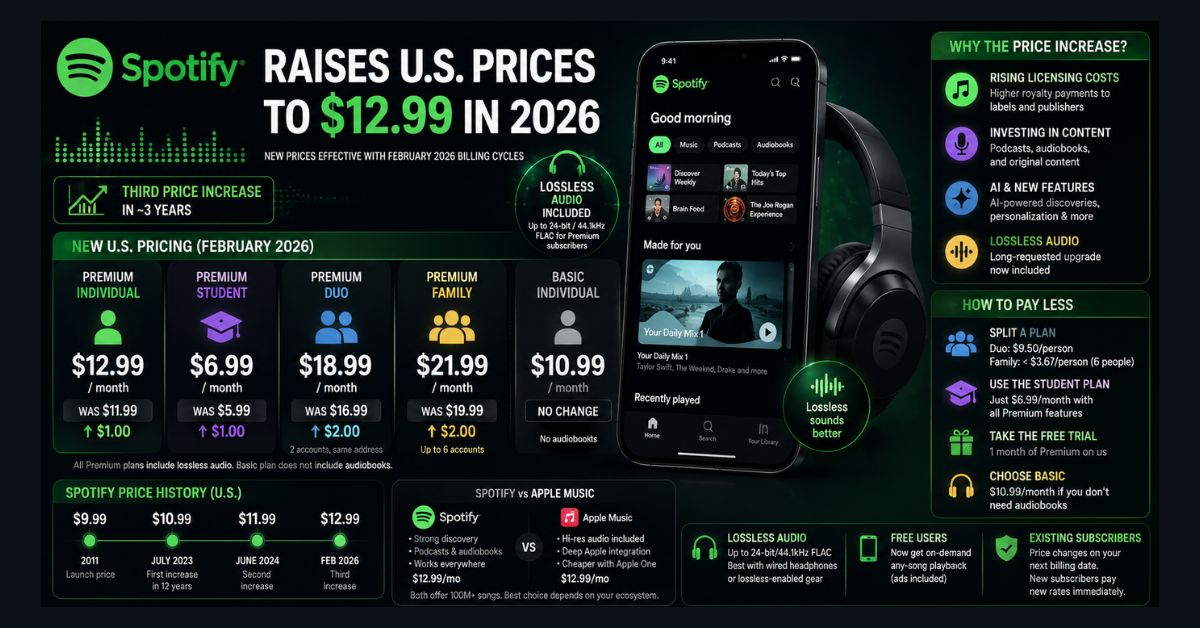
Spotify raised the price of its U.S. Premium plans starting with February 2026 billing cycles, pushing the individual plan from $11.99 to $12.99 per month. It’s the third increase in roughly three years, and this time every tier went up. Here’s exactly what each plan now costs, why Spotify keeps raising prices, how it compares to Apple Music, and the cheapest legitimate ways to keep Premium.
For 12 years after its 2011 U.S. launch, Spotify held its price at $9.99. Since 2023 it has more than made up for that restraint — and the latest hike lands right after the company finally delivered a long-requested feature, which is no coincidence.
What are Spotify’s new 2026 prices?
The February 2026 increase applied across the board in the U.S. Here’s where each plan now sits:
Premium Individual rose from $11.99 to $12.99/month. Premium Student went from $5.99 to $6.99/month. Premium Duo (two accounts, same address) climbed from $16.99 to $18.99/month. Premium Family (up to six accounts) increased from $19.99 to $21.99/month.
The one exception is the Basic Individual plan, which stays at $10.99/month — but only if you’re willing to give up audiobook access entirely. Spotify notified subscribers by email, and while existing customers saw the change on their next billing date, new sign-ups paid the higher rates immediately.
How much has Spotify gone up over the years?
The pace of increases has accelerated sharply. Spotify launched in the U.S. at $9.99 in 2011 and didn’t touch that price for over a decade. Then came three hikes in quick succession: to $10.99 in July 2023, $11.99 in June 2024, and now $12.99 in early 2026.
Put together, the individual plan has risen about 30% since 2011, and the family plan has jumped roughly 37.5%. What was once a set-it-and-forget-it subscription has quietly become an annual budgeting question for millions of listeners — part of a wider subscription-creep trend affecting everything from streaming video to the platform economics we discuss in our look at the US TikTok deal.
Why does Spotify keep raising prices?
Two forces are at work. The first is cost: music licensing and royalty payments to record labels are Spotify’s single biggest expense, and those deals keep getting more expensive. As essentially a pure-play streaming company — unlike Apple or Amazon, which can run music at thin margins to support a larger ecosystem — Spotify has little room to absorb rising costs without passing them on.
The second is investment. Spotify points to spending on podcasts, audiobooks, AI-powered features, and audio quality to justify the increases. The timing of this hike is especially telling: it arrived just after Spotify rolled out lossless audio in late 2025, a feature users had requested for years. By bundling a marquee upgrade with a price rise, Spotify reframes the increase as added value rather than a straight cost bump. The AI features it cites are part of the same competitive wave reshaping every app, from assistants to the tools in our Claude vs ChatGPT vs Gemini comparison.
What is Spotify Lossless, and is it worth it?
Lossless audio finally arrived for Premium subscribers in Q4 2025, offering streaming up to 24-bit/44.1kHz FLAC — a clear step up from the old 320kbps ceiling. Notably, Spotify made lossless available to all Premium tiers rather than locking it behind a separate, pricier “hi-fi” plan as it had once reportedly planned.
The catch: audio experts note Spotify’s lossless arrived years after rivals and may still not match the hi-res catalogs of Apple Music, Amazon Music HD, TIDAL, or Qobuz — several of which offer comparable or better quality at similar prices. And lossless only matters with the right gear; over a Bluetooth speaker, you won’t hear the difference, since Bluetooth can’t carry lossless audio anyway. Meanwhile, free users remain capped at 160kbps, though they did gain on-demand, any-song playback in 2025 when Spotify dropped its shuffle-only restriction.
Spotify vs Apple Music: which is better value in 2026?
At $12.99, Spotify Individual now sits at the higher end of mainstream music streaming, roughly level with Apple Music. The decision comes down to ecosystem and extras. Spotify wins on discovery, playlists, podcasts, audiobooks, and cross-platform flexibility — it works seamlessly across phones, desktops, speakers, and cars regardless of brand. Apple Music appeals if you’re deep in the Apple ecosystem and want hi-res audio bundled in, and it can be cheaper as part of an Apple One bundle.
If audio quality is your priority, dedicated audiophile services like TIDAL and Qobuz remain the connoisseur’s choice. For most listeners, though, the “best” service is the one whose library, recommendations, and integrations fit their daily habits.
How can you pay less for Spotify Premium?
You don’t have to simply swallow the increase. A few legitimate ways to cut the cost:
Split a Duo or Family plan. Duo works out to about $9.50 per person for two people, and Family (up to six accounts) drops the per-person cost much lower — both cheaper than paying for separate Individual plans. Use the Student plan if you qualify: at $6.99/month it’s the single best value and includes the same Premium features, including lossless. It pairs well with the other money-savers in our guide to the best AI tools for students. Take the free trial. Spotify still offers a one-month free Premium trial, a low-risk way to decide if ad-free, offline listening is worth it for you. Consider the Basic plan at $10.99 if you never use audiobooks.
And if you’re a creator rather than just a listener, the economics of music platforms tie directly into the broader creator-economy and social trends shaping how artists distribute and monetize their work — alongside the rise of AI music generation tools that are changing how music gets made in the first place.
Should you cancel or stick with Spotify?
For most subscribers, a $1/month increase isn’t enough to justify abandoning a library, playlists, and listening history built up over years — Spotify is betting on exactly that inertia. But if you rarely use the extras, listen mostly over Bluetooth where lossless is moot, or are already in the Apple ecosystem, this is a reasonable moment to reassess. The smartest move is to match your plan to your actual usage: downgrade to Basic, split a Family plan, or switch if a competitor genuinely serves you better. With price hikes now looking like an annual event, that’s a review worth repeating each year.
FAQ
1. How much does Spotify Premium cost in 2026?
As of the February 2026 increase, Spotify Premium Individual costs $12.99/month in the U.S. Student is $6.99, Duo is $18.99, and Family is $21.99. A Basic Individual plan remains $10.99 but excludes audiobooks.
2. Why did Spotify raise its prices again?
Spotify cites rising music licensing and royalty costs plus continued investment in podcasts, audiobooks, AI features, and lossless audio. As a streaming-only company, it has thinner margins than rivals like Apple and tends to pass cost increases on to subscribers.
3. Does Spotify have lossless audio now?
Yes. Spotify rolled out lossless audio for Premium subscribers in late 2025, streaming up to 24-bit/44.1kHz FLAC. It’s available across Premium tiers at no extra charge, though some rivals have offered comparable or higher-resolution audio for longer.
4. Is Spotify or Apple Music cheaper?
Both individual plans are priced similarly at around $12.99. Apple Music can be cheaper bundled into Apple One and includes hi-res audio, while Spotify offers stronger discovery, podcasts, and cross-platform flexibility. The better value depends on your ecosystem and what features you use.
5. How can I get Spotify Premium for less?
Split a Duo ($18.99 for two) or Family ($21.99 for up to six) plan to lower the per-person cost, use the $6.99 Student plan if eligible, take advantage of the one-month free trial, or choose the $10.99 Basic plan if you don’t need audiobooks.