

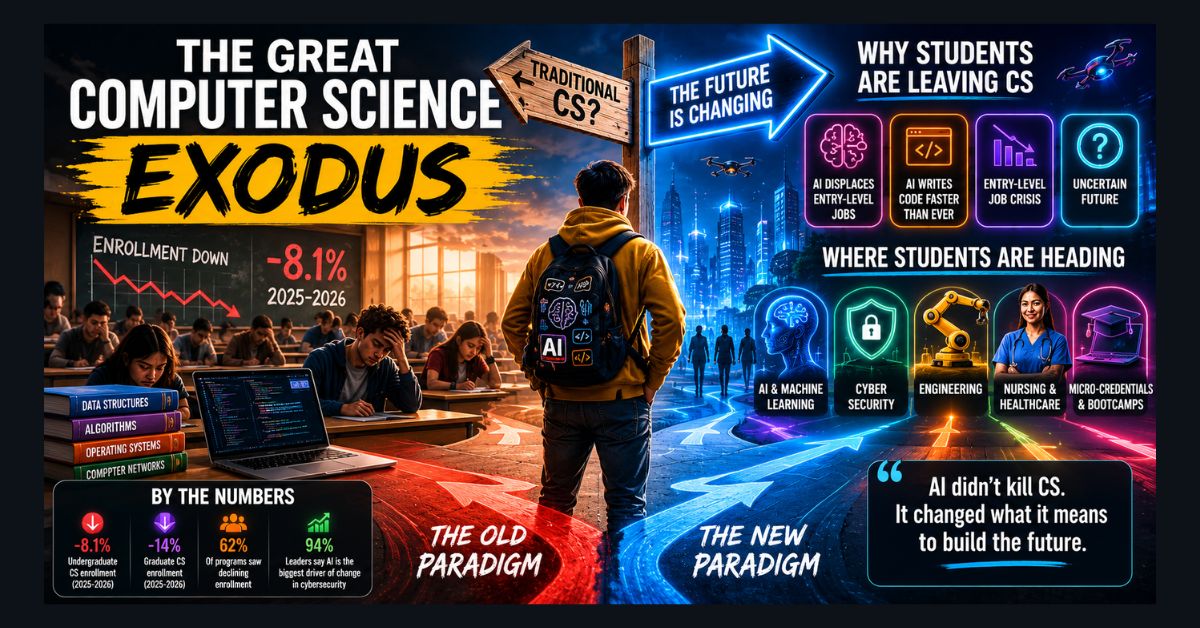
The computer science exodus refers to the sharp 2025–2026 decline in CS enrollment, as undergraduate CS enrollment fell 8.1% and graduate enrollment dropped 14% — the steepest one-year drop of any major since 2020. The main driver is fear that AI has eroded entry-level coding careers.
- The drop: Undergrad CS enrollment down 8.1%; graduate enrollment down 14% (2025–26)
- Widespread: 62% of computing programs report declining enrollment
- Main cause: Fear that AI has wiped out reliable entry-level coding jobs
- Backdrop: 113,000+ tech layoffs in 2026 amid $725B in AI spending
- The shift: Students moving toward AI-integrated and interdisciplinary fields
Computer science was the golden ticket. For fifteen years, enrollment surged, salaries climbed, and a CS degree from almost any university was a near-guarantee of a well-paying software engineering job. Between 2013 and 2023, the number of students earning CS bachelor’s degrees more than doubled — from 51,696 to 112,720.
That era is over. National Student Clearinghouse data shows that undergraduate enrollment in computer science programs at four-year universities dropped 8.1% in the 2025-2026 academic year — the steepest one-year decline of any major since at least 2020. Graduate enrollment fell even further, down 14%. The Computing Research Association’s CERP Pulse Survey found that 62% of computing programs reported declining enrollment, while only 13% saw increases.
Students aren’t abandoning technology. They’re abandoning the assumption that learning to code, by itself, leads to a career.
Why Students Are Leaving
The AI Displacement Narrative
The most powerful force driving the exodus is perception — whether fully accurate or not — that AI has “substantially wiped out” coding as a reliable career path. Nobel Prize-winning economist Simon Johnson used those exact words. By late 2025, some of the best engineers in the world said they had handed over most of their coding work to AI.
Students and parents are watching the headlines. Over 113,000 tech workers have been laid off in 2026 while companies spend $725 billion on AI infrastructure. Meta cut 8,000 jobs while simultaneously using AI surveillance software to study how employees work — then firing those employees. A Handshake survey found that 3.64% of pessimistic CS majors specifically cited generative AI as a factor in their career outlook. Inside Higher Ed reported that nearly half of college students surveyed in early 2026 had considered changing their major because of AI’s job-market impact.
As one CS department chair explained: “Whereas you used to need a person, or even a team of people, to set up a new website, to pitch a new product, or whatever it is you’re trying to do now, you can AI that in a matter of minutes.”
The Entry-Level Job Crisis
The fear isn’t abstract — it’s backed by hiring data. Entry-level software engineering positions have contracted as companies use AI to handle tasks that junior developers traditionally performed. Boilerplate code, basic debugging, API integration, and simple feature implementation can now be handled by AI coding assistants like GitHub Copilot, Cursor, and Claude Code.
The traditional career path — graduate with a CS degree, get hired as a junior developer, learn on the job, advance to senior roles — has a broken first step. If companies need fewer juniors because AI handles junior-level work, the pipeline that feeds the entire profession narrows.
At WashU, enrollment in Data Structures and Algorithms (a core CS course) dropped from 350 students to noticeably fewer in two years. Teaching assistant positions have been cut as class sizes shrink. The cascade is real and visible on campuses.
The “Vibe Coding” Effect
Making things worse for traditional CS enrollment: non-developers are now building functional applications without degrees. The micro-apps movement — where people use AI to “vibe code” custom software in days — has grown into a $4.7 billion market. GitHub reports that 46% of all new code is now AI-generated. Gartner forecasts 60% by year-end.
If a marketing manager can build a custom dashboard by describing it to Claude, and a student can build a personal app in a weekend using AI coding tools, the four-year degree requirement for “building software” feels increasingly hard to justify to an 18-year-old making enrollment decisions.
Where Students Are Going Instead
Students aren’t leaving tech entirely — they’re redirecting toward specializations they perceive as harder for AI to replace.
AI and Machine Learning Majors
The irony is thick: students are leaving CS because of AI, and heading to AI majors. UC San Diego was the only UC campus to see enrollment growth this fall — because it added a dedicated AI major. MIT, USC, Columbia, University of Pennsylvania, and Purdue have all launched AI-specific bachelor’s programs that are filling rapidly.
These programs focus on the systems behind AI rather than the code AI generates: machine learning theory, neural network architecture, data pipeline design, and AI safety. Students see these as the skills that will design the next generation of AI tools rather than be replaced by the current generation.
Engineering Disciplines
Mechanical, electrical, and biomedical engineering are absorbing some of the CS outflow. These fields involve physical systems that AI can assist with but cannot replace — you can’t vibe-code a bridge or prompt-engineer a medical device. Parents are increasingly steering students toward these fields, viewing them as more automation-resistant.
That assumption may be tested as AI aimed at engineering work itself moves from software into robotics, manufacturing, product design, and other physical-world workflows.
Cybersecurity
Cybersecurity enrollment is growing as students recognize that the AI vulnerability crisis is creating massive demand for security professionals. When AI can find tens of thousands of software vulnerabilities in weeks, someone needs to fix them — and that someone needs deep technical skills that overlap significantly with CS training.
Nursing and Skilled Trades
The most dramatic pivot isn’t within tech at all. BSN (nursing) program intake rose nearly 5% in the same window that CS fell 8%. Bureau of Labor Statistics projections show nursing and skilled trades growing well above average through 2034. Students are choosing professions where human presence is non-negotiable — you can’t automate a nurse at a patient’s bedside.
Micro-Credentials and Bootcamps
A growing number of students are opting for 3-6 month bootcamps and industry certifications instead of four-year degrees. The logic: in a field where technologies change every 6-12 months, a four-year curriculum can’t keep pace. Specialized credentials in AI engineering, cloud architecture, or cybersecurity can be earned faster and updated more frequently.
The Counterargument: CS Fundamentals Still Matter
Not everyone agrees the exodus is rational. Several CS department leaders interviewed by University Business called this a short-term disruption comparable to the dot-com crash and the 2008 recession — temporary enrollment dips that recovered as the market adjusted.
Their argument: AI tools generate code, but someone needs to understand architecture, systems design, security, scalability, and the fundamental algorithms that make AI itself work. The most productive developers in 2026 aren’t the ones who memorized syntax — they’re the ones who understand systems deeply enough to direct AI effectively. AI tools amplify expertise; they don’t replace it.
Harvard’s David Malan (who teaches CS50, the most popular CS course in history) argues that the decline reflects a paradox: coding as a manual skill is becoming less valuable, but computational thinking — the ability to reason about problems algorithmically — is becoming more valuable across every field. The enrollment drop may represent CS losing its monopoly on computational education rather than computation itself becoming irrelevant.
The data supports this nuanced view. While general CS enrollment drops, specialized CS subfields (AI, security, systems) are growing. Students aren’t rejecting computation — they’re rejecting the generic “learn to code” value proposition that drove enrollment for a decade.
What This Means for Current and Prospective Students
If you’re a current CS student: don’t panic. Your degree is not worthless — but it’s not sufficient either. Supplement your coursework with AI tools proficiency, learn to work with AI coding assistants rather than competing against them, and specialize in areas where human judgment remains essential (architecture, security, AI systems design).
If you’re considering CS: the degree still provides the strongest foundation for understanding how software and AI systems work at a fundamental level. But consider programs that integrate AI education into the core curriculum rather than treating it as an elective. Universities that have adapted their CS programs for the AI era are producing more employable graduates than those still teaching 2020-era curricula.
If you’re pivoting away from CS: understand what you’re pivoting toward and why. Engineering, cybersecurity, and healthcare are genuinely strong alternatives. But “anything that isn’t CS” isn’t a strategy — choose a field based on your interests and aptitudes, not just fear of AI displacement.
The AI companies themselves — SpaceX, OpenAI, and Anthropic are all going public this year with combined valuations approaching $3.7 trillion — are hiring aggressively for technical roles. The industry isn’t shrinking; it’s restructuring. The students who thrive will be the ones who adapt to the restructuring rather than flee from it.
For practical next steps, check our guides to using AI to write code as a beginner, the best AI tools for students, and the best laptops for college under $500.
FAQ
1. Is a computer science degree still worth it in 2026?
Yes, but with caveats. A CS degree provides the deepest foundation for understanding software systems, algorithms, and AI — skills that remain highly valued. However, a generic CS degree without AI proficiency, specialization, or practical project experience is less competitive than it was five years ago. Supplement your degree with AI tool skills and choose a specialization.
2. How much has CS enrollment dropped?
Undergraduate CS enrollment at four-year universities dropped 8.1% in 2025-2026, the steepest decline of any major. Graduate CS enrollment fell 14%. The Computing Research Association found that 62% of computing programs reported declining enrollment.
3. What majors are growing as CS declines?
AI and machine learning programs, cybersecurity, mechanical and electrical engineering, nursing (up ~5%), and skilled trades are all growing. Micro-credential programs and AI-focused bootcamps are also absorbing students who want tech careers without four-year CS degrees.
4. Will AI really replace programmers?
AI is replacing specific programming tasks (boilerplate code, simple debugging, basic feature implementation) but not the profession. Senior developers who understand architecture, security, and systems design are more in demand than ever. The role is shifting from “writing code” to “directing AI that writes code” — which requires deeper understanding, not less.
5. Should I switch from CS to an AI major?
Not necessarily. Many AI programs are essentially CS programs with an AI specialization — the fundamentals overlap significantly. If your current CS program offers AI courses, taking those may be more practical than switching majors entirely. The specific major matters less than the skills you acquire.
Originally published: February 15, 2026. Updated: May 22, 2026 with National Student Clearinghouse enrollment data, vibe coding market data, and 2026 industry hiring context.