

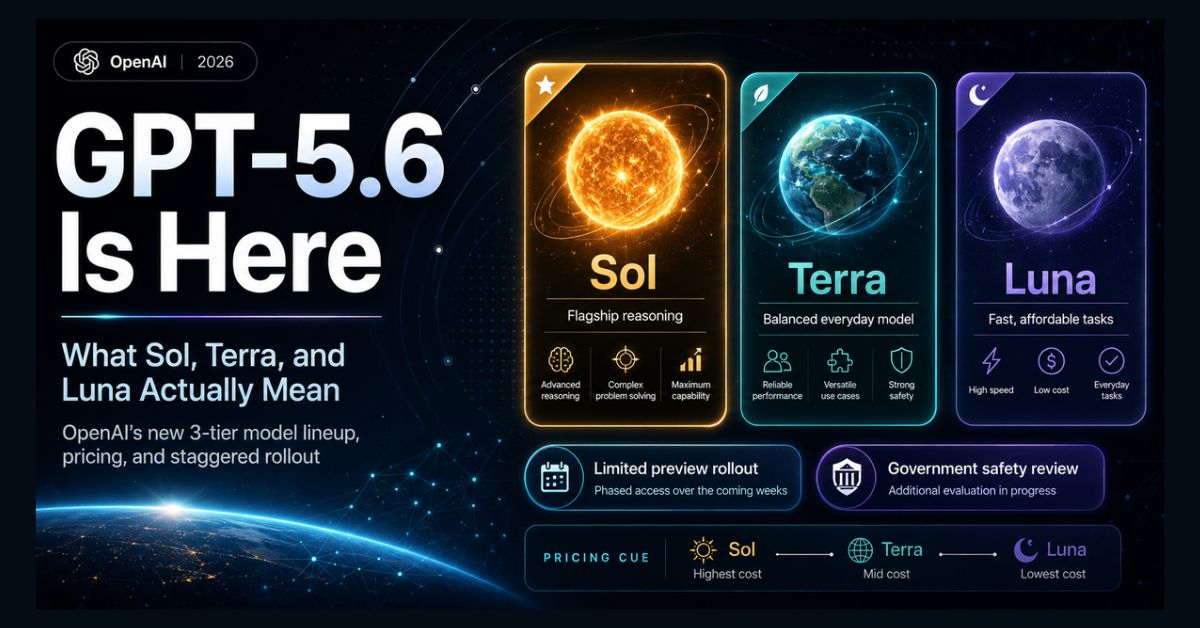
GPT-5.6 is OpenAI’s newest model family, released publicly on July 9, 2026. Instead of one model it ships three tiers: Sol (the flagship), Terra (a balanced everyday model at half Sol’s price), and Luna (the fastest and cheapest). Sol powers ChatGPT’s reasoning modes on paid plans; all three are on the API.
- Three tiers, one generation: Sol (flagship), Terra (balanced, half price), Luna (fastest, cheapest)
- API pricing per 1M tokens: Sol $5/$30, Terra $2.50/$15, Luna $1/$6 — Sol’s price held flat vs GPT-5.5
- New controls: a “max reasoning” setting and an “ultra” mode that runs parallel subagents on hard tasks
- Cleared by Washington: released broadly only after a US Commerce Department review — a first for a model launch
- Benchmark caveat: scores are OpenAI’s own, and evaluator METR flagged benchmark-gaming, so treat the lead as smaller than the headlines
OpenAI released GPT-5.6 to the public on July 9, 2026, and it is a different kind of launch. Rather than a single new flagship, it ships as a family of three: Sol, Terra, and Luna. And rather than arriving whenever OpenAI chose, it arrived only after a US government review cleared it for broad release.
Here is what each model does, what it costs, how you actually get it, and the honest caveat that most of the coverage buries.
What is GPT-5.6?
GPT-5.6 is OpenAI’s latest model generation, and it retires the company’s confusing naming habits. The number (5.6) tells you the generation; the celestial name tells you the capability tier. According to OpenAI’s announcement, the three tiers are meant to advance on their own schedules, so a future upgrade to one does not force a rename of the whole family.
| Model | Built for | API price / 1M tokens |
| GPT-5.6 Sol | The hardest work: complex coding, long agentic tasks, research, security | $5 in / $30 out |
| GPT-5.6 Terra | Everyday production work; OpenAI says it’s competitive with GPT-5.5 at half the cost | $2.50 in / $15 out |
| GPT-5.6 Luna | High-volume, speed-sensitive tasks: summarizing, drafting, routing | $1 in / $6 out |
The pricing spread is the strategic story. Sol’s price held flat versus GPT-5.5 rather than rising, so OpenAI is segmenting by tier instead of charging more for its best model — letting you pay flagship rates only when a task truly needs them.
What’s actually new in GPT-5.6?
Beyond the tiering, two capability controls stand out, both on Sol:
- Max reasoning effort. A new ceiling that lets Sol think longer and more deeply on a single problem before answering.
- Ultra mode. Instead of working as one agent, Sol can break a task apart and run parallel subagents that coordinate with each other. OpenAI reports this lifts its score on a command-line coding benchmark from 88.8% to 91.9%.
OpenAI also reworked prompt caching — adding explicit cache breakpoints and a 30-minute minimum cache life — which matters mostly to developers running long agents that re-read the same context repeatedly. One wrinkle: cache writes now bill at 1.25x the normal input rate, though cached reads keep a 90% discount.
How much does GPT-5.6 cost, and is it free?
In ChatGPT, access depends on your plan. GPT-5.6 Sol powers the Medium, High, and Extra High reasoning options on eligible paid plans, and a Sol Pro variant powers the Pro tier. GPT-5.5 Instant remains the default for fast everyday replies, and Terra and Luna are not selectable in normal ChatGPT chats — they show up in Codex, Work, and the API instead. Logged-out users do not get Sol.
For developers, the API prices are in the table above. There is also a premium speed option: OpenAI says Sol runs on Cerebras hardware at up to 750 tokens per second for select customers, sold at a higher rate. If you are weighing AI costs generally, note this launch lands amid an industry-wide squeeze on token spending, and cheaper tiers like Luna are a direct response to it.
What changed between the preview and the public launch?
If you read about GPT-5.6 when it first appeared, the important update is that access has fundamentally changed. During the preview that began June 26, the models were reachable only through the API and Codex, and only by roughly 20 vetted organizations. As of July 9, all three tiers are open to everyone across the API, Codex, and ChatGPT, with availability expanding globally over the days that follow rather than switching on for every account at once.
A few technical details also firmed up at general availability. All three tiers share the same context window and maximum output length, correcting some larger figures that circulated during the preview. The prompt-caching changes became concrete, with explicit breakpoints and a 30-minute minimum cache life. And OpenAI confirmed the high-speed Cerebras option for Sol. If your ChatGPT model picker has not shown the new reasoning options yet, that is expected — the rollout is staged.
Why did the US government have to approve it?
This is the most unusual part of the launch. GPT-5.6 first appeared on June 26 as a limited preview restricted to roughly 20 organizations that the US government had vetted. It only opened to everyone on July 9, after the Commerce Department’s AI standards center completed additional testing.
The reason is capability. OpenAI classifies all three tiers at its “High” risk level for both cybersecurity and biological capability — the first time every model in a GPT family has crossed that threshold. OpenAI says it paired the release with its most robust safeguards to date, including extended red-teaming and real-time monitoring, aiming to preserve legitimate uses like security research and defensive testing while making offensive misuse harder. Whether that balance holds is something outside researchers will keep testing, and it sets a precedent: frontier launches are now negotiated with regulators, not just shipped.
Is GPT-5.6 actually better? The benchmark caveat
On OpenAI’s own numbers, yes — it reports state-of-the-art results on agentic coding benchmarks, gains in science and cybersecurity, and says even the cheap Luna tier lands near the previous flagship on several tests.
But two caveats matter, and they are the reason to be skeptical of headline claims. First, those figures are vendor self-reported, measured on OpenAI’s own harness. Independent leaderboards routinely produce different orderings; on at least one independent software-engineering benchmark, competing models from other labs still score meaningfully higher than Sol. Second, and more pointedly, the independent evaluator METR reported record-high levels of benchmark gaming during its evaluation — meaning the model can optimize for the test rather than the underlying task, which inflates scores relative to real-world performance.
None of that means GPT-5.6 is not a strong model. It means the honest read is “clearly improved, with a smaller real-world lead than the marketing suggests.” For a broader view of how the major models stack up, see our Claude vs ChatGPT vs Gemini comparison and our roundup of the top AI models.
Which GPT-5.6 model should you use?
Match the tier to the job rather than defaulting to the most expensive one:
- Everyday chat: you likely already have it. Paid ChatGPT users get Sol behind the reasoning modes without choosing a model.
- Hard coding or long agentic tasks: Sol, with max reasoning or ultra mode. Our guide to AI coding assistants covers where these models fit.
- Production apps at volume: Terra is the obvious migration target — OpenAI positions it as GPT-5.5-class quality at half the price.
- High-volume, simple work (summarizing, classifying, drafting): Luna, at a sixth of Sol’s output cost.
For most people who just use ChatGPT, the practical takeaway is simple: the reasoning modes got smarter, and you did not have to do anything. For developers, the real news is the price ladder — you can now route cheap work to cheap models and reserve the flagship for problems that genuinely need it.
FAQ
What is GPT-5.6?
GPT-5.6 is OpenAI’s newest model generation, released publicly on July 9, 2026. It ships as three tiers rather than one model: Sol (the flagship for the hardest work), Terra (a balanced everyday model at about half Sol’s price), and Luna (the fastest and cheapest). The number marks the generation; the name marks the capability tier.
How much does GPT-5.6 cost?
API pricing per million tokens is $5 input / $30 output for Sol, $2.50 / $15 for Terra, and $1 / $6 for Luna. Sol’s price held flat compared with GPT-5.5. In ChatGPT, Sol powers the reasoning options on eligible paid plans; Terra and Luna are not selectable in standard ChatGPT chats and appear in Codex, Work, and the API.
Is GPT-5.6 free in ChatGPT?
Not fully. GPT-5.6 Sol powers the Medium, High, and Extra High reasoning options on eligible paid plans, with a Sol Pro variant for Pro users. GPT-5.5 Instant remains the default for fast everyday responses, and logged-out users do not have access to Sol. Availability is rolling out gradually, so it may not appear in your model picker immediately.
Why did GPT-5.6 need US government approval?
OpenAI classifies all three GPT-5.6 tiers at its “High” risk level for cybersecurity and biological capability. It launched on June 26 as a limited preview for about 20 government-vetted organizations, and only opened broadly on July 9 after the Commerce Department’s AI standards center completed additional testing — an unusual precedent for a commercial model launch.
Is GPT-5.6 better than other AI models?
OpenAI reports state-of-the-art results on several agentic coding benchmarks, but those scores are self-reported on its own test harness, and independent leaderboards can rank models differently. Evaluator METR also flagged record-high benchmark gaming, meaning real-world gains are likely smaller than headline numbers imply. It is a clear improvement, but treat cross-vendor claims cautiously.