

Quick Answer
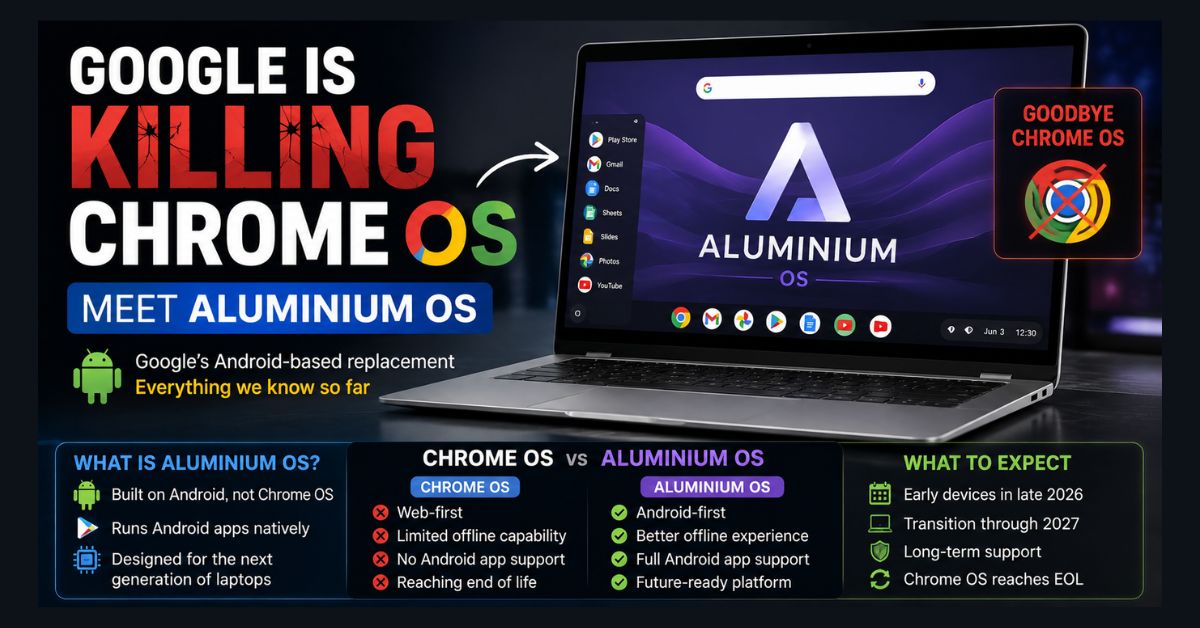
Aluminium OS is Google’s Android-based desktop operating system that replaces ChromeOS on consumer laptops, announced May 12, 2026. The first Googlebook devices are confirmed for fall 2026, not Q3, from five OEMs including Dell. Google is targeting the premium tier above $999, not the budget Chromebook market it built.
Key Takeaways
- Google confirmed a fall 2026 launch window — earlier “Q3” and “early summer” claims were not confirmed by Google
- Five OEMs are confirmed: Acer, ASUS, Dell, HP and Lenovo — Dell was often omitted from early coverage
- Bloomberg reports entry pricing above $999, positioning Googlebook against the MacBook, not budget Chromebooks
- “Aluminium” is a development codename; the retail OS name is still unannounced as of late July 2026
- ChromeOS continues for enterprise and education, with a full transition not expected to complete until around 2034
What is Aluminium OS, and what did Google actually confirm?
Aluminium OS is a desktop operating system built on Android 17 that replaces ChromeOS on consumer hardware. Google announced it on May 12, 2026, at The Android Show: I/O Edition, and confirmed a new laptop brand to go with it: the Googlebook, replacing the Chromebook name for consumer devices.
The core technical claim is the one worth holding onto, because it is the reason the project exists. Previous attempts to run Android apps on Chromebooks used ARC, a translation container layered on top of Chromium OS. Apps ran poorly, crashed, and handled keyboard and mouse input badly. Aluminium OS removes the container because the operating system itself is Android. Apps run natively, which is Google’s stated fix for a decade of poor app behaviour on its laptops.
This refresh matters because the story has firmed up considerably since the announcement, and several widely circulated details from the first wave of coverage turned out to be wrong. One outlet issued a formal correction noting that a widely shared summary contained incorrect launch timing, wrong upgrade-eligibility criteria, overstated feature confirmations, and a mischaracterisation of the OS’s origins. The section below separates what Google confirmed from what did not hold up.
When does Aluminium OS actually launch?
Fall 2026. That is the window Google itself gave, and it is more specific to state than the ranges that circulated earlier.
Google confirmed hardware “in the fall” of 2026 without naming a date. A number of early reports compressed this into “Q3 2026” or even “early summer,” and at least one claimed pre-orders had already opened. Those tighter timings were not confirmed by Google, and a leaked early build that surfaced days after the announcement looked rough enough to be consistent with a later, holiday-season target rather than a summer one. The most reliable framing right now is fall 2026 for the first devices, with a broader rollout through the holiday season.
As of late July 2026, no retail Googlebook has shipped and no firm on-sale date has been published. The software is expected to ship in step with Android 17, which follows a second-quarter major release and a fourth-quarter minor update. So the schedule is real and near, but it has not started yet — anyone who told you devices were arriving in summer was ahead of Google.
Who is building Googlebooks, and how much will they cost?
Five manufacturers are confirmed, and this is a place early coverage was incomplete.
The confirmed OEMs are Acer, ASUS, Dell, HP and Lenovo — the same companies that built the Chromebook ecosystem, plus Dell, which was frequently missing from the first round of reporting. Dell’s inclusion is strategically significant because it is the dominant enterprise-procurement laptop vendor, which signals ambitions beyond the consumer launch.
On price, the direction is the opposite of what the Chromebook legacy would suggest. Google has positioned Googlebook at the premium end of the laptop market, and Bloomberg has reported that entry pricing for the first wave could start above $999 — MacBook territory. Reported hardware requirements point the same way: figures circulating before I/O described a Gemini Intelligence minimum of around 12GB of RAM and a qualified flagship processor. That is a deliberate move up-market.
| Detail | Early reports claimed | What’s actually confirmed |
|---|---|---|
| Launch window | Q3 2026 / early summer | Fall 2026 (Google’s own wording) |
| Pricing | Budget devices under $300 | Premium; Bloomberg reports $999+ entry |
| OEM partners | Often listed 4 (Acer, ASUS, HP, Lenovo) | 5 confirmed, including Dell |
| Retail OS name | Sometimes treated as final | “Aluminium” is a codename; name still unannounced |
| Chromebook upgrades | Specific spec cutoffs stated as fact | Eligibility unconfirmed by Google |
Pricing here is reported and pre-launch, not official — treat the $999 figure as a Bloomberg estimate to confirm when OEMs publish individual SKUs closer to launch. If you need a laptop today, that is covered in our guide to the best laptops for students under $500.
What can Aluminium OS actually do?
The headline feature is Gemini built into the operating system rather than bolted on as an app.
The most concrete example Google demonstrated is Magic Pointer: shaking the cursor lets Gemini read what is on screen and offer contextual actions — analysing a chart, rewriting a paragraph, summarising a document. It extends the assistance covered in our guide to Gemini in Docs, Sheets and Slides from Workspace apps to the whole OS, and connects to Google’s AI Mode, which already pulls context from Gmail and Photos.
Beyond the AI layer, Aluminium OS is described as a genuine desktop environment: a taskbar, virtual desktops, snap-layout window management, a Files app with real folder navigation, and a built-in Linux terminal for developers. It supports Chrome browser extensions, so an existing extension library carries over. Phone integration mirrors apps and notifications from an Android phone, and Google confirmed a “Link to iOS” app for limited iPhone interoperability.
One caution the marketing understates. Aluminium OS inherits Android’s long-standing weakness with large-screen app layouts. Google says a new window manager handles resizing, and it has added a desktop device profile to the Android Studio emulator so developers can test for laptop screens. But app optimisation depends on developers, not Google, and early Googlebook users will likely hit apps that do not scale cleanly. This is the single biggest open risk to the platform, and it is a developer-ecosystem problem rather than an OS one.
What happens to ChromeOS and existing Chromebooks?
ChromeOS is being phased out on consumer hardware, but it is not disappearing on the timeline the “ChromeOS is dead” framing implies.
Google confirmed that ChromeOS continues for enterprise and education — the managed, locked-down deployments that schools and IT departments rely on. Reporting tied to the search antitrust proceedings points to a full consumer phase-out around 2034, aligned with Google’s ten-year update commitment for Chromebooks released from 2021 onward. The enterprise and education transition to the new platform is not expected to complete until roughly 2028. ChromeOS Flex, for installing ChromeOS on older PCs, also continues.
For existing Chromebook owners, the honest status is: your device keeps receiving ChromeOS updates on its current support schedule, and there is no need to replace it. Whether your specific Chromebook can upgrade to Aluminium OS is unconfirmed. Early coverage stated firm spec cutoffs — particular Intel generations, exact RAM and storage minimums — as though Google had published them. Google has not confirmed upgrade eligibility, so treat any specific model-by-model list as speculation until Google says otherwise.
How does this compare to Windows and macOS?
The launch lands in the middle of an industry-wide rebuild of the operating system around AI.
Microsoft is embedding Copilot across Windows, a direction we covered from Build 2026. Apple is threading Apple Intelligence through iOS, iPadOS and macOS, compared in our Gemini vs Apple Intelligence piece. Google’s structural argument is that building from Android rather than retrofitting an existing OS lets it integrate Gemini more deeply. That is a plausible engineering claim, but it is a claim about potential, not a demonstrated advantage, and Google has a track record of ambitious platforms that did not last.
The comparison that matters most for buyers is narrower. A Googlebook runs Android and Linux apps natively; it does not run Windows applications natively, though cloud-based Windows options work through the browser. At a $999-plus entry price competing directly with the MacBook, Aluminium OS is asking premium money for a desktop platform with no track record — a genuinely different proposition from the cheap, browser-first Chromebook that built the brand.
Should you wait for a Googlebook or buy now?
Wait to buy the platform, not the hardware you need today.
If your current laptop works, there is no reason to replace it ahead of a fall launch of a first-generation platform. First-generation operating systems ship with rough edges, and Aluminium OS carries a specific known risk in large-screen app quality that will take developers months to address after devices ship. Buying into version 1.0 means being an early tester.
If you need a laptop now, buy for today’s needs. A current Chromebook Plus remains a solid browser-first machine and will keep getting updates. If you are weighing a slow Windows machine, our guide to making a laptop faster may buy you time until the landscape settles. And if you are choosing mainly for the AI assistant, that decision does not require new hardware — it is covered in our Claude vs ChatGPT vs Gemini comparison, since Gemini already runs on the device you own.
The reasonable move is to watch the fall launch, wait for real-device reviews and confirmed pricing, and let the app-optimisation situation clarify before committing to a Googlebook.
FAQ
When will Googlebooks be available to buy?
Google confirmed a fall 2026 launch window without a specific date, with a broader rollout through the holiday season. Earlier “Q3 2026” and “early summer” timings were not confirmed by Google. As of late July 2026, no retail Googlebook has shipped and no firm on-sale date has been published.
Is “Aluminium OS” the final name?
No. Google has confirmed that “Aluminium” is a development codename and that the consumer-facing operating system name will be revealed later in 2026. As of late July 2026 the retail name has not been announced. The hardware brand is Googlebook.
How much will a Googlebook cost?
Google has not confirmed pricing. Bloomberg has reported that entry-level Googlebooks could start above $999, placing them against the MacBook rather than the budget Chromebook segment. Reported hardware minimums, including around 12GB of RAM, point the same way. Final pricing should arrive as OEMs reveal individual models closer to the fall launch.
Will my existing Chromebook get Aluminium OS?
Unconfirmed. Google has not published upgrade-eligibility criteria, so specific processor, RAM and storage cutoffs that appeared in early coverage should be treated as speculation. Existing Chromebooks will continue to receive ChromeOS updates on their current support schedules regardless, so there is no urgency to replace a working device.
Can Aluminium OS run Windows apps?
No. Aluminium OS runs Android apps natively and Linux apps through its built-in terminal. Windows applications are not supported natively, though cloud-based Windows options such as Microsoft 365 on the web and Windows 365 Cloud PC work through the Chrome browser, as they do on current Chromebooks.
Is ChromeOS being discontinued?
Only on consumer hardware, and gradually. ChromeOS continues for enterprise and education deployments, and ChromeOS Flex remains supported. Reporting tied to antitrust proceedings points to a full consumer phase-out around 2034, aligned with Google’s ten-year Chromebook update commitment. This is a multi-year transition, not an overnight switch-off.