

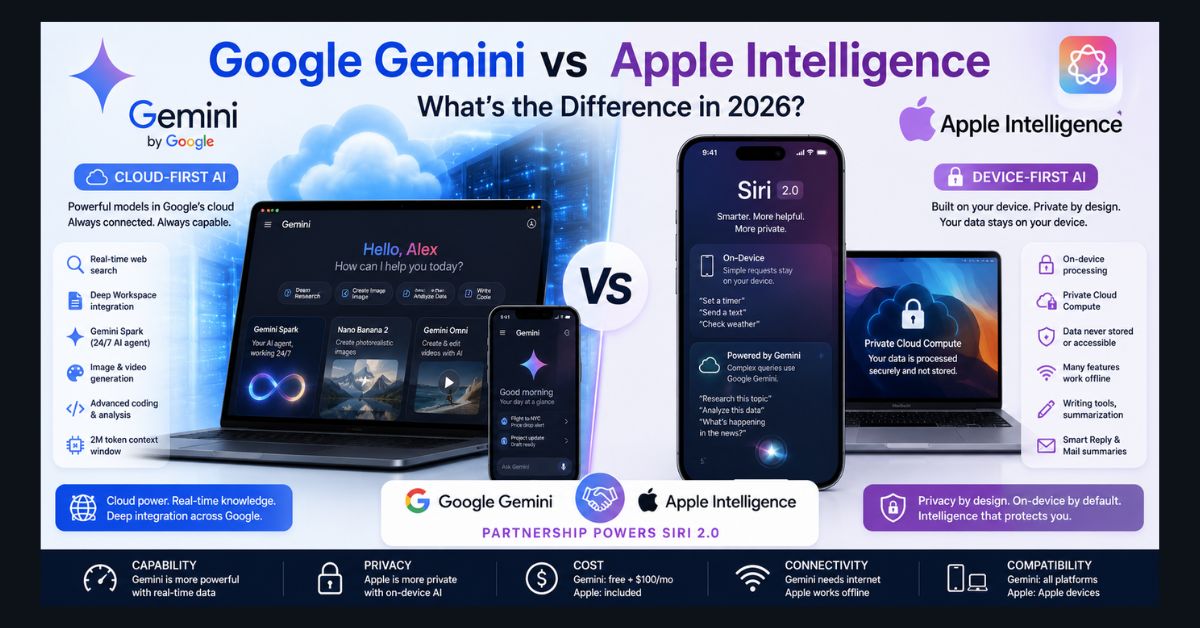
Google Gemini and Apple Intelligence differ mainly in where they process data. Gemini runs in Google’s cloud, with a free plan and paid tiers from $4.99 to $199.99 a month in the US as of October 2026. Apple Intelligence runs on-device or on Apple’s Private Cloud Compute and is included with compatible iPhones, iPads, and Macs.
- Architecture: Gemini is cloud-first; Apple Intelligence is device-first, with Private Cloud Compute for heavier tasks
- Siri AI: the rebuilt Siri began rolling out as a beta with iOS 27 on September 14, 2026, built on Apple models based on Gemini
- Gemini pricing (US, October 2026): Free, AI Plus $4.99, AI Pro $19.99, and AI Ultra from $99.99 per month
- Apple Intelligence cost: no subscription, but server-side features carry daily usage limits
- Supported iPhones: iPhone 15 Pro and Pro Max, iPhone 16 models or later, iPhone Air, and iPhone Duo
Google and Apple are taking fundamentally different approaches to AI — and understanding the difference matters for choosing your next phone, laptop, and the digital ecosystem you’ll live in for the next several years.
Google Gemini is cloud-first: powerful models running on Google’s data centers, accessing your Gmail, Drive, Calendar, and Photos to provide deeply personalized responses. Apple Intelligence is device-first: smaller models running directly on your iPhone, iPad, and Mac, processing data locally so it never leaves your hardware.
Neither approach is universally “better.” Each makes deliberate trade-offs between capability and privacy. Here’s how they compare across the dimensions that actually affect your daily experience.
The Core Architecture: Cloud vs Device
Google Gemini runs primarily in the cloud. When you ask Gemini a question, your request travels to Google’s massive data centers, where models such as Gemini 3.8 Flash and Gemini 4 Argon process it and send back a response (the free plan uses Gemini 3.5 Flash-Lite as of October 2026, according to Google’s plans page). This cloud-first approach means Gemini can access real-time information via Google Search, process large context windows (up to 1 million tokens on AI Pro and AI Ultra, and 32,000 tokens without a plan, per Google’s Gemini Apps limits page), generate photorealistic images and video, and run persistent agents (Gemini Spark) that work 24/7 even when your phone is off.
The Google I/O 2026 announcements pushed Gemini even further into the cloud, with Spark running as a persistent AI agent that monitors your tasks, tracks flight prices, and takes actions on your behalf continuously. Gemini now works across Docs, Sheets, and Slides with deep workspace integration that pulls context from your entire Google ecosystem.
Apple Intelligence runs primarily on-device. Apple’s models are engineered to be small enough to run on the Neural Engine built into Apple silicon (A17 Pro and newer). Text summarization, writing tools, image understanding, notification summaries, and most Siri processing all happen locally — your data never leaves your iPhone or Mac.
Only when a task exceeds on-device capability does Apple route it to Private Cloud Compute — Apple’s cloud infrastructure that processes data without storing it, without making it accessible to Apple employees, and with hardware that can be independently verified by security researchers. The data is processed, the response is returned, and no trace remains.
The practical impact: Gemini is significantly more capable but requires constant internet and trusts Google with your data. Apple Intelligence is more private but handles fewer tasks and can’t match Gemini’s raw power.
Feature-by-Feature Comparison
| Feature | Google Gemini | Apple Intelligence |
| Text generation | Full articles, code, analysis, creative writing | Writing tools (rewrite, proofread, summarize) |
| Image generation | Nano Banana 2 (photorealistic, included on the free plan; limits vary by plan) | Image Playground (photorealistic and other styles since iOS 27; daily usage limits) |
| Image understanding | Detailed analysis, Google Lens integration | On-device description, VoiceOver integration |
| Video generation | Gemini Omni (conversational video creation and editing; paid Google AI plans) | Not available |
| Web search | Native Google Search (real-time, cited) | Siri AI web search for up-to-date answers (iOS 27 beta) |
| Voice assistant | Gemini voice mode (natural conversation) | Siri AI (iOS 27 beta, built on Apple Foundation Models based on Gemini) |
| Persistent agent | Gemini Spark (runs 24/7 in cloud; paid plans, select countries) | Not available |
| Email integration | Deep Gmail/Workspace — pulls context across apps | Mail summarization, Smart Reply |
| Code generation | Full coding capabilities, Google Antigravity agent (AI Pro and AI Ultra) | Not available on-device |
| Privacy model | Cloud-processed, subject to Google data policies | On-device + Private Cloud Compute (data not stored) |
| Offline functionality | Very limited — most features need internet | Many features work fully offline |
| Price | Free tier; AI Plus $4.99, AI Pro $19.99, AI Ultra from $99.99/month (US, as of October 2026) | Included with compatible hardware (no subscription); daily limits on server-side features |
The Surprise Partnership: Siri Built With Gemini
The most interesting development in 2026 is that Apple and Google aren’t purely competitors. In a joint statement on January 12, 2026, the companies said the next generation of Apple Foundation Models would be based on Google’s Gemini models and cloud technology. Those models now power Siri AI, the rebuilt Siri that began rolling out as an English-language beta with iOS 27 on September 14, 2026, according to Apple. Here’s how the partnership works:
For simple requests (setting timers, sending texts, checking weather, basic calculations), Siri uses Apple’s on-device models running locally on your iPhone. No data leaves the device, and the response comes back quickly.
For complex queries, such as detailed research questions, multi-step reasoning, and analysis of current events, Siri sends the request to Apple’s server models on Private Cloud Compute. Apple says these cloud models were refined using outputs from Gemini frontier models, and Apple software chief Craig Federighi said Apple does not use the Gemini app or Google’s own deployment infrastructure to run them, as 9to5Mac reported after WWDC. For its largest model, Apple says it is extending Private Cloud Compute to NVIDIA GPUs in Google’s cloud while keeping its privacy guarantees.
This means iPhone users get Gemini-derived reasoning inside Apple’s privacy framework rather than a direct connection to Google’s Gemini service. The arrangement still has limits: Siri AI is labeled a beta, Apple says it is not available initially in the EU on iPhone or in China, and certain server-side Apple Intelligence features are subject to daily usage limits. For more detail on the rollout, see our Siri AI in iOS 27 coverage.
Privacy: The Philosophical Divide
This is where the core difference is sharpest, and where your personal priorities determine which approach is “better.”
- Google’s philosophy: Your data makes the AI better. Gemini accesses your Gmail, Photos, Calendar, and Drive to provide personalized responses that no device-only AI can match. Google’s privacy policy allows data processing for service improvement. On paid Workspace plans, Google states data isn’t used for model training — but the consumer tier has fewer explicit guarantees.
- Apple’s philosophy: Your data stays yours. Apple Intelligence processes data on-device whenever possible. When cloud processing is needed, Private Cloud Compute ensures data isn’t stored after processing, isn’t accessible to Apple employees, and runs on hardware with a verifiable security chain. Apple explicitly states it does not use your personal data to train AI models, on any tier, for any feature.
For users who prioritize privacy above all, Apple’s architecture is structurally superior — the data literally cannot be misused because it’s never stored. For users who want the most capable, personalized AI regardless of data handling, Gemini’s cloud access to your entire digital life enables things device-only processing simply can’t do.
For broader digital privacy strategies beyond the Gemini/Apple choice, see our cybersecurity and data privacy guide.
Who Should Choose What
- Choose Apple Intelligence if: Privacy is your top priority and you refuse to have personal data processed in the cloud. You’re already in the Apple ecosystem (iPhone + Mac + iPad). You want AI features that work offline and on-device. You’re okay with less powerful but more private AI capabilities. And you don’t want to pay a separate AI subscription — Apple Intelligence is included with compatible hardware. For setup steps, supported features, and device requirements, see our full Apple Intelligence guide.
- Choose Google Gemini if: You want the most capable AI assistant available, period. You live in Google Workspace (Gmail, Docs, Sheets, Drive). You want persistent AI agents (Gemini Spark) that work while you sleep. You want photorealistic image generation. And you’re comfortable with cloud-based data processing in exchange for dramatically more powerful features.
- The hybrid reality (what most iPhone users actually get): Thanks to the Apple-Google partnership, iPhone users don’t have to choose entirely. Siri AI handles on-device tasks locally and sends complex requests to Apple models built on Gemini technology inside Private Cloud Compute, while the separate Gemini app remains available for Google’s full feature set. Android users get Gemini everywhere, with no Apple Intelligence equivalent.
For a broader comparison that includes ChatGPT and Claude alongside Gemini, see our complete AI assistant comparison.
FAQ
1. Does Apple Intelligence use Google Gemini?
Yes, indirectly. Since iOS 27, Siri AI and newer Apple Intelligence features run on Apple Foundation Models that Apple and Google say are based on Google’s Gemini models, and Siri AI began rolling out as an English beta on September 14, 2026. Apple says these models run on the device or on Private Cloud Compute rather than through the Gemini app, so simple tasks stay local and complex requests go to Apple’s servers.
2. Is Apple Intelligence available on all iPhones?
No. Apple Intelligence requires an iPhone 15 Pro, iPhone 15 Pro Max, any iPhone 16 model or later, iPhone Air, or iPhone Duo, according to Apple. Older iPhones, including the standard iPhone 15 and all iPhone 14 models and below, do not support Apple Intelligence. The Neural Engine in older chips isn’t powerful enough for on-device AI processing.
3. Which is more private — Gemini or Apple Intelligence?
Apple Intelligence is structurally more private. It processes data on-device by default, and when cloud processing is needed, Private Cloud Compute ensures data is never stored and Apple cannot access it. Gemini processes data in Google’s cloud, where it’s subject to Google’s data policies. The privacy difference is architectural, not just policy-based — Apple physically cannot access your data in the same way Google can.
4. Does Apple Intelligence cost extra?
No. Apple Intelligence is included at no additional cost with any compatible iPhone, iPad, or Mac, although Apple says certain server-side features have daily usage limits and that expanded access will be available for a fee in the future. Google’s basic Gemini features are also free, while US paid plans cost $4.99 (AI Plus), $19.99 (AI Pro), and from $99.99 per month (AI Ultra) as of October 2026, with Gemini Spark on paid plans and Deep Think on AI Ultra only.
5. Can I use both Gemini and Apple Intelligence?
Yes, you can use both. On an iPhone running iOS 27, Siri AI already uses Apple models built with Gemini technology, and you can also install the Google Gemini app separately to access Gemini’s full interface alongside Apple Intelligence. The two systems don’t conflict.