

Quick Answer
Cybersecurity programs range from four-year degrees to short certifications like CompTIA Security+ (about $404) and bootcamps. For most newcomers in 2026, Security+ is the fastest employer-recognized entry point. The field pays a US median of about $124,910 (BLS), but entry-level roles are now competitive, so hands-on skills matter as much as the credential.
Key Takeaways
- Cybersecurity programs come in four forms: degrees, certifications, bootcamps, and self-paced online courses
- CompTIA Security+ is the most-required entry-level credential, named in over 70% of junior postings
- US information security analysts earn a median of about $124,910 per year, per BLS May 2024 data
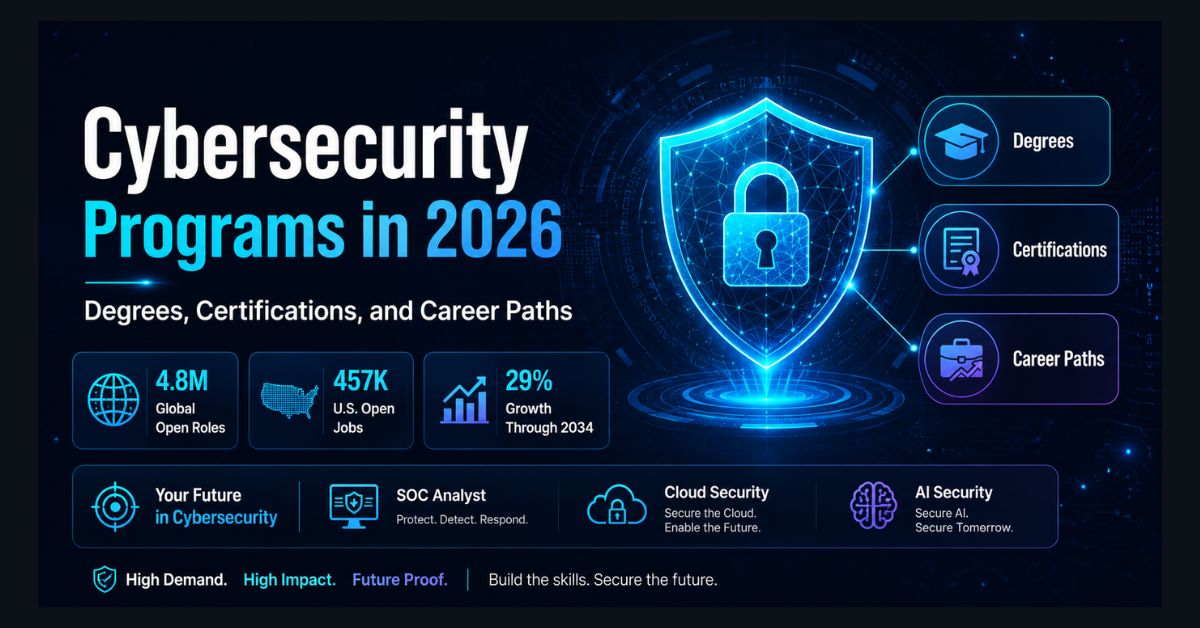
- Job growth is projected at roughly 29% through 2034, far above the average for all occupations
- A certificate alone no longer guarantees a job; employers want demonstrable hands-on skill and a lab portfolio
Cybersecurity is one of the fastest-growing career fields in the US, and the path in has never had more options: degrees, certifications, bootcamps, and free online courses. That range is good news, but it also makes choosing where to start confusing. This guide breaks down the real program types, what they cost in 2026, what the field actually pays, and an honest take on what it takes to break in, so you can pick a path that fits your goals and budget.
One note up front: cybersecurity is a strong field, but it is not the “get one cert and walk into a six-figure job” pipeline some ads promise. The demand is real and the pay is real, and the entry-level market is genuinely competitive. Treat this as a map, not a guarantee.
What are the main types of cybersecurity programs?
Cybersecurity programs fall into four main types, each suited to a different starting point and budget. The right one depends on whether you’re starting from zero, already in IT, or aiming at a specific role.
The four paths are these. Degree programs are bachelor’s and master’s degrees that give broad, deep education in areas like cryptography, network defense, and risk management, and they suit people who want a comprehensive foundation or aim at research and leadership roles. Certifications are shorter, credential-focused programs such as CompTIA Security+, CySA+, CEH, and CISSP that validate specific skills quickly and are what most employers actually screen for. Bootcamps are intensive multi-month programs focused on hands-on skills, useful for career changers who want structure without a full degree. Self-paced online courses, on platforms like Coursera, edX, and Google’s own certificate track, are the cheapest and most flexible way to build a foundation and confirm your interest before spending more. Many people combine them: a foundational course, then a Security+ certification, then a specialization. One caution on bootcamps specifically: they vary enormously in quality and price, and an expensive bootcamp is not automatically better than a cheap certificate plus self-study, so check graduate outcomes and read independent reviews before paying several thousand dollars.
Do you need a degree, or is a certification enough?
You usually do not need a four-year degree to start in cybersecurity; a certification plus demonstrable skills is often enough for a first role. Employers increasingly weigh hands-on ability and recognized certs over formal degrees, though a degree still helps for some corporate and government positions.
The practical reality is that a certification gets you past the initial screen faster and far cheaper than a degree. CompTIA Security+ appears in more than 70% of entry-level cybersecurity job postings and has no prerequisites, which makes it the standard starting credential. A degree adds value if you want a deep theoretical foundation, plan to reach senior architecture or research roles, or are targeting employers that formally require one. For most career changers, the fastest route is a foundational course, then Security+, then a first role, with a degree pursued later if at all. If you’re weighing the field against other tech paths, our look at the computer-science enrollment shift is worth reading for context on where tech careers are heading.
Which cybersecurity certification should you start with?
Start with CompTIA Security+ if you want the single most widely recognized entry-level certification, or the Google Cybersecurity Certificate first if you’re starting from zero and want to confirm your interest cheaply. The right first cert depends on your budget and how much IT background you already have.
This table compares the main certifications by role and 2026 cost. Costs are exam fees in the US and shift over time, so confirm current pricing with the certifying body.
| Certification | Best for | Approx. exam cost | Prerequisites |
|---|---|---|---|
| Google Cybersecurity Certificate | Absolute beginners, foundation | ~$150-300 (course) | None |
| CompTIA Security+ | First employer-recognized cert | ~$404-425 | None (Network+ helpful) |
| CompTIA CySA+ | SOC analyst, threat detection | ~$404-439 | None (Security+ recommended) |
| CEH (Certified Ethical Hacker) | Offensive security, pen testing | ~$950-1,200 | Recommended experience |
| CISSP | Senior, architecture, leadership | ~$749+ | 5 years experience in 2+ domains |
A sensible progression for a newcomer looks like this: a foundational course such as the Google certificate to build basics and a lab portfolio, then Security+ to land a first role, then CySA+ or a cloud-security credential to move up. CompTIA Security+ typically takes two to three months of study; CISSP, which is a mid-to-senior credential, requires both an exam and five years of documented experience, so it is not a starting point. Do not collect certifications for their own sake; match each one to the specific role you want next.
Does cybersecurity require programming?
Cybersecurity does not require programming for many roles, but it helps for advanced and offensive positions. Entry-level and analyst jobs often need little or no coding, while penetration testing, security engineering, and tool development do.
The split runs roughly like this. Defensive and analyst roles, such as SOC analyst, GRC analyst, and compliance-focused positions, rely more on tools, processes, and judgment than on writing code. Offensive and engineering roles, such as penetration tester, ethical hacker, and security engineer, benefit heavily from scripting and programming, with Python the most useful language to learn first, followed by familiarity with Bash, PowerShell, and sometimes C. Even in non-coding roles, understanding how software works makes you better at spotting vulnerabilities, so a little programming knowledge is an asset everywhere. You don’t need to be a software developer, but you should not fear the command line.
How much do cybersecurity jobs pay in 2026?
US information security analysts earn a median of about $124,910 per year, according to the Bureau of Labor Statistics Occupational Outlook Handbook (May 2024 data, the most recent federal figures). Entry-level roles typically start around $65,000 to $75,000, while senior and specialized roles can exceed $180,000.
The BLS puts the lowest 10 percent below $69,660 and the highest 10 percent above $186,420, so location, specialization, and clearance matter enormously. Reported averages vary by source and methodology: self-reported platforms like PayScale skew lower (around $84,000 for the narrow “analyst” title), while surveys that include engineers and incident responders run higher. The highest-paying specializations in 2026 are cloud security, DevSecOps, AI security, and security architecture, and a US government security clearance can add a significant premium. For senior professionals at major tech firms, total compensation including bonuses and equity can reach $200,000 to $300,000 or more. Treat any single salary number with caution and benchmark against several sources for your specific role and city.
Is it hard to get a job in cybersecurity right now?
Getting the first job is harder than the demand headlines suggest, even though the field has a large long-term talent shortage. The paradox of 2026 is real: employers report roughly 4.8 million unfilled positions globally, yet entry-level candidates still struggle to land a first role.
The reason is that most of the open demand is for experienced professionals, not beginners, so the “just get a cert and get hired” pitch is outdated. What actually helps entry-level candidates stand out is demonstrable, hands-on skill: a home lab, documented projects, capture-the-flag results, and a portfolio that shows you can investigate an alert without making an incident worse. Cloud and AI-security skills are in particularly high demand, which ties into the broader security shifts we cover in our pieces on agentic AI security risks and whether AI browsers are safe. Practical steps you can take today, before or alongside any program, include practicing your own defenses with a good free antivirus setup, learning to check for data breaches, and understanding how a VPN works. Real curiosity about how systems break and get fixed is what separates candidates who get hired from those who just hold a certificate.
How do you choose the right cybersecurity program?
Choose a cybersecurity program by matching it to your target role, budget, and current experience rather than by prestige alone. The best program is the one that gets you employable skills for the specific job you want, at a cost you can justify.
Weigh five things when comparing options. Check accreditation or industry recognition, since an employer-recognized credential like Security+ or an accredited degree carries more weight than an unknown certificate. Confirm the program teaches hands-on skills with labs and real projects, not just theory, because practical experience is what employers test for. Compare total cost honestly, including exam fees, materials, and time, and look for scholarships, veteran benefits (GI Bill and DoD tuition assistance often cover Security+ and CISSP), or employer sponsorship. Match the specialization to demand, favoring cloud, AI, and incident-response skills. And look for career support such as portfolio guidance and interview prep. If you’re a student mapping a broader plan, our guide to the best AI tools for students pairs well with a security study plan.
FAQ
What is the best cybersecurity certification to start with?
CompTIA Security+ is the best starting certification for most people. It has no prerequisites, appears in more than 70% of entry-level job postings, costs about $404-425, and takes two to three months to prepare. If you’re starting from zero, the lower-cost Google Cybersecurity Certificate is a good foundation to build first, then move to Security+ to become employable.
How much do cybersecurity jobs pay?
US information security analysts earn a median of about $124,910 per year, per BLS May 2024 data. Entry-level roles typically start around $65,000-75,000, and senior or specialized roles (cloud security, security architecture) can exceed $180,000, with total compensation at major tech firms reaching $200,000-300,000+. Pay varies widely by location, specialization, and security clearance.
Do you need programming for cybersecurity?
Not for every role. Analyst, SOC, and compliance jobs often need little or no coding, while penetration testing, security engineering, and tool development benefit heavily from programming. Python is the most useful language to learn first. Even in non-coding roles, understanding how software works helps you spot vulnerabilities, so basic programming knowledge is an asset across the field.
Is a cybersecurity degree worth it?
It depends on your goals. A degree helps for senior architecture, research, and some government or corporate roles that formally require one, but it’s not necessary to start. Many people enter faster and cheaper through a certification like Security+ plus a hands-on portfolio. A degree is a strong long-term investment for depth, while certifications are the quicker route to a first job.
Is it hard to get an entry-level cybersecurity job in 2026?
Yes, harder than the demand figures suggest. Despite a global shortage of about 4.8 million professionals, most open roles want experience, so beginners face real competition. Standing out requires demonstrable hands-on skills: a home lab, documented projects, capture-the-flag results, and cloud or AI-security familiarity. A certificate alone is rarely enough; employers want proof you can do the work.