

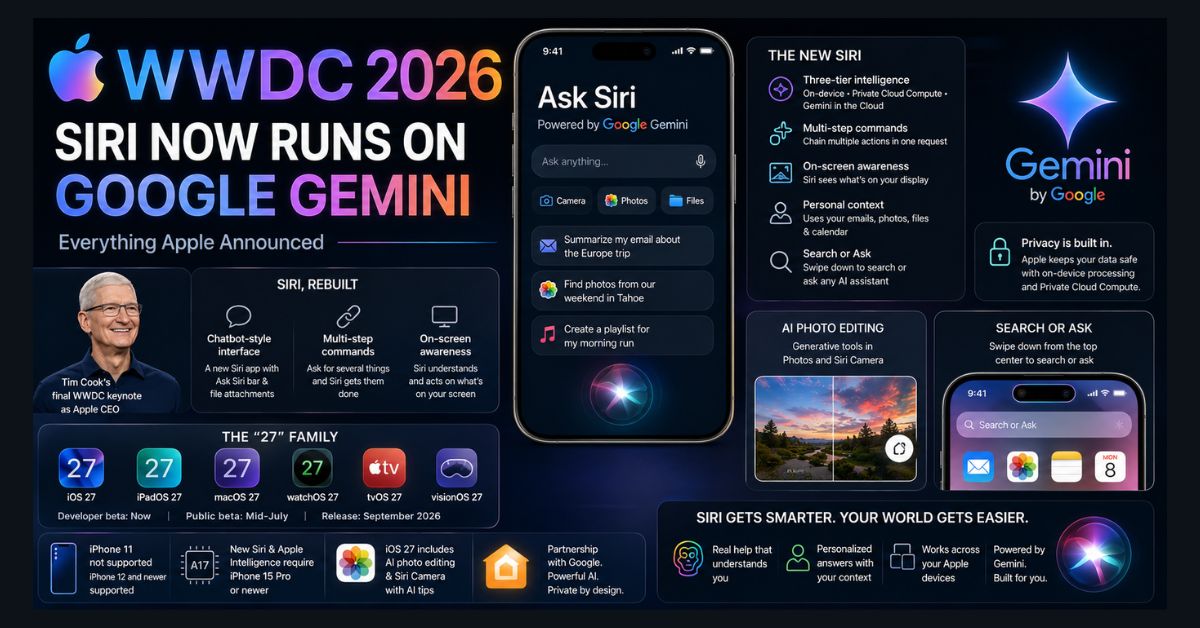
At WWDC 2026, Apple did something it has never done before: it handed the brains of Siri to a rival. The rebuilt assistant now runs on a custom Google Gemini model, part of a sweeping AI push unveiled alongside iOS 27 and a new family of “27” operating systems. It was also Tim Cook’s final WWDC keynote as CEO — and he used it to fix the one product Apple has struggled with most.
Here’s everything Apple announced, what’s confirmed versus reported, and what it actually means for your iPhone.
The headline: Siri is rebuilt on Google Gemini
The centerpiece is a completely overhauled Siri, and the surprise is what powers it. According to reporting from Bloomberg’s Mark Gurman and others, Apple has licensed a custom Google Gemini model — roughly 1.2 trillion parameters — for a reported price of about $1 billion per year to serve as the backbone of Siri’s cloud intelligence. That model is far larger than anything Apple had built in-house for the cloud, and it ends years of speculation about whether Apple would build, buy, or partner its way out of Siri’s long stagnation. It chose to partner.
Crucially, this isn’t a wholesale handover. Siri now uses a three-tier routing system: simple requests are handled on-device by Apple’s own models for speed and privacy, mid-level tasks run through Apple’s Private Cloud Compute, and only the heaviest queries are routed to the Gemini model (reportedly running on Nvidia hardware on Google Cloud). Apple keeps the privacy-facing front end; Google provides the raw horsepower underneath.
If you want to understand the engine now sitting inside your iPhone, it’s the same model family we cover in our explainer on what Google Gemini is — and the competitive dynamics are laid out in our Claude vs ChatGPT vs Gemini comparison. The Gemini line was the talk of Google I/O 2026 just weeks ago; now it’s quietly running the most-used voice assistant on the planet.
What the new Siri can actually do
The new Siri is a genuine rethink, not a tune-up. The standout changes:
A standalone Siri app with a chatbot-style interface and an “Ask Siri” bar where you can type questions, attach images, PDFs, and documents via a paperclip icon — much like ChatGPT or Gemini. Multi-step, chained commands, so you can ask for several things in one request and Siri executes them in sequence. On-screen awareness, letting Siri see and act on what’s currently on your display. Personal context, drawing on your emails, photos, and files to give tailored answers (the same direction Google took, which we covered in AI Mode using Gmail and Photos). A “Search or Ask” gesture — swipe down from the top center to run shortcuts, search your phone, or hand a complex query off to a third-party chatbot like ChatGPT, Claude, or Gemini.
This is the Siri Apple first promised back in 2024 and then failed to ship — a delay that became a running embarrassment and even triggered a legal settlement over Apple Intelligence marketing. Getting it out the door is squarely aimed at securing Cook’s legacy on the way out.
iOS 27 and the “27” family
Apple moved its whole software lineup to version 27: iOS 27, iPadOS 27, macOS 27, watchOS 27, tvOS 27, and visionOS 27, under the keynote tagline “All systems glow.” Developer betas land immediately, with public betas expected in mid-July and final releases in September 2026 alongside the iPhone 18 lineup.
The most consequential consumer detail: iOS 27 is expected to drop support for the iPhone 11. Based on widely corroborated compatibility lists, iPhone 12 and newer remain supported, while the iPhone 11 ages out. Note too that the headline Apple Intelligence and Gemini-Siri features are separately gated — they require iPhone 15 Pro or newer, so simply running iOS 27 won’t guarantee access to the new Siri. If you’re holding an older device, it’s worth waiting for Apple’s official compatibility confirmation before deciding whether to upgrade. (If your current iPhone is acting up in the meantime, our iPhone charging fix guide covers the common issues.)
iOS 27 also brings generative editing tools in Photos and a Siri Camera feature that uses AI object recognition to suggest settings and real-time editing tips.
homeOS and the hardware that stayed hidden
Apple gave a developer preview of homeOS, a new operating system for upcoming smart-home hardware — a signal that Apple wants Gemini-powered Siri to anchor a future home-device push against Amazon and Google.
Hardware, though, was mostly absent. Expected Mac refreshes — an M5 Mac Studio and Mac mini — appear delayed, with reports blaming high RAM costs and chip shortages. That fits a broader 2026 pattern of AI demand straining the component supply chain. For now, if your Mac is feeling its age, our guide on fixing a slow MacBook is more useful than waiting for new silicon.
Why does this matter?
Three big takeaways. First, Apple conceded the model race. By licensing Gemini rather than shipping its own frontier model, Apple effectively admitted it’s behind on large-scale AI — a striking move for a company that prizes vertical integration. It mirrors the broader reality that even giants are leaning on partners and capital to compete, the same theme running through Microsoft’s own agent push at Build 2026.
Second, Google just won the most valuable AI distribution deal on Earth. Gemini is now the default cloud intelligence on over a billion active iPhones. That’s a colossal validation of Google’s model and a complication for OpenAI, even as Apple keeps ChatGPT and Claude available as optional hand-offs.
Third, the assistant wars are now everywhere. Between Gemini in Search and Android, Gemini inside Siri, and Microsoft’s agents in Windows, the AI assistant has become the battleground of 2026 — and increasingly, the same underlying models power competing products. For students and everyday users, the practical upside is that the AI in your pocket is about to get dramatically more capable; our roundup of the best AI tools for students is a good companion as these features roll out.
One caveat worth keeping
Several of the most eye-catching figures — the $1 billion annual price tag and the 1.2-trillion-parameter model size — come from reporting rather than Apple’s own statements, and Apple rarely confirms commercial terms. Treat them as well-sourced but unofficial. What’s clear is the direction: Siri’s intelligence now runs substantially on Google’s AI, and that’s a genuine turning point for both companies.
FAQ
1. Is Siri really powered by Google Gemini now?
Yes. At WWDC 2026 Apple unveiled a rebuilt Siri whose cloud intelligence runs on a custom Google Gemini model, reported to be around 1.2 trillion parameters. Apple still handles simple requests with its own on-device models and routes only heavier queries to Gemini, keeping its privacy layer in place.
2. When does iOS 27 come out?
Developer betas of iOS 27 are available immediately after the June 8, 2026 keynote, with public betas expected in mid-July and the final public release in September 2026, typically alongside the new iPhone lineup.
3. Will my iPhone support iOS 27 and the new Siri?
iOS 27 is expected to support iPhone 12 and newer, dropping the iPhone 11. However, the new Gemini-powered Siri and Apple Intelligence features require iPhone 15 Pro or newer, so running iOS 27 alone won’t unlock them. Wait for Apple’s official compatibility list to confirm.
4. How much is Apple paying Google for Gemini?
According to Bloomberg’s reporting, Apple is paying Google roughly $1 billion per year for a custom Gemini model to power Siri. Apple has not officially confirmed the financial terms, so the figure should be treated as reported rather than confirmed.
5. Was this Tim Cook’s last WWDC?
Yes. WWDC 2026 was Tim Cook’s final keynote as Apple CEO. He is set to transition to executive chairman, handing the chief executive role to John Ternus, making the Siri overhaul a capstone moment of his tenure.