

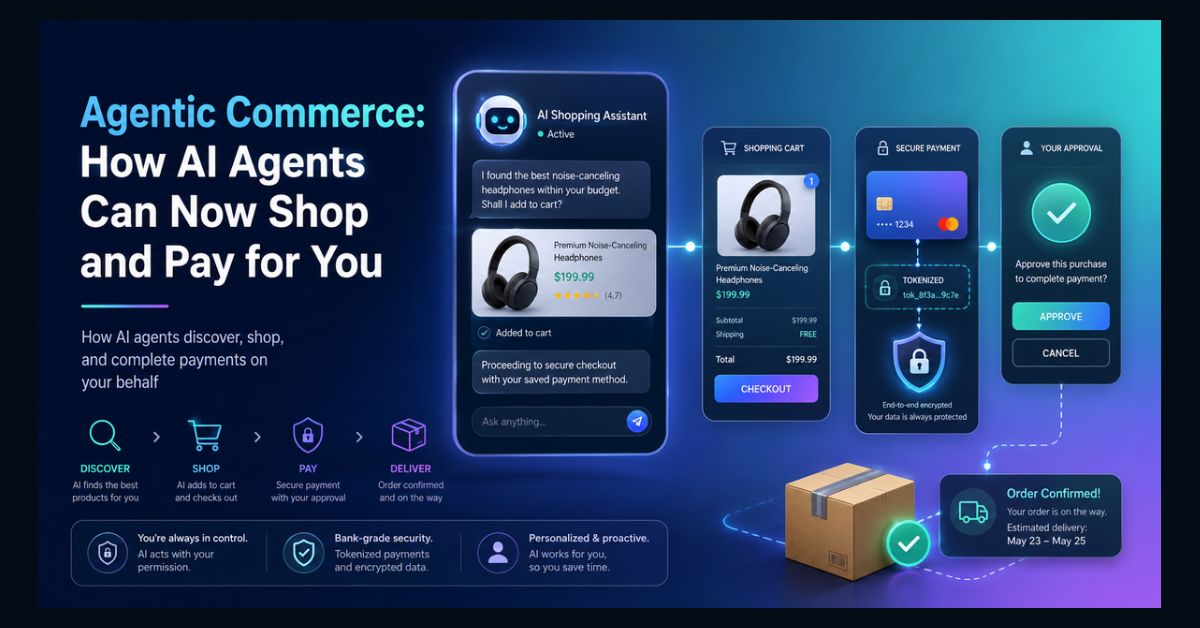
Agentic commerce is online shopping where an AI agent finds, compares, and buys products on your behalf, instead of you clicking checkout yourself. On June 10, 2026, Visa and OpenAI announced a deal to let ChatGPT agents pay with linked Visa cards within limits you set, but as of October 2026 neither company has given a consumer launch date.
- What’s new: Visa and OpenAI announced a deal so ChatGPT agents can check out, not just recommend; no consumer launch date yet (as of October 2026)
- How it works: a scoped “agentic token” lets the agent pay without seeing your card number
- You stay in control: spend caps, merchant limits, and approval prompts are configurable and revocable
- The players: Visa, Mastercard Agent Pay, Google’s AP2 and Universal Commerce Protocol, and OpenAI’s checkout protocol
- Open question: who is liable when an agent buys the wrong thing
For years, AI chatbots could help you shop but not finish the job. They could compare headphones and find a flight, then hand you back to a checkout page to actually pay. That last step is now closing. In June 2026, Visa and OpenAI announced plans to let an AI agent complete the purchase for you, and the change is bigger than another checkout button.
This guide explains what agentic commerce is, what Visa and OpenAI actually announced, how the payments work under the hood, and the real questions about safety and control before you let an agent spend your money.
What is agentic commerce?
Agentic commerce is online buying where an AI agent discovers, selects, and pays for products on your behalf, rather than you clicking through checkout yourself. You give the agent a goal, such as “order more dog food under $40,” and it finds the item, compares options, and completes the transaction.
It builds on the idea of an AI agent, software that takes actions toward a goal rather than just answering questions, which we cover in our explainer on agentic AI. Shopping is simply one of the first mainstream jobs people are handing to agents.
What did Visa and OpenAI announce?
On June 10, 2026, at the Visa Payments Forum in San Francisco, Visa announced a strategic collaboration with OpenAI to enable Visa payments in agentic commerce. According to the Associated Press, Visa described it as embedding its payment network in ChatGPT, which means an agent could not only recommend a product but buy it at potentially any merchant that accepts Visa.
The split of work is straightforward. OpenAI supplies the agent technology that interacts, decides, and initiates a purchase. Visa, the largest payment network outside China, provides the payment authorization and fraud monitoring to do this safely at scale, and users will be able to link their Visa card to ChatGPT.
Visa’s chief product and strategy officer, Jack Forestell, gave a simple example: tell ChatGPT you want wireless headphones under $150, and it finds a pair and buys them for you. Visa also unveiled supporting tools the same day: an Agentic Directory of agents and merchants Visa has verified, an Agent Score tool that lets merchants check whether their websites are ready for agentic commerce, and a Large Transaction Model, an AI model trained on billions of transactions to improve fraud detection.
The announcement is not yet a consumer product. Visa’s press release gives no launch date, and the AP reported that the system will start in a beta stage with human oversight, approval notifications, and use limited to merchants approved by OpenAI. As of October 2026, neither company has published a consumer launch date, and Visa told Fortune in September 2026 that Visa Intelligent Commerce is still being deployed. For readers, this means the controls described below are the announced design, and the final details of availability, eligible cards, and fees are still unconfirmed.
Why this attempt is different from “Buy in ChatGPT”
This is not OpenAI’s first try at shopping. It launched an Instant Checkout feature in September 2025, but the process was error-prone and saw little merchant adoption, partly due to a roughly 4% fee. In March 2026, OpenAI moved away from Instant Checkout, letting merchants use their own checkout experiences while it focused on product discovery, according to CNBC.
The Visa version is different because it runs on rails that banks and merchants already trust. When the settlement layer is the network everyone already supports, adoption becomes a plumbing decision rather than a fee negotiation. That is the key reason this round is being treated as infrastructure rather than a demo.
How do AI agents actually pay for things?
The security model is the interesting part. Instead of handing your raw card number to a chatbot, the networks issue a scoped credential, often called an agentic token, that ties a tokenized card to a specific agent, a specific merchant scope, and a specific consent policy.
In practice that means three things. The agent can pay without ever seeing your real card number. The token only works within the limits you set, such as a spending cap or a category of merchant. And you can revoke it in real time from your bank app, which makes the next attempted charge fail at authorization. Spend caps, merchant restrictions, and expiration windows are all set when you grant access.
The major agentic-payment players compared
Several systems are converging on the same goal from different angles. Here is how the main ones line up.
| Player | What it is | Agent surface | Status (as of October 2026) |
| Visa Intelligent Commerce (+ OpenAI) | Visa network linked into ChatGPT for card-funded agent payments | ChatGPT | Announced June 2026; no consumer launch date yet |
| Visa Trusted Agent Protocol | Verified agent IDs with cryptographic authentication | Network layer | Announced 2025 |
| Mastercard Agent Pay | Agentic tokens scoped to agent, merchant, and consent | Copilot and partners | Expanding; agent virtual-card option added September 2026 |
| Google AP2 | Open protocol using signed “intent” and “cart” mandates | Cross-platform | 60+ launch partners; donated to the FIDO Alliance in April 2026 |
| Google Universal Commerce Protocol (UCP) | Open standard for the full shopping journey, co-developed with Shopify, Etsy, Wayfair, Target, and Walmart | Google Search (AI Mode) and Gemini app | Launched January 2026; Universal Cart rolling out in the US |
| OpenAI checkout protocol | Product feed plus checkout and payment integration | ChatGPT | Live; checkout now mainly through merchant apps and merchant sites |
Mastercard is pushing a parallel track, including agent-to-agent payments for businesses, such as letting a coffee shop authorize an agent to buy advertising services for a campaign. On September 17, 2026, Mastercard also rolled out an option that lets people give an AI agent a virtual card to buy online without checking in before each purchase, with limits on spending, retailers, or required approval, according to Fortune. For the business side of this shift, see our guide to AI tools for small business.
Google is building its own path. Google launched the Universal Commerce Protocol on January 11, 2026, as an open standard that is compatible with AP2, and on October 15, 2026, it began rolling out Universal Cart in the US across Google Search and the Gemini app, with Google Pay checkout for many stores. Google also donated AP2 to the FIDO Alliance on April 28, 2026, together with Verifiable Intent, a record of user-authorized agent actions that it co-developed with Mastercard.
What can you actually buy with an AI agent right now?
Early use is deliberately cautious. In a December 18, 2025 release, Visa said its partners had completed hundreds of controlled, real-world agent-initiated transactions, and it predicted that millions of consumers will use AI agents to complete purchases by the 2026 holiday season.
Expect the first wave to focus on simple, repeatable, lower-risk buys: reordering household goods, grabbing a specific product under a price cap, or booking straightforward travel. At first, most transactions will still loop you in, with the agent sending a notification to approve the purchase. Forestell described the likely progression as your agent eventually asking, “Do you want me to just not check?”
Is it safe to let an AI agent use your card?
This is the question that matters most, and the honest answer is that the guardrails are real but the rules are still being written.
Reasons it’s reasonably safe
- Your real card number is never exposed to the agent; a scoped token stands in for it.
- You set spending caps, merchant limits, and expiration windows up front.
- Authorization is revocable in real time from your bank app.
- Visa adds fraud monitoring and authentication built for agent transactions.
Reasons for caution
- Liability is unresolved when an agent buys the wrong item, such as the wrong size or the wrong date.
- Disputes now involve a fifth party, the AI platform, on top of the usual four.
- Agents do not browse like humans, so a misread product feed can lead to a wrong purchase.
- Trusting an agent to buy without checking each time is a big leap, as Visa itself acknowledges.
Consumer trust is still low. Visa’s own Trust Index, released September 9, 2026, found that only 23% of US consumers trust generative AI to handle payment transactions on their behalf. The liability question also remains open: when Fortune asked Mastercard in September 2026 who is responsible if an agent makes an incorrect or unauthorized purchase, the company pointed to its Verifiable Intent record and did not specify who would ultimately be responsible.
The practical takeaway: start with tight limits and per-purchase approval, and only loosen them once you trust the agent’s judgment on a specific task.
What it means for shoppers, merchants, and banks
For shoppers, discovery and checkout collapse into one step, which is convenient but shifts power toward whichever agent you use. For merchants, the buyer is increasingly the agent, not the person, so clean product data and a reliable checkout API start to matter more than a polished landing page.
For banks, there is a real disintermediation risk. As American Banker reported, if customers start opening an AI assistant instead of their banking app to handle transactions, banks could lose the direct relationship. The same logic is reshaping how the big AI platforms compete, a race we track in our Claude vs ChatGPT vs Gemini comparison.
How to try agentic shopping and stay in control
If you want to experiment, do it deliberately. Link a single card with a low spending cap rather than your primary account, and keep per-purchase approval switched on at first so nothing happens without your sign-off.
Be specific in your instructions, including price ceilings and preferred merchants, the same way you would with any ChatGPT prompt for work. Review the first several purchases closely, and remember you can revoke the agent’s access instantly if anything looks off.
The bottom line
Agentic commerce is moving from concept to live infrastructure, and the Visa and OpenAI deal to put Visa payments inside ChatGPT is the clearest signal so far, even though its consumer launch date is still unannounced. The convenience is genuine, and the security model, scoped tokens with caps you control, is more thoughtful than handing a chatbot your card. But the liability rules are unfinished, and trusting an agent to buy without checking is a real leap. Start small, keep the limits tight, and let the agent earn that trust one purchase at a time.
FAQ
Can ChatGPT really buy things for me now?
ChatGPT can complete some purchases today through retailer apps, such as Walmart’s app inside ChatGPT, but the broader Visa integration is not yet available to consumers. Visa and OpenAI announced that integration on June 10, 2026, and as of October 2026 neither company has published a launch date; at first, each purchase is expected to require your approval.
What is agentic commerce in simple terms?
Agentic commerce is when an AI agent shops and pays for you, finding a product, comparing options, and completing checkout, instead of you doing it manually. You give the agent a goal and a budget, and it handles the transaction within the limits you set.
Is it safe to let an AI agent use my credit card?
Letting an AI agent use your credit card is built to be safer than sharing your raw card number, because the agent uses a scoped token with spending caps and merchant limits that you can revoke instantly. The main unresolved risk is liability when an agent buys the wrong thing, since dispute rules for agent purchases are still being finalized.
How is this different from OpenAI’s earlier “Buy in ChatGPT” feature?
OpenAI’s earlier Instant Checkout was error-prone, charged merchants a roughly 4% fee, and saw little adoption before OpenAI moved away from it in March 2026. The Visa version runs on the card network merchants already trust, which removes the fee barrier and makes broad acceptance far more likely.
Which companies are building agentic commerce?
The main companies building agentic commerce are Visa (partnered with OpenAI for ChatGPT), Mastercard with its Agent Pay framework, and Google with its open AP2 and Universal Commerce Protocol standards. OpenAI provides the agent and checkout technology, while PayPal, Amazon, and others are building their own agent-shopping features.