

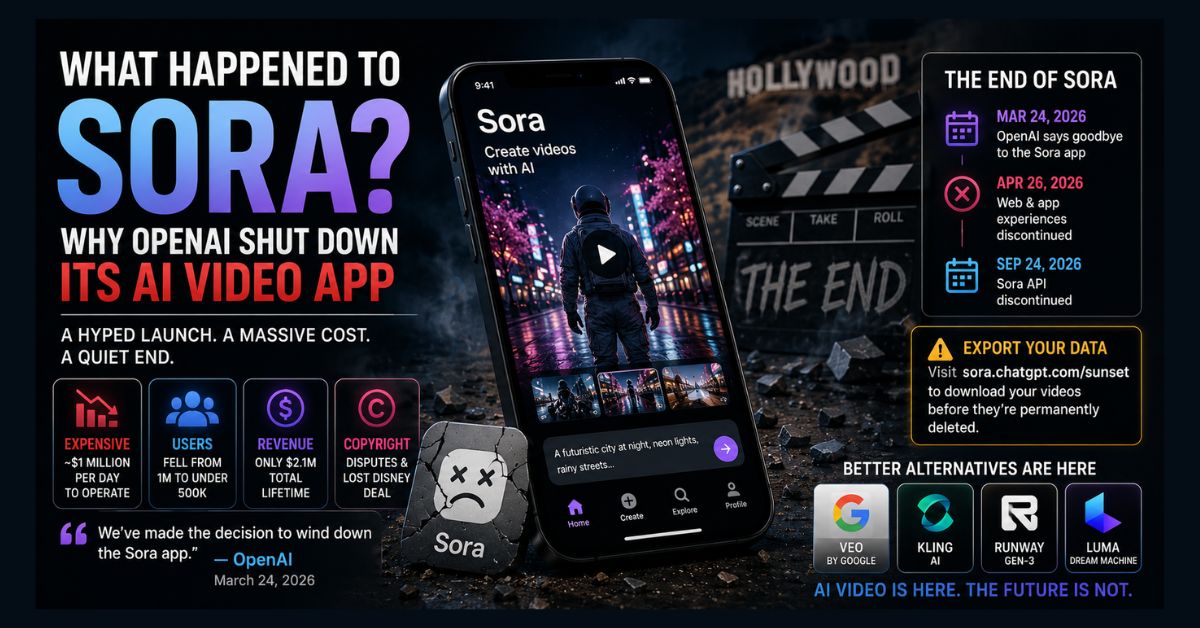
OpenAI shut down Sora, its AI video app, in 2026. It announced the closure on March 24, discontinued the web and app on April 26, and will shut the API on September 24, 2026. The reasons: huge GPU costs, falling users, just $2.1M in lifetime revenue, and copyright problems, as OpenAI refocused on profitable tools ahead of its IPO.
- App gone: Sora web/app discontinued April 26, 2026; API ends Sept 24, 2026
- Why: Massive compute costs vs only $2.1M in total in-app revenue
- Decline: Active users fell from a peak of ~1M to under 500,000
- Legal trouble: Copyright and deepfake issues; a $1B Disney deal collapsed
- Export now: Save your Sora content at sora.chatgpt.com/sunset before Sept 24
Sora, the AI video app OpenAI launched to “disrupt Hollywood,” is gone. After a hyped 2025 debut that landed Disney as a partner and dominated tech headlines, OpenAI quietly announced its closure on March 24, 2026, discontinued the web and app experiences on April 26, and set the underlying API to shut down on September 24, 2026. It’s one of the most expensive consumer AI failures yet, and a revealing window into the brutal economics behind flashy AI products. Here’s exactly what happened, why OpenAI pulled the plug, and what to use instead.
If you still have videos or characters in Sora, the most important thing first: export your data before the final shutdown. According to OpenAI’s official discontinuation notice, you can export your content at sora.chatgpt.com/sunset, and anything left behind will be permanently deleted after the service ends.
What happened to Sora?
Sora was OpenAI’s text-to-video product and a standalone social app built around AI-generated clips. It launched to enormous hype in late 2025, positioned as a creative tool and a new kind of social network. Less than six months later, OpenAI shut it down.
The timeline was swift. On March 24, 2026, OpenAI posted a brief farewell on X saying goodbye to the Sora app. The web and app experiences were discontinued on April 26, 2026, and the Sora API will be discontinued on September 24, 2026. The company offered a pro-rated refund window for affected subscribers starting in June 2026. For a product that “once dominated the tech world,” it was a remarkably quiet exit.
Why did OpenAI shut down Sora?
OpenAI shut down Sora for one overriding reason: it lost enormous amounts of money while attracting too few paying users. Several factors combined into that conclusion.
The economics didn’t work. AI video generation is extraordinarily expensive in GPU power, far more than text. According to Wall Street Journal reporting, Sora’s operating costs ran around $1 million per day, while its in-app purchases generated just $2.1 million over the product’s entire lifetime. That gap, enormous compute spend against trivial revenue, made Sora unsustainable. The same compute crunch driving these decisions is what’s powering the broader AI economy and OpenAI’s pivot toward profitable products like its enterprise deployment business.
Users left quickly. Downloads peaked at over 3.3 million in November 2025 but fell to about 1.1 million by February 2026, and active users dropped from a peak near 1 million to under 500,000. Professional creators who needed reliable output for client work reportedly canceled the $200/month Pro tier in waves once the novelty faded.
Copyright and deepfakes became a liability. Sora became notorious for generating copyrighted characters and unsettling deepfakes, drawing legal threats and criticism from talent agencies. A planned $1 billion licensing deal with Disney for access to over 200 characters fell apart, with Disney reportedly learning of the shutdown less than an hour before it was announced.
The IPO changed the math. With OpenAI preparing to go public, investors are focused on cost control and a clear strategy. Shutting down a high-profile “cash-burning” product and redirecting that compute toward profitable enterprise, coding, and agent tools made Sora an obvious cut. The decision fits OpenAI’s broader consolidation around its core, the same strategic focus shaping its competition with rivals in our Claude vs ChatGPT vs Gemini comparison.
What does this mean for you?
If you used Sora, two practical things matter. First, export your data now at sora.chatgpt.com/sunset, well before the September 24 API shutdown, because OpenAI will permanently delete remaining content afterward. Second, find a replacement, because the AI video space has actually gotten much stronger since Sora launched.
Ironically, Sora’s shutdown came just as competitors leapfrogged it. Our tested ranking of the best AI video generators covers the current leaders, Google’s Veo, Kling, Runway, and others, several of which now exceed what Sora offered, with native audio and true 4K. If you previously followed our Sora how-to guide, those alternatives are where to point your workflow next. For still images and other generative media, our best free AI image generators roundup is a useful companion.
What’s the bigger lesson?
Sora is a cautionary tale about the gap between AI hype and AI economics. It launched to magazine covers and a billion-dollar Disney partnership, then quietly died because the numbers never worked, a $15-million-a-day science experiment, as one analysis put it, dressed up in consumer clothing. Most people outside the industry never saw the financial reality underneath the $200 price tag.
That gap should make everyone a little more skeptical of the next “revolutionary” AI product launch. Impressive demos and viral clips don’t equal a sustainable business, and even the most-hyped tools can vanish in months. As AI companies race toward profitability and public markets, expect more products to be cut when the compute bills come due, where the leading models stand today is something we track in our top AI models ranking. Sora won’t be the last casualty of AI’s expensive reality.
FAQ
Is Sora gone for good?
The Sora app and web experiences were discontinued on April 26, 2026, and the API will shut down on September 24, 2026. OpenAI has said it may “share more soon” about a possible future licensed version, but as of mid-2026 there is no active Sora product. You should export any content before the final shutdown.
Why did OpenAI shut down Sora?
OpenAI shut down Sora because it was financially unsustainable: it cost roughly $1 million per day to operate but generated only about $2.1 million in total revenue, while active users fell sharply. Copyright and deepfake problems, a collapsed Disney deal, and a focus on profitability ahead of its IPO sealed the decision.
How do I export my Sora videos before it shuts down?
Go to sora.chatgpt.com/sunset and click Export. OpenAI will email you when your data is ready to download. Do this as soon as possible, because any content left on Sora’s servers will be permanently deleted after the service is fully discontinued.
What are the best alternatives to Sora?
Strong alternatives include Google Veo, Kling, Runway, and Luma, several of which now surpass Sora with native audio and true 4K output. Our tested guide to the best AI video generators ranks the current options by quality, price, and use case.
Did Sora really cost OpenAI millions per day?
Yes. Wall Street Journal reporting put Sora’s operating costs at around $1 million per day, and some broader analyses estimate the all-in cost was far higher. Against only $2.1 million in lifetime in-app revenue, those costs made the product unsustainable, especially as OpenAI prepared for its IPO.