

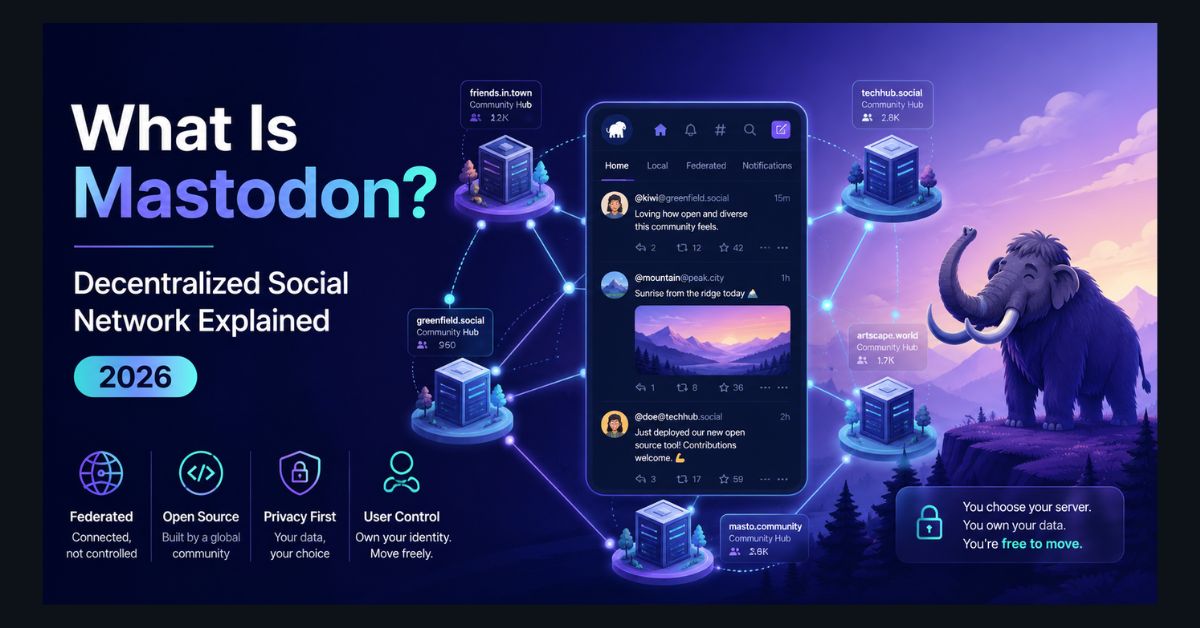
Mastodon is a free, open-source, decentralized social network run across thousands of independent servers (called instances) that connect through the open ActivityPub protocol. No single company owns it, there are no ads, and feeds are chronological. As of 2026 it has around 10.5 million accounts across the wider “Fediverse.”
- Decentralized: Thousands of independent servers (instances), no single owner
- Open protocol: Built on ActivityPub; part of the “Fediverse” with Pixelfed, PeerTube, and Lemmy
- No ads: Chronological timeline with no engagement algorithm
- Size: ~10.5M registered accounts; ~750K–1M monthly active users (2026)
- vs Bluesky: Mastodon uses ActivityPub; Bluesky uses AT Protocol (not natively compatible)
Mastodon is a decentralized, open-source social network where no single company owns the platform, your data, or your feed. Instead of one central service, it runs as thousands of independent servers (called instances) that connect through a shared open protocol, so users pick the community and rules that suit them while still talking to everyone across the wider network.
That structure is the whole point — and it is why Mastodon keeps drawing people who are tired of algorithmic feeds, ads, and abrupt policy changes on the big corporate platforms. Here is how it actually works in 2026, how it stacks up against Bluesky and X, and whether it is worth joining.
How does Mastodon work?
At its core, Mastodon runs on federation. Each server, or instance, is operated independently by a person, group, or organization that sets its own rules, moderation policies, and community standards. Despite being separate, these instances all speak the same language — an open standard called ActivityPub — so they interconnect into a larger network known as the Fediverse (a blend of “federated” and “universe”).
Your identity reflects this design. A Mastodon handle looks like an email address — for example, @[email protected] — where the first part is your username and the second is the server you call home. Just as you can email anyone regardless of whether they use Gmail or Outlook, you can follow and reply to anyone across the Fediverse no matter which instance they joined. You can post short text updates (historically called “toots,” now usually just posts), share images, video, polls, and links, much like on X.
Crucially, ActivityPub also connects Mastodon to other Fediverse platforms that use the same protocol — including Pixelfed (photo sharing), PeerTube (video), and Lemmy (link aggregation). Join one server, and you can interact with a whole ecosystem.
How is Mastodon different from X, Facebook, and Instagram?
The look is familiar, but the philosophy is the opposite of the corporate platforms. Mastodon is built around a few principles that set it apart:
- No central owner. No single company can sell the platform, change the rules overnight, or harvest your data for advertising. Governance is distributed across the people who run each instance.
- No ads or algorithmic manipulation. Mastodon shows a chronological timeline by default — posts appear in the order they were made, not reordered by an engagement-maximizing algorithm. Notably, the platform reports that essentially zero percent of its traffic comes from paid advertising; every visitor arrives organically.
- Community moderation. Each instance enforces its own standards, so moderation is local and context-aware rather than dictated by a distant corporate policy team. This is a sharp contrast to the moderation controversies on centralized platforms — including the wave of non-consensual AI imagery on X and Grok that prompted government action.
- Privacy and control. Because there is no ad-driven business model, there is far less incentive to track and profile you. For users who care about data ownership, Mastodon fits naturally alongside broader data-privacy practices and tools we cover in our guide to data privacy management software.
The platform is funded through community donations, sponsorships, grants, and volunteer development rather than advertising — keeping its ethos free from commercial pressure, though it also means a tiny operating budget compared with its rivals.
How many people use Mastodon in 2026?
Mastodon is meaningful but small. As of mid-2026, the network holds roughly 10.5 million registered accounts spread across more than 10,000 active instances, with over a billion posts published and support for 93 languages. Monthly active users, however, sit in the range of 750,000 to 1 million — well below the November 2022 peak of about 2.6 million that followed Elon Musk’s Twitter acquisition.
The broader Fediverse totals around 11 million accounts when you add platforms like Pixelfed and PeerTube. (Meta’s Threads, with 275 million-plus users, is sometimes counted as Fediverse-adjacent because it has begun adopting ActivityPub, but it is not yet fully federated.)
Demographically, Mastodon skews younger and more technical than most networks: adults 25 to 34 make up roughly a third of users, the base is heavily male (around two-thirds), and a large share of users are in Germany. In short, it is a smaller, more intentional, more privacy-minded crowd.
Mastodon vs Bluesky: which decentralized network should you pick?
The biggest story of the last two years is the rise of Bluesky, which has grown rapidly since opening to the public and, by active-user count, has overtaken Mastodon. Bluesky uses a different open standard — the AT Protocol — rather than ActivityPub, which means the two networks do not natively talk to each other; bridges exist but remain experimental as of 2026. For readers deciding between the two, our breakdown of how Bluesky compares on features and growth covers its newer additions like cashtags, live badges, and rising installs. We track Bluesky’s evolution, including features like cashtags and live badges, in a dedicated guide.
The practical differences come down to feel and values:
- Choose Mastodon if you want community-driven moderation, a default chronological timeline with no ads, and access to the wider Fediverse (Pixelfed, PeerTube, Lemmy). It is the most established option with the broadest ecosystem.
- Choose Bluesky if you want a more Twitter-like experience, portable identity, and the ability to subscribe to custom algorithmic feeds and third-party moderation “labelers.” Its developer ecosystem is growing fast and it has corporate backing.
- Consider Nostr if censorship resistance and cryptographic identity ownership are your top priorities, though it is the least polished of the three.
To stay relevant, Mastodon is actively closing usability gaps. A planned “Packs” feature (similar to Bluesky’s starter packs) aims to help newcomers quickly build a useful follow list, addressing the friction that historically caused new users to drift away in their first 48 hours, and the independent Fediscovery project is working to improve how content surfaces across all Fediverse platforms.
How do you join Mastodon?
Getting started means choosing an instance, which is the one step that trips up newcomers. Each server can set its own moderation policies, privacy preferences, and rules about who can join or post. You can pick a large general-interest server (mastodon.social is the flagship). You can pick a large general-interest server or browse servers on the official Mastodon site, or choose a smaller one built around a specific interest, region, or profession.
Don’t overthink it — because of federation, your choice of server doesn’t lock you out of anyone. You can follow people across the entire Fediverse regardless of where you signed up, and most instances let you migrate your account and followers to a different server later if you change your mind. The key thing to remember is the email analogy: Mastodon isn’t one giant social network, but a network of communities linked by a shared protocol, much like how email works across different providers.
Why does Mastodon matter in 2026?
Mastodon represents a structural alternative to the centralized social web. Even as Bluesky pulls ahead on raw numbers, the open, federated model Mastodon pioneered is increasingly seen as the long-term direction for a healthier internet — one where users, not advertisers or a single CEO, hold the power. For anyone weighing platform risk after watching ownership fights like the US TikTok deal play out, that resilience is the appeal. It fits squarely within the broader social media trends of 2026, where diversification and user ownership are quietly reshaping where people spend their time.
FAQ
1. Is Mastodon free to use?
Yes, Mastodon is completely free and open-source. There are no subscription fees or ads. The servers are funded by community donations, sponsorships, grants, and volunteers, though individual instance operators sometimes accept contributions to cover their hosting costs.
2. Is Mastodon more private than X or Facebook?
Generally, yes. Because Mastodon has no advertising business model, there is far less incentive to track or profile users, and you can choose an instance whose privacy policies you trust. However, posts on public timelines are still publicly visible, so it offers more control over your data rather than guaranteed anonymity.
3. What is the Fediverse?
The Fediverse (a blend of “federated” and “universe”) is a network of independent, interconnected social platforms that communicate using open protocols like ActivityPub. It includes Mastodon along with Pixelfed for photos, PeerTube for video, and Lemmy for link sharing, allowing users on different services to interact with one another.
4. Can Mastodon and Bluesky users talk to each other?
Not natively. Mastodon uses the ActivityPub protocol while Bluesky uses the AT Protocol, so they are separate networks. Experimental third-party bridges can connect them, but seamless interoperability is still an active area of development in 2026.
5. How many people use Mastodon?
As of mid-2026, Mastodon has roughly 10.5 million registered accounts across more than 10,000 servers, but monthly active users number between 750,000 and 1 million. That is smaller than Bluesky’s active user base, though Mastodon remains the most established platform in the broader Fediverse.