

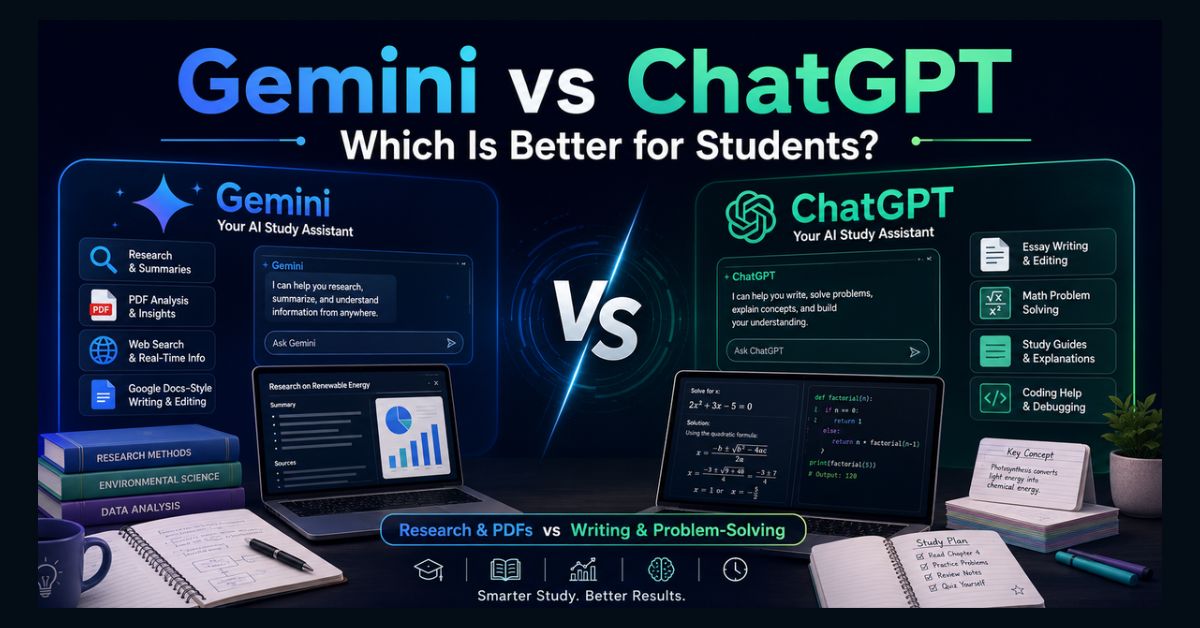
Neither Gemini nor ChatGPT is universally better for students; each wins different tasks. Gemini is stronger for research, large PDFs, Google Docs work, and free-tier value. ChatGPT is stronger for essay writing, math, and structured study help. Since both have capable free plans, most students use both, picking the right one for each task.
- Use ChatGPT for: essays, math and STEM steps, structured study plans, coding
- Use Gemini for: research, big PDFs, Google Docs, current events, free uploads
- Free-tier winner: Gemini, with live web and free image and PDF uploads; its 1M-token window needs AI Pro
- Pricing: no permanent ChatGPT student discount; Google offers US college students a free year of AI Pro until December 31, 2026
- Golden rule: use AI to learn, and always check your school’s AI policy
Ask ten students which AI is better and you will get a heated debate. The honest answer in 2026, based on what each tool offers students, is that neither wins outright. ChatGPT is the better writer and problem-solver; Gemini is the better researcher and free-tier value. Knowing which to open for which task is what actually saves you time the night before a midterm.
This guide breaks it down task by task, covers the free plans and student pricing, and ends with a simple rule for using either one without crossing your school’s lines.
Gemini vs ChatGPT for students: which is better?
For most students, the right answer is both, used for different jobs. Gemini, made by Google, is stronger at research, reading large documents, and anything inside Google Docs, Gmail, and Drive, and its free tier is more generous. ChatGPT, made by OpenAI, produces more polished writing, handles step-by-step math more reliably, and has better structured study tools.
If you must pick one, choose based on your courses: Gemini if you do heavy reading and research, ChatGPT if you write essays or take quantitative classes. For the wider toolkit beyond these two, see our guide to the best AI tools for students.
Quick comparison: which wins each task
Here is the task-by-task verdict at a glance.
| Study task | Better pick | Why |
| Essay writing and prose | ChatGPT | More natural, polished academic voice |
| Math and STEM steps | ChatGPT | Stronger multi-step reasoning (verify the final number) |
| Research and large PDFs | Gemini | 1M-token context on AI Pro and Ultra reads whole papers at once (32K on the free plan) |
| Current events and live web | Gemini | Real-time web access |
| Google Docs / Gmail tasks | Gemini | Native Workspace integration |
| Studying your own notes | Gemini Notebook (formerly NotebookLM) | Cites your sources, builds flashcards and quizzes |
| Free-tier value | Gemini | Strong model, free image/PDF uploads, live web |
| Coding help | ChatGPT | Cleaner code and clearer debugging |
Which is better for writing essays?
ChatGPT has the edge. In side-by-side tests on the same essay prompt, ChatGPT consistently produces more natural, better-structured academic prose with clearer argument flow, while Gemini tends to read as accurate but more mechanical and textbook-like.
The smart workflow is to split the job: use Gemini to gather sources and build an outline, then use ChatGPT to draft and refine the prose. Treat both as editors of your own thinking, not ghostwriters, more on that in the ethics section below.
Which is better for math and STEM?
ChatGPT is the safer bet for quantitative work. It is stronger at multi-step problems, proofs, and showing its reasoning, and it can catch its own mistakes when you point them out. You can also photograph a handwritten problem and have it work through the steps.
One caution that applies to both tools: AI models still slip on raw arithmetic, so verify any final number, ideally with a dedicated calculator like Wolfram Alpha. Gemini is capable here too, and it is genuinely strong at computational and data-analysis tasks.
Which is better for research and reading?
This is Gemini’s home turf. Google’s paid AI Pro and Ultra plans include a one-million-token context window, which means you can drop in a 60-page paper, or a whole semester of lecture notes, and ask for summaries, key terms, and contradictions across sources. The free plan has a much smaller 32,000-token window and AI Plus has 128,000 tokens, according to Google’s Gemini Apps limits page as of November 2026, so very long documents need a paid plan. Gemini also has live web access for current information and reads images and PDFs on the free plan.
For research built on your own materials specifically, Google’s Gemini Notebook is the standout free tool. Google renamed it from NotebookLM on July 16, 2026, and our report on the NotebookLM rename explains what changed. It answers only from the sources you upload, gives clickable citations to the exact passage, and turns your notes into flashcards, quizzes, and even an audio overview. Our guide to what Google Gemini is explains the current model line.
Which has the better free plan for students?
On free tiers, Gemini offers more. Its free plan gives access to a capable current-generation model, real-time web, and image and PDF uploads, none of which all come together on ChatGPT’s free tier. The one-million-token context window, however, belongs to the paid AI Pro and Ultra plans; the free plan is limited to 32,000 tokens. ChatGPT’s free plan runs a strong default model but with tighter rate limits, and some features push you toward a paid tier.
That said, ChatGPT’s free tier is perfectly good for occasional writing help and quick explanations. The reason most students do not pay is that stacking the two free plans covers nearly everything, a pattern echoed across our free AI chatbots roundup.
Student discounts and pricing
Pricing and student offers shift often, so always confirm on the official pages before paying. As of November 2026, here is the landscape.
For ChatGPT, there is no permanent student discount. OpenAI’s 2026 Back to School offer gave eligible US college and graduate students four free months of ChatGPT Plus, but the claim deadline was October 31, 2026, so that offer has now closed. The cheapest paid plan is ChatGPT Go ($8/month in the US, the same price for everyone), with ChatGPT Plus at $20/month adding unlimited use of the default model, Deep Research, and more. Check current tiers on OpenAI’s pricing page.
For Gemini, Google announced on August 19, 2026 that eligible US college students can get one year of Google AI Pro free, while eligible students in more than 140 other markets get one year of Google AI Plus. The offer can be redeemed until December 31, 2026, a payment method is required at sign-up, and the plan renews at the standard price unless canceled. Paid plans run $4.99/month (AI Plus) and $19.99/month (AI Pro, which now includes 5 TB of storage). See what is currently available on the official Gemini site. If you live in Google Docs already, our guide to using Gemini in Workspace shows where it fits.
Study modes and tools
Both tools now ship dedicated learning modes that guide you through material instead of just handing over answers. ChatGPT has a Study mode built for exam prep, which OpenAI says is available on all ChatGPT plans, and Gemini has a Guided Learning mode. Used well, with prompts that ask the AI to quiz you and explain at two levels of difficulty, these turn a chatbot into a patient 24/7 tutor.
The biggest difference in tooling is ecosystem. ChatGPT has a large library of custom GPTs and plugins, while Gemini’s advantage is being built into the Google apps students already use. If you are also choosing a machine to run all this on, our guide to the best laptops for college students pairs well here.
Using AI ethically (this part matters)
A 2026 survey found that over 85% of college students now use AI for schoolwork, which makes academic integrity the most important part of this comparison. Most university policies govern what you submit, not which tool you used, so submitting AI-generated text as your own can be a violation regardless of whether it is ChatGPT or Gemini.
Use these tools to understand material, outline arguments, check your reasoning, and get feedback, then write the work yourself. AI detection tools are imperfect and sometimes flag genuine writing, but that is not a reason to risk it. Always check your own institution’s policy first; the International Center for Academic Integrity is a good primer on the principles behind those rules.
The verdict: which should you use?
Use both. They are free, they are good at different things, and the students who get the most from AI are the ones who match the tool to the task rather than forcing one to do everything.
If you genuinely need a single pick: choose Gemini if you read and research more than you write, especially if you live in Google Docs and want the strongest free tier. Choose ChatGPT if your courses are writing-heavy or quantitative and you value polished prose and step-by-step problem solving. For how these two stack up against Claude as well, see our Claude vs ChatGPT vs Gemini breakdown.
FAQ
Is Gemini or ChatGPT better for students?
Neither is better overall; it depends on the task. Gemini is better for research, large PDFs, current events, and Google Docs work, and it has a stronger free tier. ChatGPT is better for essay writing, step-by-step math, and structured study help. Most students use both for free.
Which is better for writing essays, Gemini or ChatGPT?
ChatGPT generally writes better essays, producing more natural, well-structured academic prose with stronger argument flow. Gemini is accurate but tends to read more mechanically. A good workflow is to research and outline in Gemini, then draft and polish in ChatGPT, while writing the final work yourself.
Is Gemini or ChatGPT free for students?
Both have free tiers anyone can use, and Gemini’s is more generous, with live web access and free image and PDF uploads, although its one-million-token context window requires a paid plan. ChatGPT has no permanent student discount, and its 2026 four-month Plus offer closed on October 31, 2026. Google is offering eligible US college students a free year of Google AI Pro until December 31, 2026. Always check the official pages, as offers change.
Can teachers tell if I used Gemini or ChatGPT?
Sometimes. Schools use AI detection tools, which are imperfect but can flag AI-generated text, and many instructors recognize the style. More importantly, most academic policies cover the work you submit regardless of tool, so the safe approach is to use AI to learn and then produce the work yourself.
Should students use both Gemini and ChatGPT?
Yes. Because both have capable free plans and excel at different tasks, using both is the most effective approach. Open Gemini for research, reading, and Google Docs work, and open ChatGPT for writing, math, and structured study. Matching the tool to the task beats forcing one to do everything.